RFL Communications SMX3 Manuel utilisateur

RFL Communications plc
U
U
Ut
t
ti
i
il
l
li
i
it
t
ty
y
y
N
N
Ne
e
et
t
tw
w
wo
o
or
r
rk
k
k
S
S
Sp
p
pe
e
ec
c
ci
i
ia
a
al
l
li
i
is
s
st
t
ts
s
s
SMX3 / 21 Sub-MUX
X.21 / V.24 Dual-Protocol sub-rate multiplexer
User Manual
Issue 1.4

RFL SMX3 / 21 Page 2 of 22 Issue 1.4
User Manual 08 June 2009
Contents
1. Introduction............................................................................................................ 3
2. Features................................................................................................................ 3
3. Concatenation and Network Timing...................................................................... 4
4. Equipment Layout ................................................................................................. 4
5. Channel Characteristics........................................................................................ 5
6. X.21 Aggregate Port.............................................................................................. 6
7. Concatenation Port................................................................................................ 8
8. X.21 Data Port (Channel A)................................................................................. 10
9. V.24 Data Ports (Channels B & C)...................................................................... 11
10. DIP Switches....................................................................................................... 13
11. LEDs.................................................................................................................... 18
12. Power Input......................................................................................................... 19
13. Alarms................................................................................................................. 19
14. Example Configurations...................................................................................... 20
15. Blank Setting Table............................................................................................. 22
Issue Comments Date
1.0 Draft issue 19 February 2009
1.2 Initial Release
Applicable Firmware release smx-2-1-0-1.mcs 04 March 2009
1.3 Example configurations added, timing details expanded 07 May 2009
1.4 Loopback schematics added 08 June 2009

RFL SMX3 / 21 Page 3 of 22 Issue 1.4
User Manual 08 June 2009
1. Introduction
Prompted by SP Powersystems’ operational requirements in the former MANWEB
region, RFL developed a four channel sub-multiplexer to support operation of their
MPR – LZPK102 protection relays and SCADA systems over leased digital circuits.
The requirements for this multiplexer is described in SMX3/40 Sub-MUX X.21 High
speed sub-rate multiplexer User Manual Release 2.01.
This new Dual-Protocol version, SMX3/21, is designed to support protection relays
with an X.21 serial interface rather than a V.24 interface, together with two V.24
channels (typically used for RS232) that can be used for the existing SCADA
equipment.
2. Features
The RFL SMX3/21 Sub-MUX is a hardened (EATS 48-5) sub-rate multiplexer. The
equipment is 19” rack mountable, 1U high, with reversible mounting brackets
permitting either the connectors or the LEDs to face the front of the rack.
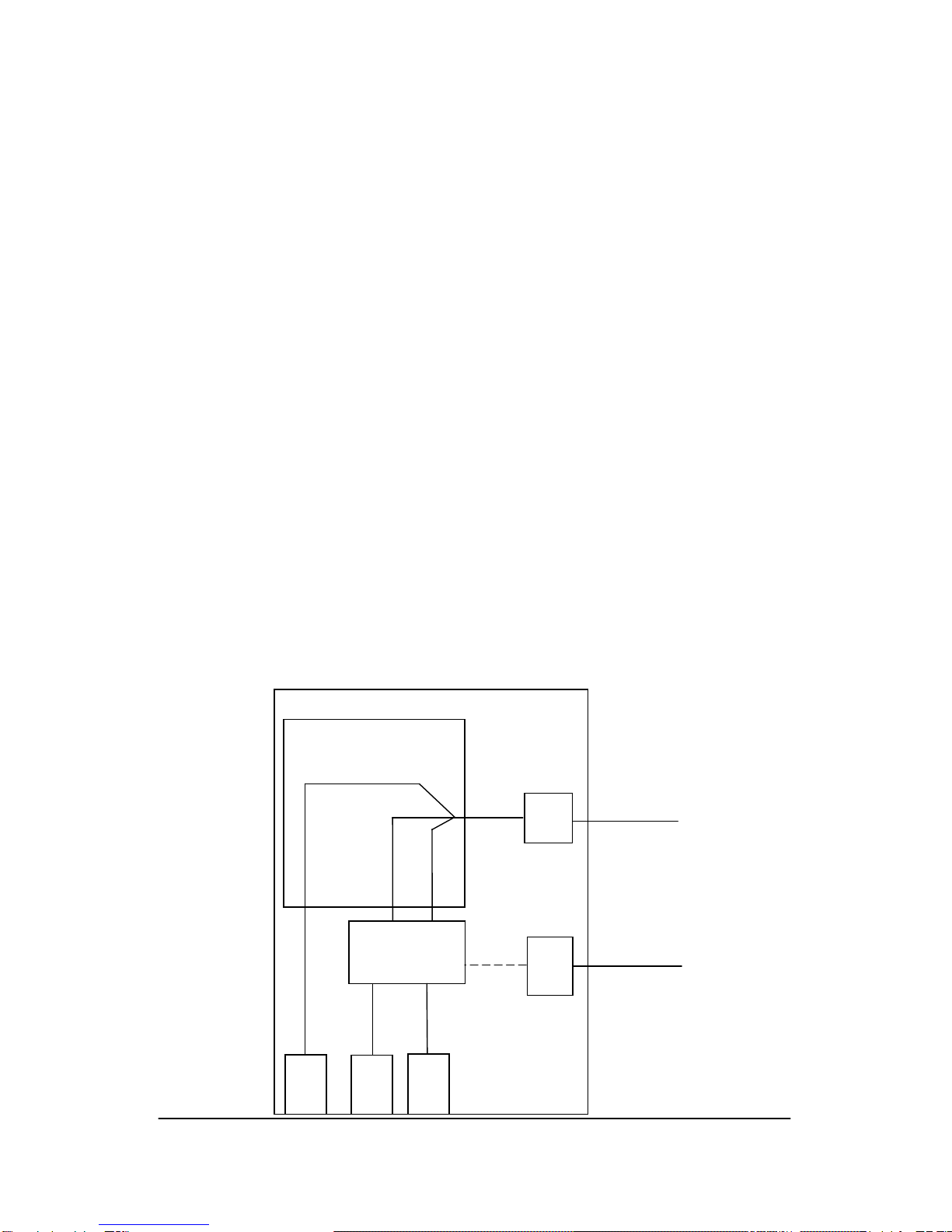
SMX3/21 aggregates one X.21 data channel (Channel A) and two V.24 data
channels (Channel B & Channel C) across a single point to point X.21 service. Data
Channel A is permanently allocated to Aggregate Channel 1. The V.24 Data
Channels B and C may both be assigned to either Aggregate Channel 2 or
Aggregate Channel 3. Both V.24 channels may be assigned to a single aggregate
channel; this feature is useful for supporting SCADA systems where multiple
terminals are attached.
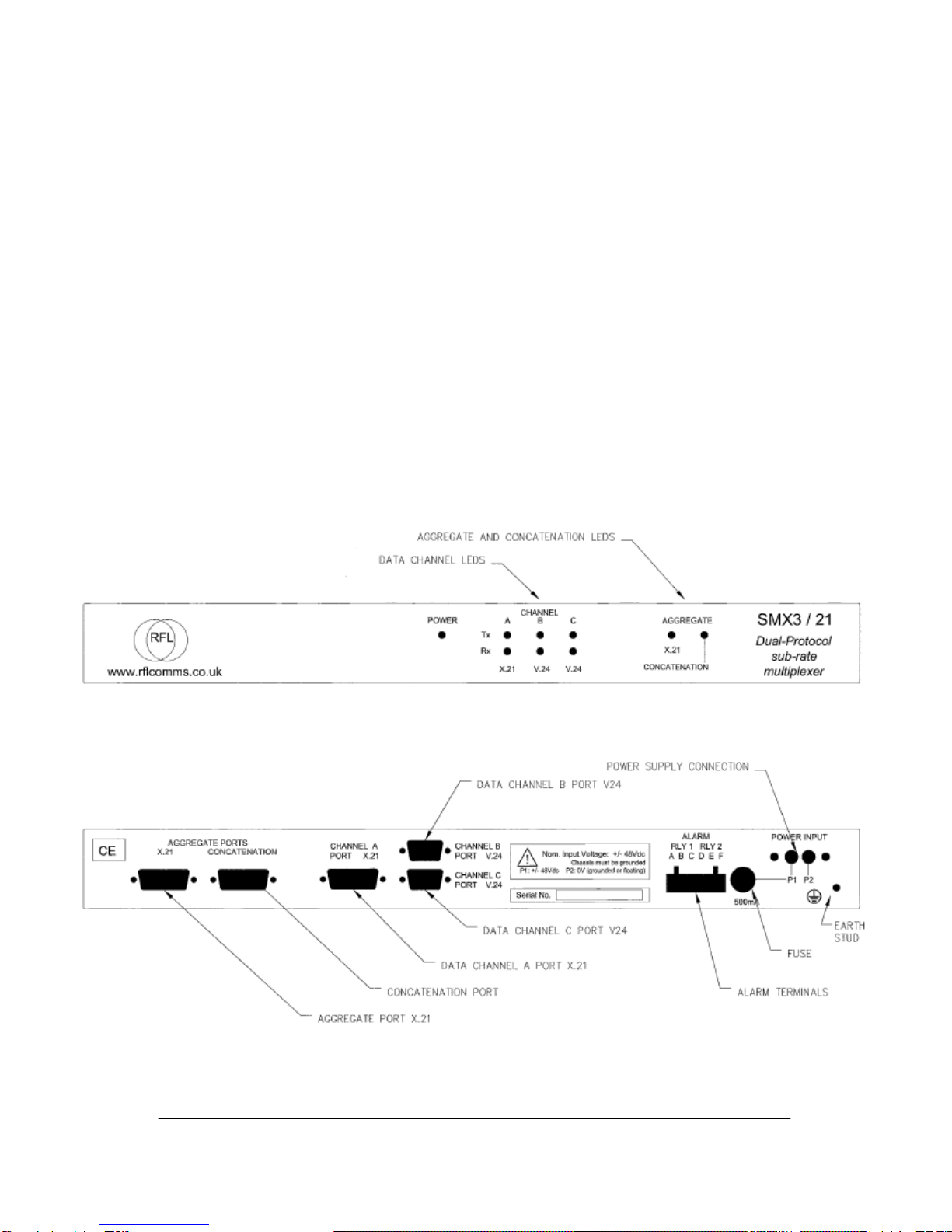
LEDs are provided for Power Supply healthy and for the status of all ports. Two volt
free alarm changeover contacts are provided for Power and Aggregate
Communications healthy.
BT KiloStream or similar
Port
assignment
& sharing
X.21
Port
V24
Channel B
Optional Aggregate Concatenation
SMX3 / 21
Block Diagram
Ch. A
Port
X.21
Concat.
Port
X.21 Channel A
Ch. B
Port
V24
Ch. C
Port
V24
V24
Channel C
MUX
Agg.Channel 1
A
gg.Channel 2
A
gg.Channel 3

RFL SMX3 / 21 Page 4 of 22 Issue 1.4
User Manual 08 June 2009
3. Concatenation and Network Timing
SMX3/21 will operate on a network of concatenated X.21 links. A facility is provided
so that two co-located SMX3/21 (i.e. one at each end of separate X.21 links) units
can be linked ‘back to back’. This feature is referred to as Aggregate Concatenation.
In this case the units may be configured so that the data on Channel A and / or
Channel B is re-transmitted onto a second point to point link at the aggregate level
via the Concatenation Port. For this to operate all links must be synchronised to the
network master timing signal. If any link within the network is unsynchronised (e.g. a
single radio link), SMX3/21 provides the option to output master network clock
signals to otherwise unsynchronised links.
An alternative option is to concatenate a single data channel at V.24 level by daisy-
chaining the V.24 data links. This is referred to as Data Channel Concatenation. In
this case each X.21 link may be free-running (unsynchronised).
4. Equipment Layout

RFL SMX3 / 21 Page 5 of 22 Issue 1.4
User Manual 08 June 2009
5. Channel Characteristics
The maximum bandwidth that may be configured for Data Channel A (X.21) is a
function of the speed of the aggregate.
The sample rates for Aggregate Channels 2 & 3 are also a function of the aggregate
speed; thus the maximum baud rate that can be configured for Data Channels B & C
are a function of both the aggregate speed and the aggregate channel to which they
are assigned. The range of baud rate settings remains the same regardless of
aggregate speed.
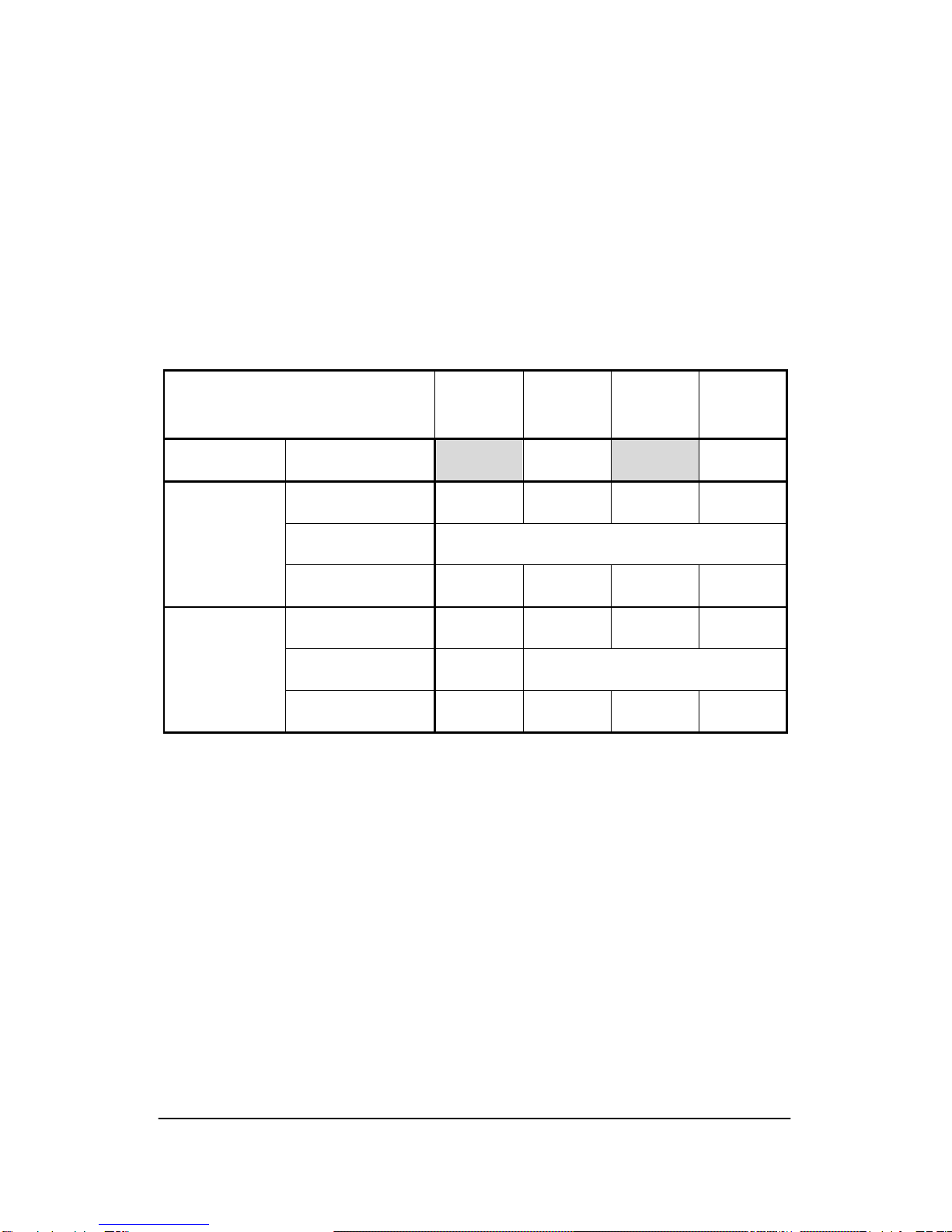
Data Channel Aggregate Speed 64kbit/s 128kbit/s 192kbit/s 256kbit/s
Channel A
(X.21) Bandwidth kbit/s 64 64 or 128
Sample Rate 16k 32k 48k 64k
Baud Rate range
(Async Mode) 1200 - 9600
Channel B or C
(V.24) assigned
to Agg. Ch 2 Baud Rate range
(Transparent Mode) 4800 9600 19200 38400
Sample Rate 8k 16k 24k 32k
Baud Rate range
(Async Mode) 1200 -
4800 1200 - 9600
Channel B or C
(V.24) assigned
to Agg. Ch 3 Baud Rate range
(Transparent Mode) 2400 4800 9600 19200
Transparent Mode is a high speed configuration for the V.24 ports particularly suited
to applications for protection relays. The end to end delay in this mode is less than
0.5s (excluding delays introduced by the comms link).

RFL SMX3 / 21 Page 6 of 22 Issue 1.4
User Manual 08 June 2009
6. X.21 Aggregate Port
The X.21 port is a DB15 male connector; this is connected internally to a header on
the PCB using a ribbon cable. The X.21 port may be configured as DTE or DCE by
fitting the ribbon cable to the appropriate X.21 Port Header, and by selecting settings
on DIP switch 5. Note: DTE is the standard configuration, and is used in all
applications where the network provides the signal timing.
Transceivers are specified to ± 15kV IEC1000-4-2 air discharge ESD protection and
port connections are additionally protected by Tranzorb type arrays.
This port carries an aggregate of three bi-directional data channels; one X.21
channel and two V.24 channels.
Standard X.21 Port Pin-out (when in DTE configuration) – D15M on chassis
Circuit Pin A Pin B Direction Notes
T Transmit Data 2 9 Output
R Receive Data 4 11 Input
C Control 3 10 Output Permanently on
I Indication 5 12 Input Signal ignored
S Signal Element
Timing 6 13 Input Timing signal derived from
the network
G Ground 8 15
X Signal Element
Timing 7 14 Output Timing signal transmitted to
network (X). Special applications
only. Requires to be enabled
using mode DTE + Timing X
enabled
Screen / Drain Must be earthed to shell
X.21 (DTE)
X.21 (DCE)
X.21V24
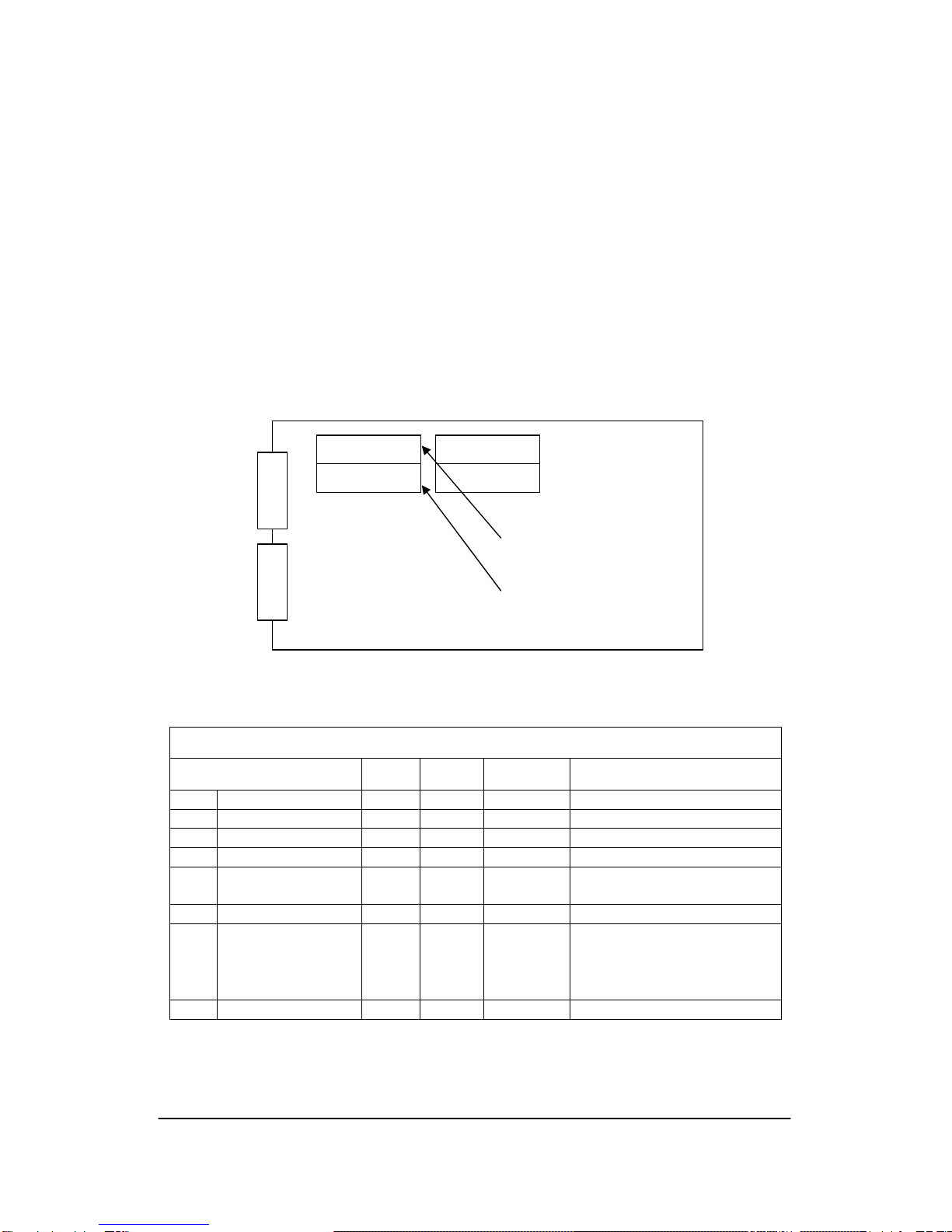
X.21 header locations
Headers connected
to X.21 Port Standard header location
DCE header location only
used when SMX3/40
provides signal timing

RFL SMX3 / 21 Page 7 of 22 Issue 1.4
User Manual 08 June 2009
The DCE configuration may be used in specific circumstances where signal timing
from the network timing is unavailable (e.g. when used with a radio link that does not
provide a clock source). Two alternatives are:
The timing source is derived from a co-located unit that is itself deriving the
master clock signal from the network. The two units are interconnected via the
concatenation link (refer to following section. In this case Clock Source must be
configured to Concat Port.
The timing source is derived from within the unit; in this case the Clock
Source must be configured to Master.
In both cases the timing signal is output on pins 6 and 13.
Optional X.21 Port Pin-out (when in DCE configuration) – D15M on chassis
Circuit Pin A Pin B Direction Notes
T Transmit Data 2 9 Input
R Receive Data 4 11 Output
C Control 3 10 Input Signal ignored
I Indication 5 12 Output Permanently on
S Signal Element
Timing 6 13 Output Timing signal derived from
the port and transmitted to
network
G Ground 8 15
Screen / Drain Must be earthed to shell
In either configuration, use 6 pair plus ground stranded cable with overall shield
(eg RS 111-8994).
Maximum recommended length in substations - 10m (Check Utility standards).
DIP switches provide configuration options, see section 10.

RFL SMX3 / 21 Page 8 of 22 Issue 1.4
User Manual 08 June 2009
7. Concatenation Port
The Concatenation Port provides optional direct connection to a co-located SMX3/21
that is serving another X.21 link. Unless interrupted by a particular V.24 port setting,
aggregate channel data passes between this port and the X.21 port. This port has
the same capacity as the X.21 Port. Signal timing is always transferred across the
Concatenation port when the port mode is set to ‘Enabled as Concatenation’.
The Concatenation Port is a DB15 female connector; this is connected internally to a
header on the PCB using a ribbon cable. The Concatenation Port may be configured
as DTE or DCE by fitting the ribbon cable to the appropriate X.21 Port Header, and
by selecting settings on DIP switch 5. Note: DTE is the standard header location
used for Aggregate Concatenation i.e. direct connection to a co-located
SMX3/21.
Transceivers are specified to ± 15kV IEC1000-4-2 air discharge ESD protection and
port connections are additionally protected by Tranzorb type arrays.
Aggregate Concatenation
Aggregate Concatenation is the interconnection at aggregate level of two co-located
SMX3/21 units. For this function the Concatenation Port is configured as Enabled as
Concatenation mode, (i.e. DTE with Timing X enabled). The timing signal is derived
from the port and is transmitted on pins 7 and 14 (Xa and Xb).
In installations where the X.21 aggregate that is connected to each co-located unit
receives timing from the network master clock, the clock source for both units should
be configured as X.21 Port.
In installations where the X.21 aggregate that is connected to one or both co-located
units do not receive timing from the network, the source of the timing signal must be
determined and the clock source for each unit should be configured as X.21 Port,
Concat Port or Master as appropriate (refer to DIP Switch 6 settings).
DIP switches provide configuration options, see section 10.
CONC. (DCE)
CONC. (DTE)
X.21V24
Headers connected
to X.21 Port Headers connected
to Concatenation
Port
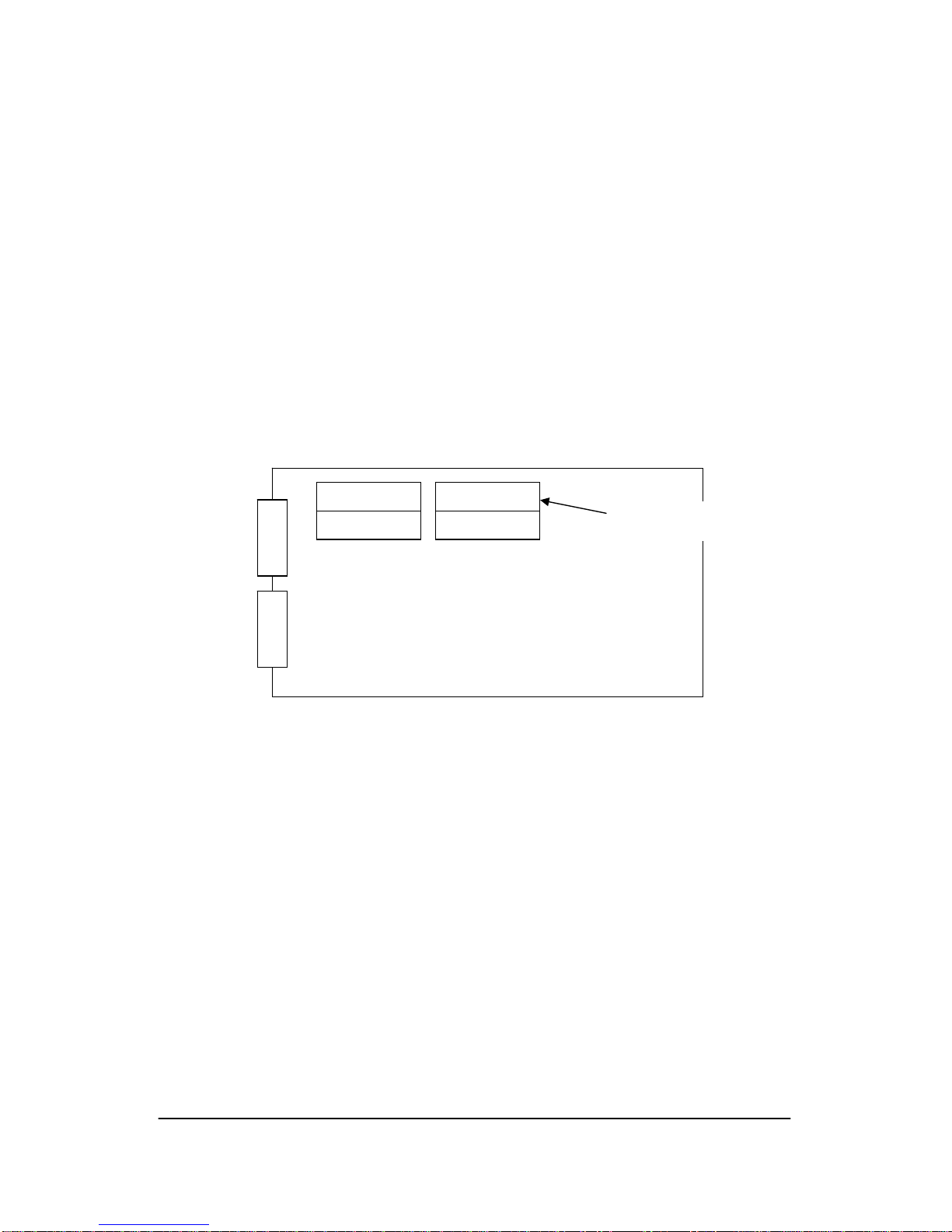
Concatenation header locations
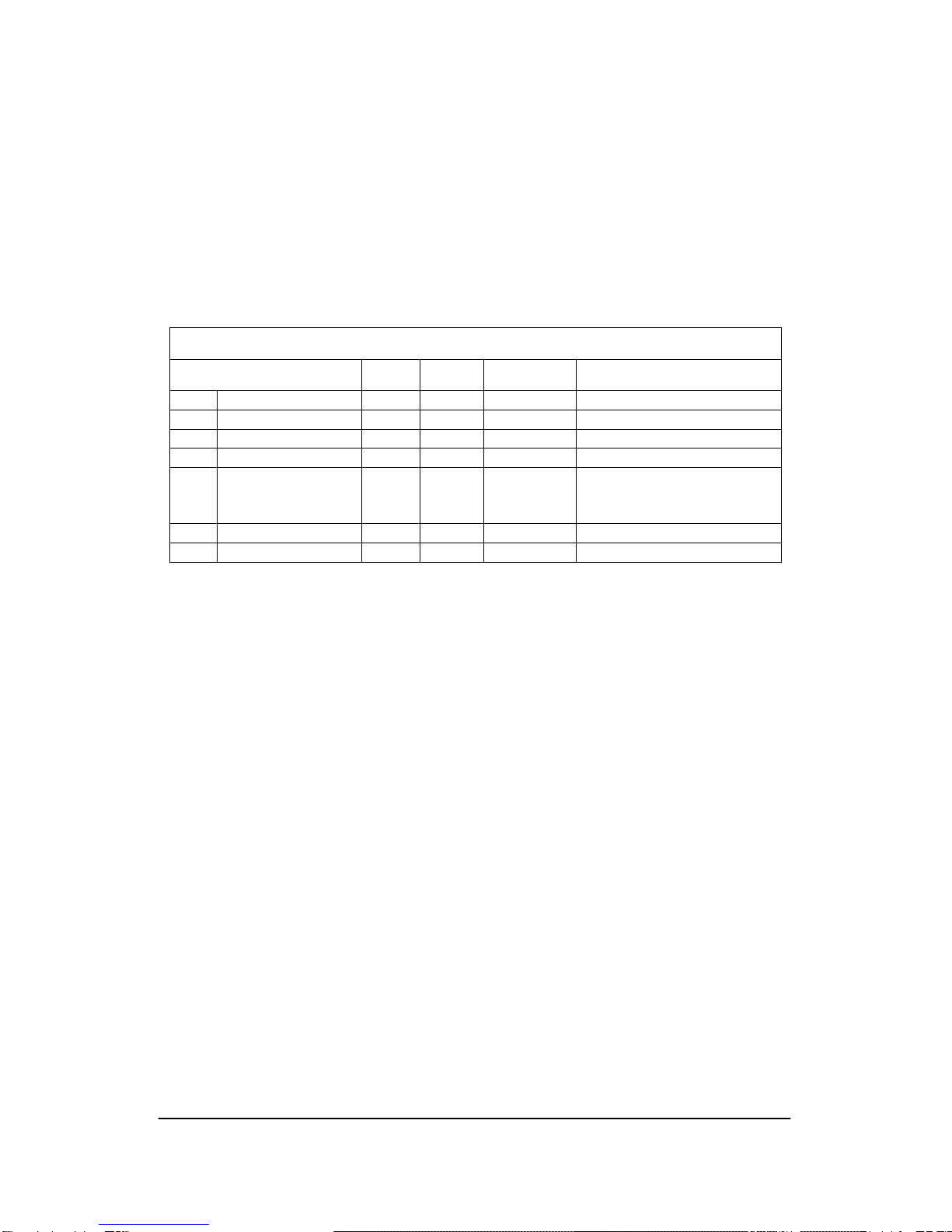
Header location used for
Aggregate Concatenation
RFL SMX3 / 21 Page 9 of 22 Issue 1.4
User Manual 08 June 2009
Standard Concatenation Port Pin-out (DTE configuration)
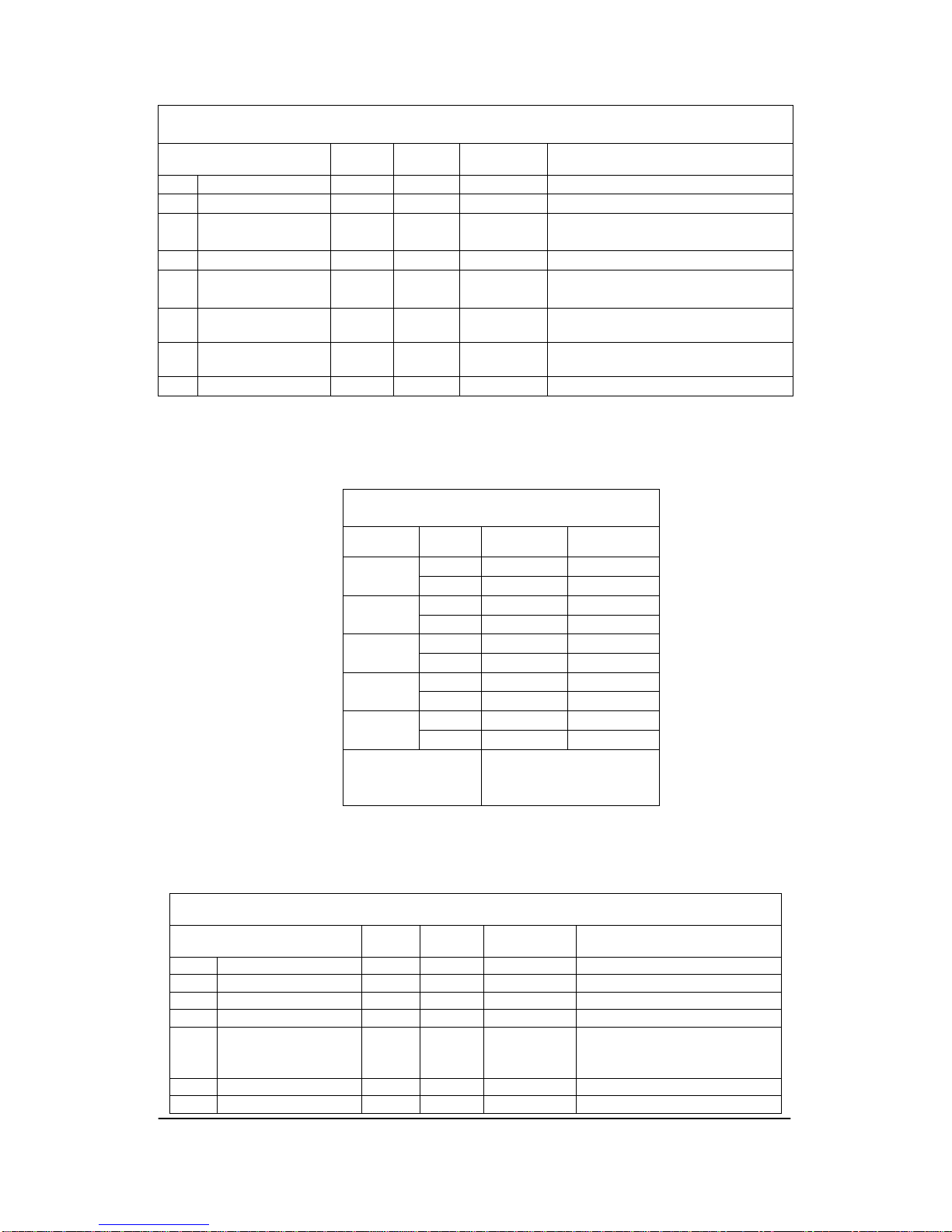
as used for Aggregate Concatenation - D15F on chassis
Circuit Pin A Pin B Direction Notes
T Transmit Data 2 9 Output
R Receive Data 4 11 Input
S Signal Element
Timing 6 13 Input Timing signal derived from the
network
G Ground 8 15
X Signal Element
Timing 7 14 Output Timing signal derived from the
port and transmitted to network.
C Control 3 10 Output Permanently on. Not used in
Aggregate Concatenation
I Indication 5 12 Input Signal ignored. Not used in
Aggregate Concatenation
Screen / Drain Must be earthed to shell
Aggregate Concatenation to a co-located SMX3/21 requires a five twisted pair cross-
over cable with overall shield (eg RS 111-8988). Maximum recommended length
10m (check Utility standards).
Aggregate Concatenation Cable
D15M – D15M
Pair Pin End 1 End 2
A 2 4
1 B 9 11
A 4 2
2 B 11 9
A 6 7
3 B 13 14
A 7 6
4 B 14 13
A 8 8
5 B 15 15
Screen / Drain Must be earthed to
connector shells at
both ends
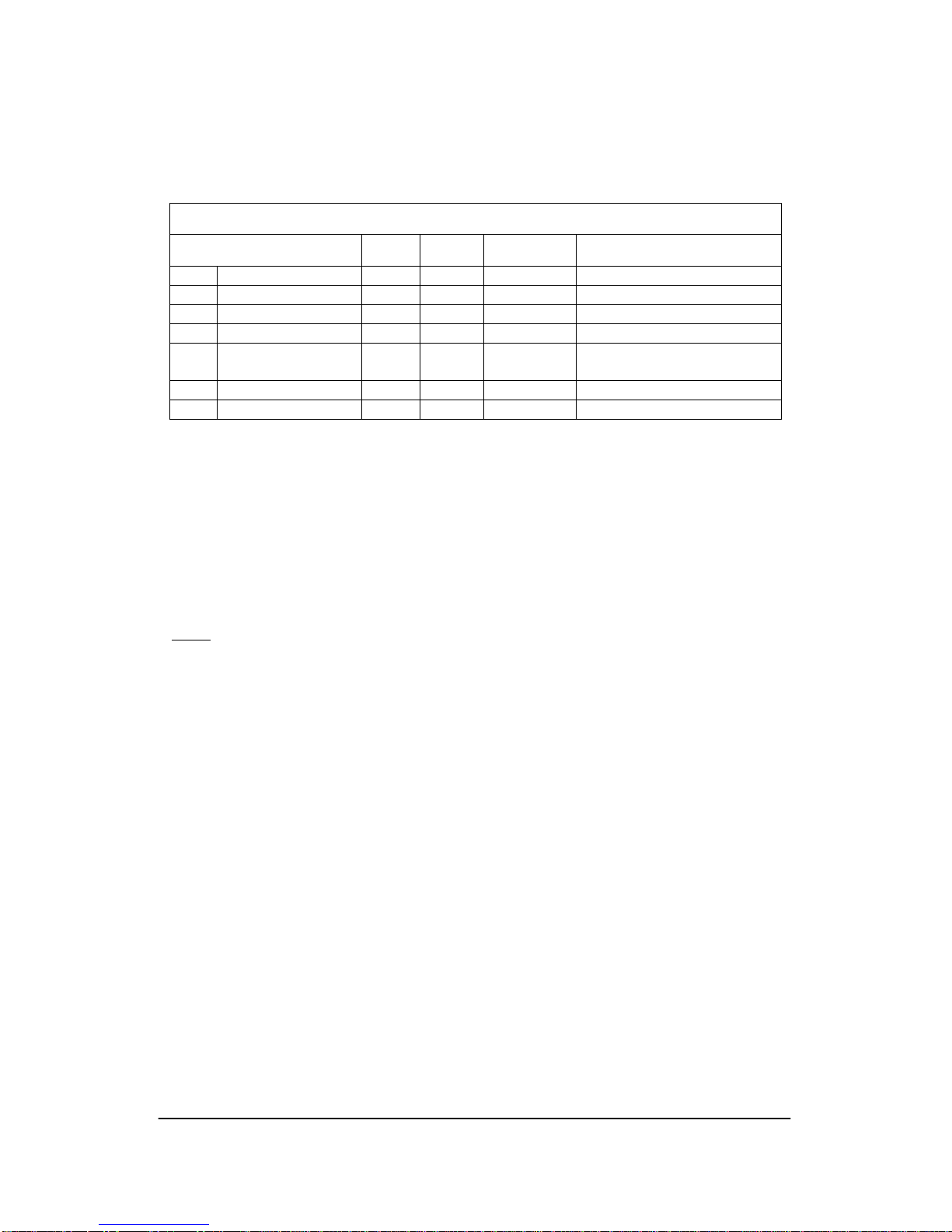
The following table is for information only, and is not used in any standard configurations.
Optional Concatenation Port Pin-out (when in DCE configuration) – D15F on chassis
Circuit Pin A Pin B Direction Notes
T Transmit Data 2 9 Input
R Receive Data 4 11 Output
C Control 3 10 Input Signal ignored
I Indication 5 12 Output Permanently on
S Signal Element
Timing 6 13 Output Timing signal derived from
the port and transmitted to
network
G Ground 8 15
Screen / Drain Must be earthed to shell

RFL SMX3 / 21 Page 10 of 22 Issue 1.4
User Manual 08 June 2009
8. X.21 Data Port (Channel A)
The port for Channel A is a DB15 female connector; it is configured as DCE.
Channel A Port Pin-out – D15F on chassis (DCE)
Circuit Pin A Pin B Direction Notes
T Transmit Data 2 9 Input
R Receive Data 4 11 Output
C Control 3 10 Input see Note below
I Indication 5 12 Output See Note below
S Signal Element
Timing 6 13 Output Timing signal transmitted
to network
G Ground 8 15
Screen / Drain Must be earthed to shell
Transceivers are specified to ± 15kV IEC1000-4-2 air discharge ESD protection and
port connections are additionally protected by Tranzorb type arrays.
Data received at the Channel A port is always terminated; it cannot be concatenated
across the concatenation link.
S is normally synchronised to network timing but in the event of this being
unavailable runs from an internal source within the SMX.
Note:
When DIP SW 1-2 is set to Local, I is ON when the channel is legally configured, the
aggregate is running and in sync, in which case C is ignored
When DIP SW 1-2 is set to Remote, I is ON when the channel is legally configured,
the aggregate is running and in sync, and C is received from the remote end.
Ce manuel convient aux modèles suivants
2
Table des matières
Manuels Multiplexeur populaires d'autres marques

ADTRAN
ADTRAN Frameport 768 Manuel utilisateur

Elo TouchSystems
Elo TouchSystems E247 Manuel utilisateur

Paradyne
Paradyne Hotwire 8786 Manuel utilisateur

RFL Electronics
RFL Electronics 9508D UCC Manuel utilisateur

Miranda
Miranda AMX-101i Mode d’emploi

ShipModul
ShipModul MiniPlex-AIX NMEA-0183 Manuel utilisateur