Requisite Audio Engineering L2M MKIII M/S VERSION Manuel utilisateur

THE L2M MKIII M/S VERSION
Optical Leveling Amplifier
By Requisite Audio Engineering
OPERATOR’S MANUAL
2175 Goodyear Ave., Suite 110, San BuenaVentura, California 93003
telephone: 818.437.0779 • www.requisiteAudio.com

TABLE OF CONTENTS
INTRODUCTION!1
RECEIVING YOUR L2M!2
UNPACKING and INSPECTION:!2
GENERAL NOTES!3
WARNING:!3
THIS SHIPMENT SHOULD INCLUDE:!3
SERVICING:!3
ENVIRONMENTAL CONSIDERATIONS:!3
FRONT PANEL CONTROLS (top & bottom rows)!4
IN/BYPASS!4
IN/BYPASS - OPERATIONAL NOTE:!4
OUTPUT LEVEL!4
OUTPUT LEVEL - OPERATIONAL NOTE:!4
OUTPUT LEVEL - CALIBRATION PROCEDURE:!4
FRONT PANEL CONTROLS (continued)!5
LIMITER FEEDBACK!5
LIMITER FEEDBACK - OPERATIONAL NOTE:!5
LIMITER RESPONSE!6
LIMITER RESPONSE - OPERATIONAL NOTE:!6
PEAK REDUCTION!6
PEAK REDUCTION - OPERATIONAL NOTE:!6
THE L2M MKIII M/S VERSION
Requisite Audio Engineering L2M MkIII M/S Version

FRONT PANEL CONTROLS (center row)!7
MID!7
MID - OPERATIONAL NOTE:!7
SIDE!7
STEREO LEVEL RIDE!7
STEREO LEVEL RIDE - OPERATIONAL NOTE:!7
FRONT PANEL CONTROLS (center row- continued)!8
PK REDUCTION (MONO - LINK)!8
PK REDUCTION - OPERATIONAL NOTE:!8
METER SELECT!8
FRONT PANEL CALIBRATION POINTS!9
ZERO ADJ!9
ZERO ADJUST - OPERATIONAL NOTE:!9
GR TRACK!9
GR TRACK - CALIBRATION PROCEDURE:!9
FRONT PANEL CALIBRATION POINTS (continued)!10
VU ADJ!10
VU ADJ - CALIBRATION PROCEDURE:!10
STEREO ADJ!10
FRONT PANEL CALIBRATION POINTS (continued)!11
STEREO ADJ - CALIBRATION PROCEDURE:!11
FRONT PANEL CALIBRATION POINTS (continued)!12
STEREO ADJ - OPERATIONAL NOTE:!12
THE L2M MKIII M/S VERSION
Requisite Audio Engineering L2M MkIII M/S Version

REAR PANEL (LEFT to RIGHT, top and bottom row)!13
GROUND!13
POWER SUPPLY INLET!13
AUDIO OUTPUTS!13
LIMITER LINK!13
TUBE CHANNEL!13
TUBE PLACEMENT and FUNCTION (left to right)!13
AUDIO INPUTS!13
OUTBOARD POWER SUPPLIES!14
POWER SUPPLIES!14
POWER ON!14
POWER CABLE!14
VOLTAGE SELECT!14
FUSE!14
WARRANTY!15
THE L2M MKIII M/S VERSION
Requisite Audio Engineering L2M MkIII M/S Version

INTRODUCTION
THANK YOU
Thank you for selecting the L2M Mastering Limiter and thereby making it a part of your
art. The L2M MkIII M/S Version is the third generation of our L2M platform, now in
it’s 12th year of production (2011).
We classify the L2M as a mastering limiter because it was designed with the specialized
requirements of the mastering engineer in mind. Features such as a choice of outboard
power supplies (all tube or solid-state), true bypass, 1dB 24-step attenuator, 1dB 10-step
Limiter Feedback, Limiter Response, Mid/Side function, and multiple calibration points
all contribute to its effectiveness in the demanding application of mastering. Further-
more, the L2M is equally at home in tracking and mixing situations.
The L2M is an optical limiter based on classic designs of the early 1960s, however, the
L2M is the beneficiary of many significant improvements and represents what a truly
refined optical limiter can be.
Among the more notable performance features of the L2M are it's sonic excellence, ver-
satility and stable frequency response while limiting program material. Corrective EQ,
following the L2M, is simply not required as with many limiters. Your work stays intact,
just as you need it to. While providing unobtrusive compression/limiting action, there
is no undulating bottom or loss of openness, even in the heaviest of limiting situations.
For over a decade, the L2M has been installed in some of the finest mastering and re-
cording studios throughout the U.S., Europe and Canada and has been the primary dy-
namics processor on many major record and film releases.
Please read this manual carefully as it contains information essential to the proper op-
eration of the unit. We welcome your comments and encourage you to write or call.
Thank you again, and please enjoy!
Danny “Sage” McKinney (Founder/President)
Requisite Audio Engineering
818.437.0779
THE L2M MKIII M/S VERSION
Requisite Audio Engineering!L2M MkIII
1

RECEIVING YOUR L2M
UNPACKING and INSPECTION:
Your shipment has been carefully inspected, checked and packaged at our company be-
fore being turned over to the carrier.
We fully expect your L2M to arrive in your hands without having been harmed. How-
ever, at the point at which you do receive the product, it becomes your property. There-
fore it is important that you carefully inspect the carton and it’s contents for any sign of
physical damage which could have occurred in transit. Record and report any damages
to the transportation company within 24-hours of the original shipment.
Here’s what to do if the shipment has been damaged:
Leave the product, its packing materials and box “as is.” Notify the carrier’s local office
and request an immediate inspection of the shipment.
After said inspection has been made and you have received written notification thereof,
please contact our shop at 818.437.0779 for a return authorization number.
We will repair or replace any damaged merchandise as necessary.
Remember, it is your responsibility to follow the above procedures. Otherwise, the car-
rier will not honor your damage claim. If you have any questions regarding this notice
or the shipment itself, please notify us immediately.
Thank you,
Requisite Audio Engineering
818.437.0779
THE L2M MKIII M/S VERSION
Requisite Audio Engineering!L2M MkIII
2

GENERAL NOTES
WARNING:
DO NOT OPEN THE CABINET - RISK OF SEVERE ELECTRICAL SHOCK
THIS SHIPMENT SHOULD INCLUDE:
Model L2M MkIII M/S Version Mastering Limiter
Model OPS-2D Solid-State Power Supply or RTS-2A Tube Power Supply
L2M Operator’s Manual (this book)
A.C. Cable
SERVICING:
The user should not attempt to service this unit beyond that described in this manual.
Internal voltage can exceed 350 VOLTS D.C. !!! Refer all servicing, other than tube and
opto replacement to:
REQUISITE AUDIO ENGINEERING
2175 Goodyear Ave., Suite 110
Ventura, CA 93003
•telephone: 818.437.0779
•email: [email protected]
ENVIRONMENTAL CONSIDERATIONS:
This and all electronic equipment require adequate ventilation and a dry environment
for safe operation and long component life. If proper ventilation from behind the unit is
provided, the L2M mainframe will require 4 rack spaces for mounting. If the RTS-2A
tube supply is also used, it will require an additional 4 rack spaces (8 total). If using the
OPS-2D (solid-state supply) it can be placed at the bottom of the rack, assuming reason-
able ventilation.
Do not allow either unit to become overheated.
Also, while circuitry susceptible to hum pick-up is sufficiently shielded from moderate
electromagnetic fields, installation should be planned to avoid mounting the system ad-
jacent to power transformers, motors, etc.
THE L2M MKIII M/S VERSION
Requisite Audio Engineering!L2M MkIII
3

FRONT PANEL CONTROLS (top & bottom rows)
IN/BYPASS
This switch (2 each) is a "true-hardwired" bypass, making a straight connection from input to
output allowing for accurate comparison of source and processed audio. BYPASS will work,
even if the L2M is off or unplugged from the A/C mains.
IN/BYPASS - OPERATIONAL NOTE:
For accurate perception when comparing processed audio to source material, it is essential that
make-up gain be correctly adjusted. The L2M has 2 points to which MAKE-UP GAIN can be
applied: OUTPUT LEVEL and LIMITER FEEDBACK. For more detail, see OPERATIONAL
NOTES - OUTPUT LEVEL and OPERATIONAL NOTES - LIMITER FEEDBACK. For purposes
of A/B listening STEREO LEVEL RIDE should be at it’s UNITY position.
OUTPUT LEVEL
Output level/make-up gain is accomplished using a precision 24-step attenuator (one for each
channel). Range of settings is from -6dB to +17dB in 1dB increments. As an initial setting for the
OUTPUT LEVEL attenuator, be sure the UNITY position is selected (both channels) and all
other controls are in their “OFF or UNITY” position. Verify that switching between IN & BY-
PASS exhibits no change in volume. This can be confirmed by injecting a 1-kHz tone and ob-
serving an outboard DMM or other suitable meter. The L2M is shipped with UNITY calibrated
to within .1dB. Each channel is calibrated by it’s respective UNITY ADJ on the back of the unit.
OUTPUT LEVEL - OPERATIONAL NOTE:
With program material being played, adjust the desired amount of PEAK REDUCTION and
LIMITER RESPONSE. Referring to the loudest peak in the program material, note how much
GAIN REDUCTION is occurring on the GR METER. Typical readings will be in the -3dB to
-7dB range. Adjust the OUTPUT LEVEL attenuator to have the inverse amount of gain. As an
example, if the GR METER is reading -5dB on the highest peaks adjust the OUTPUT ATTENU-
ATOR to +5dB. Go to a quiet passage of the program material. Using the IN/BYPASS switch,
you can now compare source and processed audio.
OUTPUT LEVEL - CALIBRATION PROCEDURE:
•Set PEAK REDUCTION & LIMITER RESPONSE fully-counterclockwise.
•Set OUTPUT LEVEL, LIMITER FEEDBACK & STEREO LEVEL RIDE to UNITY.
•Inject a +10dB 1-kHz tone. Verify using an external DMM or suitable meter.
•Switch between IN and BYPASS. External meter should read the same or within .1dB
•If not, adjust the UNITY trimmer (rear panel) until IN reads the same as BYPASS
THE L2M MKIII M/S VERSION
Requisite Audio Engineering!L2M MkIII
4

FRONT PANEL CONTROLS (continued)
LIMITER FEEDBACK
Left to run freely, vacuum tubes are not linear and exhibit a considerable amount of harmonic
generation and other forms of distortion. For over half a century, negative feedback has been
engineered into circuits to “improve” the linearity of vacuum tubes when used in audio gain
stages. However, best readings on a meter don’t always equate to the ideal sound, whatever
that happens to be. By making LIMITER FEEDBACK an adjustable feature, harmonic content
and texture are put into the hands of the audio engineer and not the guy with the THD meter.
As an initial setting for the LIMITER FEEDBACK control, be sure the UNITY position is selected
(Channel 1 & Channel 2). In order to maintain correct gain structure for accurate IN/BYPASS
review, LIMITER FEEDBACK should be used in tandem with the OUTPUT LEVEL control.
Since both OUTPUT LEVEL and LIMITER FEEDBACK are step attenuated in 1dB increments
this is fairly easy to do.
LIMITER FEEDBACK - OPERATIONAL NOTE:
LIMITER FEEDBACK has a direct effect on the output level of the audio, which is why it is
done in calibrated 1dB increments on the L2M. Because of this, proper setting of make-up gain
is the combined settings for OUTPUT LEVEL and LIMITER FEEDBACK which should be set to
the inverse of the GR METER reading.
For example, a -5dB meter reading of PEAK REDUCTION would allow for a setting of +5dB on
the OUTPUT LEVEL and a 0dB setting on LIMITER FEEDBACK. In this example, you would
maintain UNITY and have the cleanest possible signal.
In the same example, a -5dB meter reading of PEAK REDUCTION would allow for a setting of
0dB on the OUTPUT LEVEL and a +5dB setting on LIMITER FEEDBACK. In this example, you
would maintain UNITY and add additional harmonics. Naturally, you could have +2dB on
OUTPUT LEVEL and +3dB on LIMITER FEEDBACK.
As an extreme example, -5dB of PEAK REDUCTION would allow for a setting of -5dB on the
OUTPUT LEVEL with a +10dB on LIMITER FEEDBACK. With this setting, you would main-
tain UNITY and provide maximum harmonic generation, which can bring added “life” and “in-
terest” to a dull sounding recording or be just the right texture for a lead vocal or guitar to stand
out. Maybe, maybe not, it’s up to you.
THE L2M MKIII M/S VERSION
Requisite Audio Engineering!L2M MkIII
5

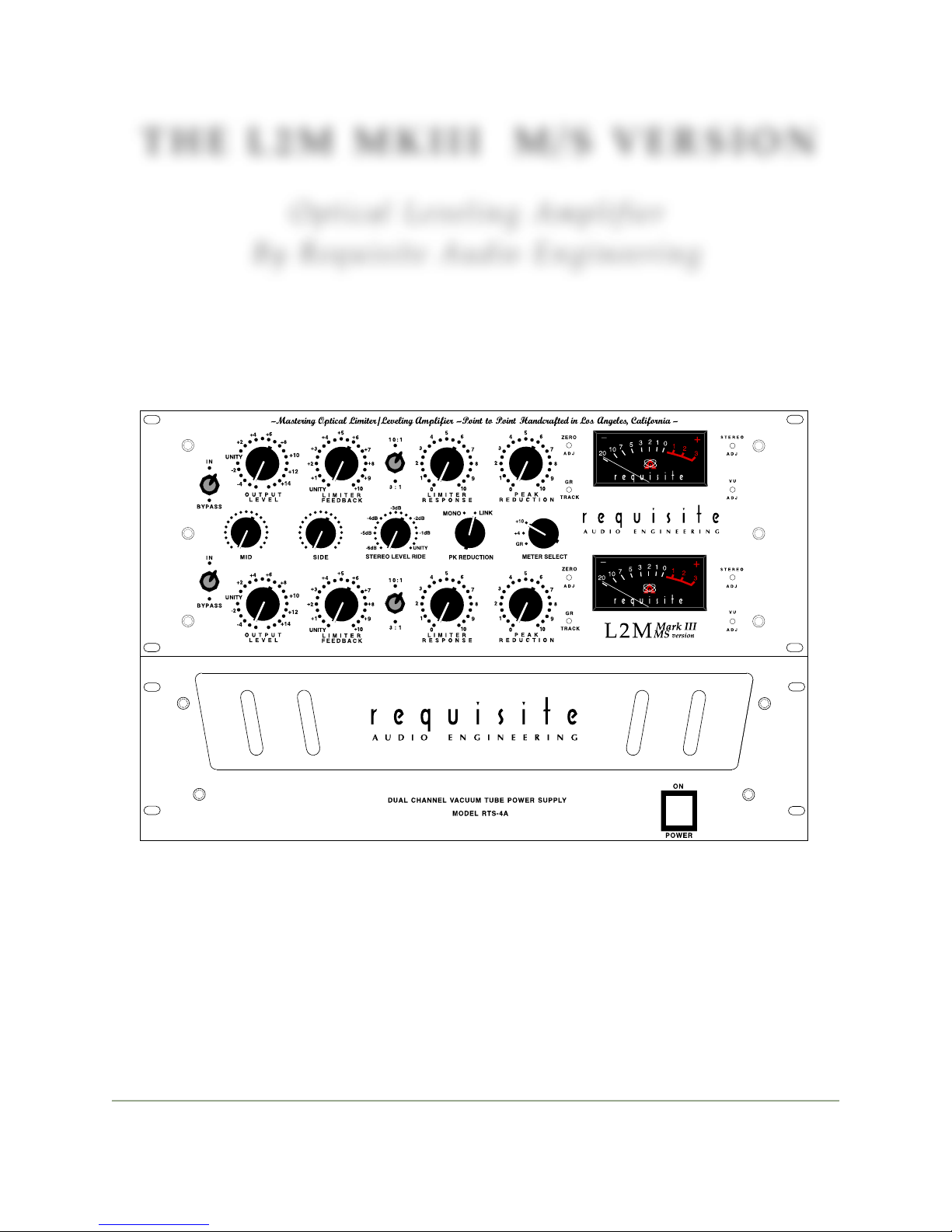
FRONT PANEL CONTROLS (continued)
RATIO 10:1 / 3:1
The purpose of this switch (Channel 1 & Channel 2) is to allow selection of either compressor
(3:1) or limiter (10:1). Compression (3:1) occurs from the breakaway point (-30dB input). In the
10:1 position, the L2M operates as a compressor until it reaches the -20dB point then rolls-over
into limiting action. Thus, combining the characteristics of a compressor and a limiter in the 10:1
mode.
LIMITER RESPONSE
With LIMITER RESPONSE (both channels) set fully counter-clockwise, the L2M will provide
equal compression/limiting at all frequencies by responding to the entire spectrum of the pro-
gram material. When LIMITER RESPONSE is set fully clockwise, frequencies below 1-kHz
gradually require more energy to initiate gain reduction. For frequencies below 100Hz, gain re-
duction initiation is down approximately 10dB. This arrangement is ideal for general program
material & especially material with a great deal of bass energy and/or broad bass dynamics.
The result is a marked smoothing of mid and high frequencies (above 1-kHz) and a tight and
punchy bass response.
LIMITER RESPONSE - OPERATIONAL NOTE:
For uniform limiter initiation and response in MONO or LINK mode, both channels require
LIMITER RESPONSE to be at the same setting. This is also applies to PEAK REDUCTION.
PEAK REDUCTION
Set fully counter-clockwise, the L2M exhibits no gain reduction and acts as a line amplifier.
Turning PEAK REDUCTION (Channel 1 & Channel 2) clockwise will gradually increase gain
reduction. PEAK REDUCTION should be set for the desired amount of gain reduction as indi-
cated on the VU meter while in the GR (GAIN REDUCTION) mode. A reading of -3dB to -7dB
during the highest peaks of the program material is a reasonable range to work within, how-
ever, you are encouraged to experiment.
PEAK REDUCTION - OPERATIONAL NOTE:
Additional PEAK REDUCTION may be needed to offset the reduction in limiting action that
occurs as you increase the setting of the LIMITER RESPONSE.
For uniform limiter initiation and response in MONO or LINK mode, both channels require
PEAK REDUCTION to be at the same setting. This is also applies to LIMITER RESPONSE.
THE L2M MKIII M/S VERSION
Requisite Audio Engineering!L2M MkIII
6
Table des matières
Autres manuels Requisite Audio Engineering Amplificateur