
PowerTech MB3908 Manuel utilisateur
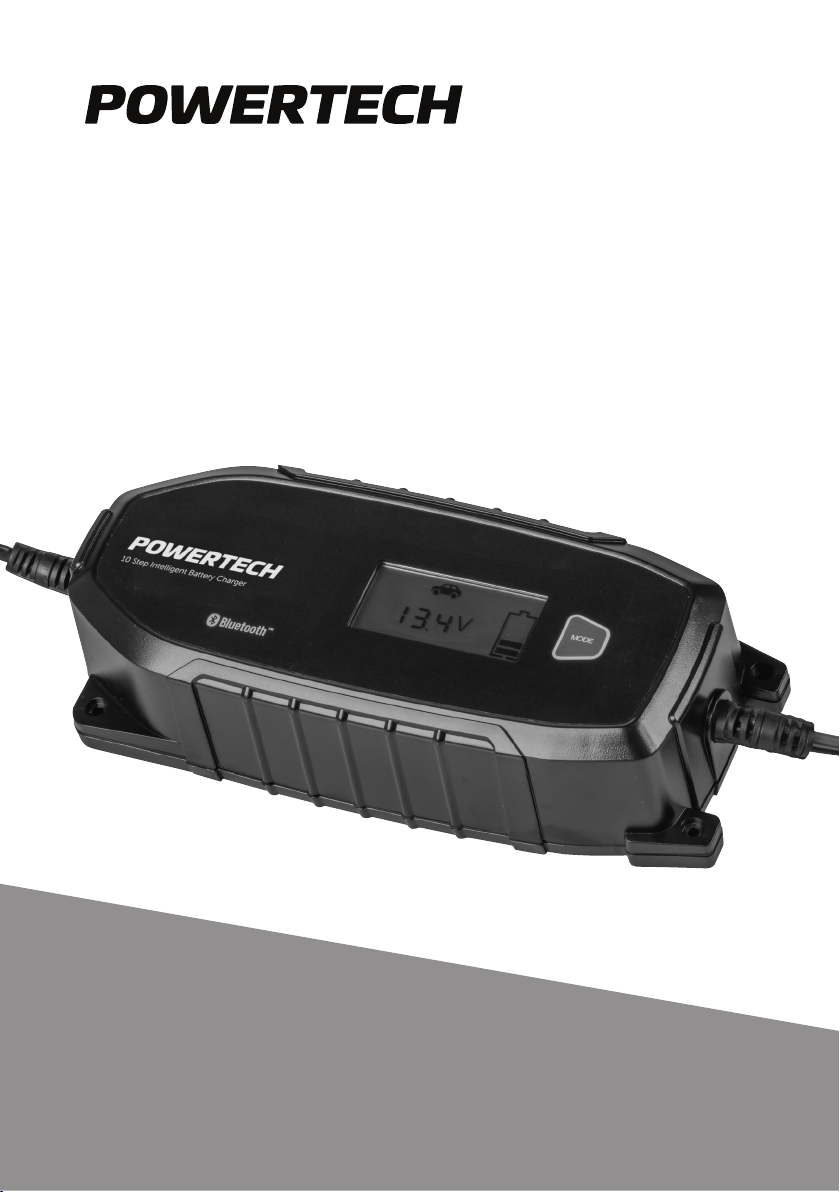
Instruction Manual
10 Step Bluetooth®
Intelligent Lead Acid and
Lithium Battery Charger
MB3908


Table of Contents
Introduction 1
Part Description 2
Product Specifications 3
Box Contents 3
Safety Information 4
Product Features 7
Operation 8
Connection 9
Disconnecting 9
Select Charging Mode 9
Memory Function / Reset 10
Switching Between Modes 10
Automatic Detection of Battery 11
Recover 12V Mode 12
12V (Automotive) Lead-acid Battery Mode 12
24V (Truck) Lead-acid Battery Mode 13
Lithium 12.8V Mode 13
Advanced AGM Mode 14
SMPS 13.6V Mode 14
Special Functions 15
Bluetooth 15
Cleaning and Maintenance 18
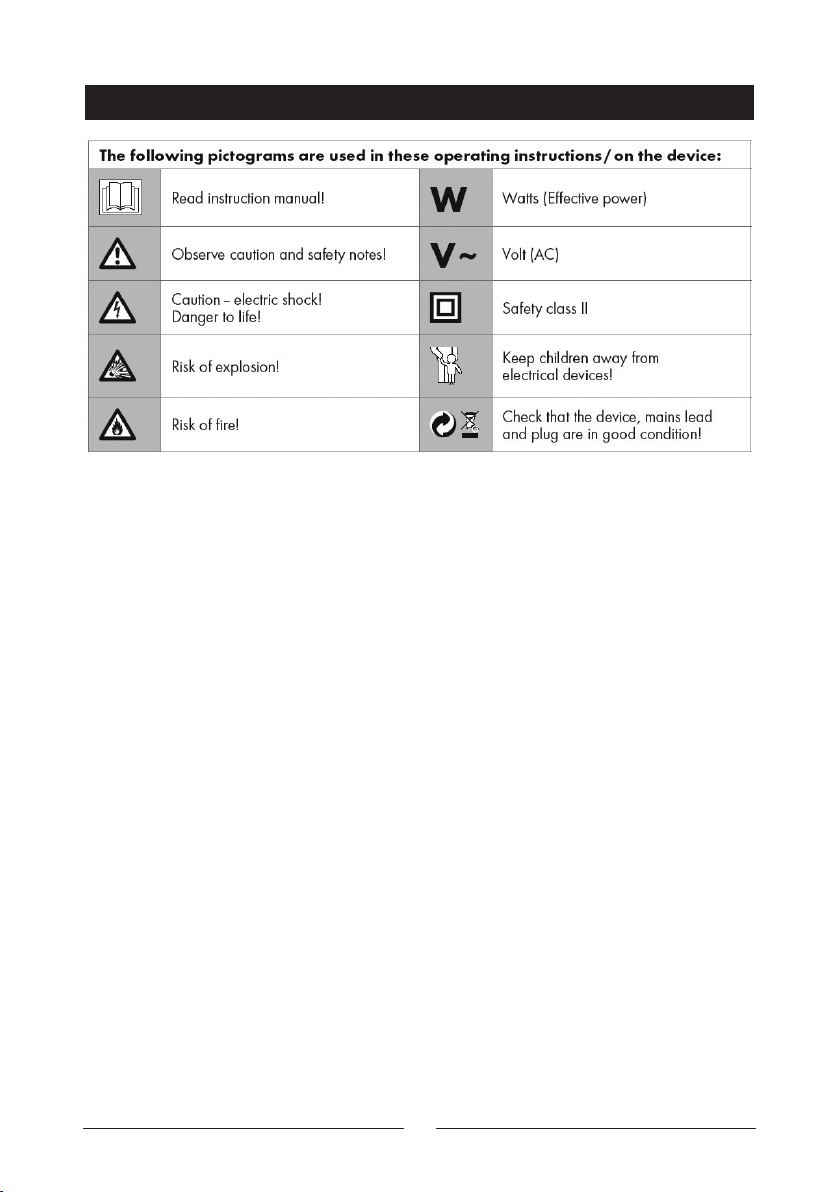
Use for the intended purpose
The MB3908 is a battery charger with a pulse trickle charge mode and is
suitable for charging and maintenance charging of the following 12 V or 24 V
lead rechargeable batteries with Wet, Gel, AGM and 12.8V 4-cells LiFePO4:
• 12 V: with a capacity of 18 - 240 Ah
• 24 V: with a capacity of 10 - 120 Ah
• Lithium (12.8V 4-cells LiFePO4): with a capacity of 10 - 80 Ah
You can also used it to regenerate completely discharged batteries. The
battery charger has protective circuits to prevent sparking and overheating.
Any incorrect or improper use leads to loss of the warranty. The manufacturer
takes no responsibility for damage(s) arising out of usage that is contrary to
the instructions laid down. The appliance is not meant for commercial use.
INTRODUCTION:
Please read these instructions for use carefully and completely, and take
note of all instructions and specifications.
SAVE THESE INSTRUCTIONS FOR FUTURE REFERENCE
1
2
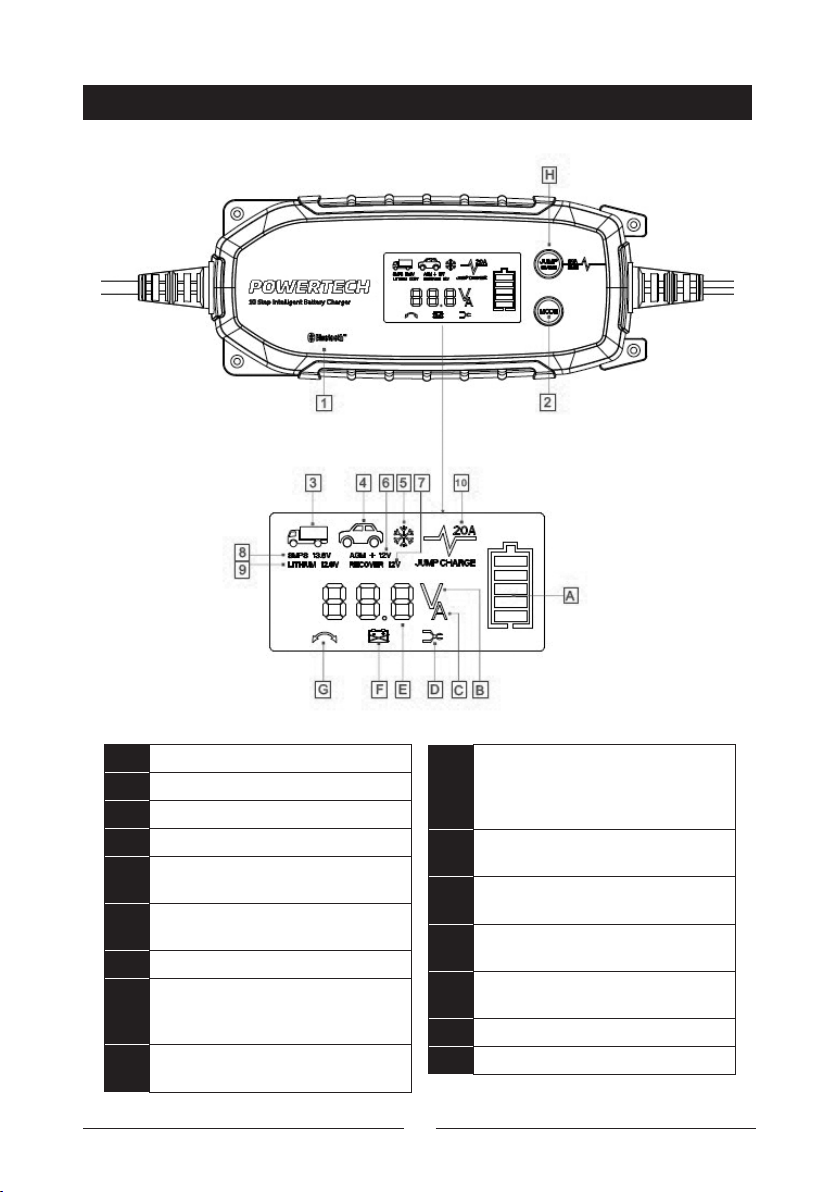
PART DESCRIPTION:
1Bluetooth Logo
2MODE selction button
3Mode 1 (24V/3.75A)
4Mode 2 (12V/7.5A)
5Mode 3
(12V or 24V cool situation)
6Mode 4 ADV. AGM 12V
(12V/7.5A)
7Mode 5 RECOVER 12V (12V/7.5A)
8Mode 6 SMPS 13.6V
(Switch Mode Power Supply
13.6V/5.0A)
9Mode 7 LITHIUM 12.8V
(12.8V 4-cells LiFePO4/5.0A)
ACharging battery level:
1 bar (20%), 2 bars (40%), 3 bars
(60%), 4 bars (80%), 5 bars (90%),
Stops flashing fully charged.
BVOLT: The current voltage of
connected battery
CAMP: The charging current when
mode is selected
DIf flashing:
“Battery is not connected“
ENumbers: Shows value of the
current and voltage.
FIf flashing: “Battery Fault”
GIf flashing: “Incorrect Polarity“

3
PRODUCT SPECIFICATIONS:
BOX CONTENTS:
Input Voltage: 220 - 240 V ~ 50 Hz 1.3A
Power consumption: 120 W
Reverse current*: < 10 mA (no AC input)
Nominal output voltage: 12 VDC / 24 VDC / 12.8 VDC/ 13.6 VDC
Nominal output current: 7.5 A / 3.75 A / 5.0 A / 5.0 A
Charging voltage: 14.5V / 14.7V for 12V battery, 29 V /
29.4V for 24V battery, 14.5V for Lithium
(12.8V 4-cells LiFePO4), 13.6V for SMPS.
Charging current: 7.5 A ± 10 %, 3.75 A ± 10 %, 5.0 A ± 10 %
Battery type: 12V lead-acid battery 18Ah - 240Ah
24V lead-acid battery 10 Ah - 120Ah
Lithium (12.8V 4-cells LiFePO4): with a
capacity of 10 - 80Ah
Housing protection type: IP 65 (dust-proof, water-proof)
Safety class: II
*Reverse current is the current used by the charging station battery, when
no mains current is connected.
Check the appliance and all accessories for damage immediately after
unpacking. Do not put a defective appliance or parts into operation.
• MB3908 Charger
• Clamps Cable
• Eyelet M6 Cable
• Instruction Manual

4
SAFETY INFORMATION:
DANGER!
Avoid danger to life and limbs caused by improper use!
CAUTION! Do not operate the appliance with a
damaged cable, power cord or plug.
Avoid danger to life and limbs caused by improper use!
PROTECT YOURSELF FROM AN ELECTRIC SHOCK!
When connecting the charging station, use a screwdriver
and a spanner with an insulated handle!
DANGER FROM ELECTRIC SHOCK!
• Do not operate the vehicle if you are charging a battery
while it is still in the vehicle! Switch o the ignition and
park the vehicle. Apply the parking brake (e.g. in cars)
or secure with a mooring rope (e.g. electric boat)!
• Disconnect the battery charger from the mains before
you make or break the connections to the battery.
1. First connect the positive/+ clamp to the positive/+
terminal of the battery, then connect the other
clamp to the vehicle chassis at a point away from
the battery and the fuel line. After this is done, you
can connect the battery charger to the mains.
2. After charging, disconnect the battery charger from
the mains. Then disconnect the negative/black
clamp before you disconnect the positive/+ clamp
from the battery.
• Handle the connecting cables (– and +) by their
insulated areas only!
• Ensure that there is complete protection from moisture
at the connections to the battery and at the mains
outlet socket!
• Carry out the mounting, maintenance and cleaning of
the battery charger only when it is disconnected from
mains!
• After completion of the charging and maintenance
charging process on a battery mounted in a vehicle,
first disconnect the negative connection cable (black)
of the battery charger from the negative terminal of the
battery.
5
SAFETY INFORMATION:
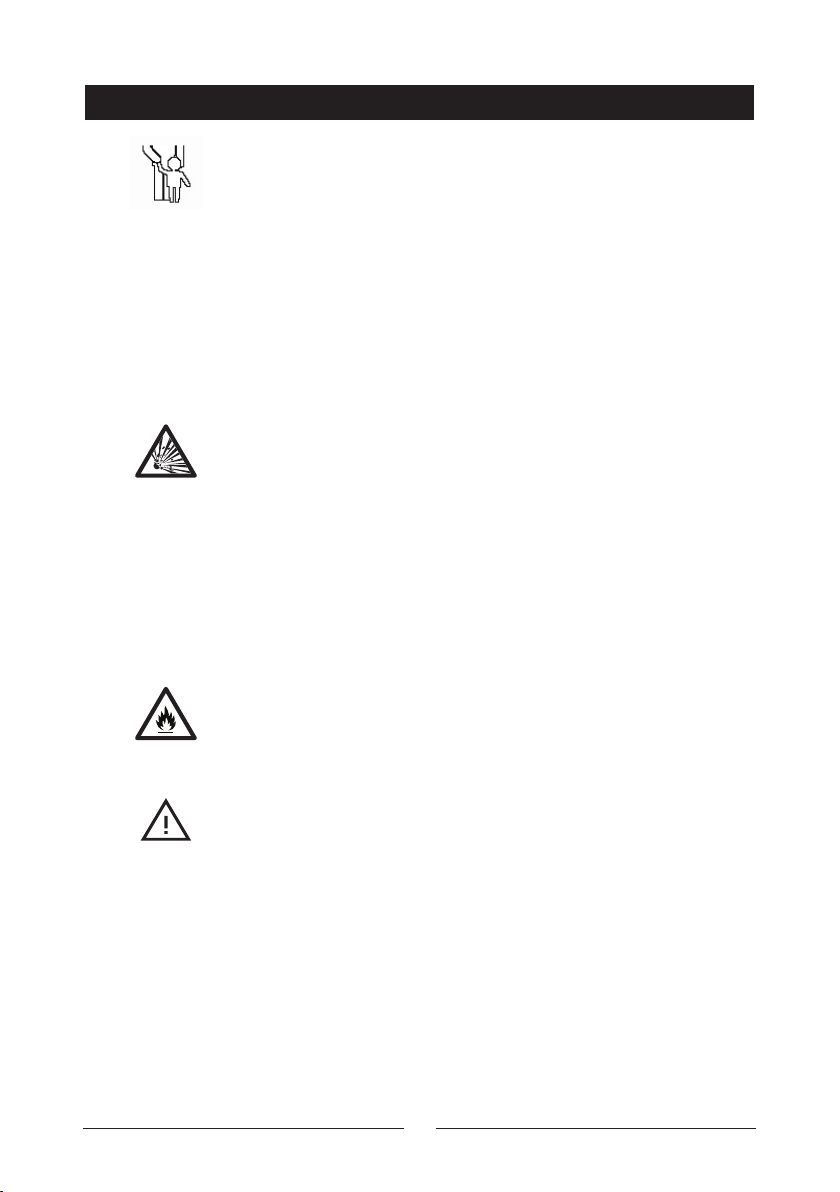
Do not leave small children unattended with the
battery charger!
• Children are too young to assess the possible dangers
associated with electrical devices. Children should be
supervised in order to ensure that they do not play with
the device.
• Children or persons who lack the knowledge or
experience to use the device or whose physical,
sensory or intellectual capacities are limited must never
be allowed to use the device without supervision or
instruction by a person responsible for their safety.
EXPLOSION HAZARD! Protect yourself from a highly
explosive oxyhydrogen gas reaction!
Gaseous hydrogen can leak from the battery during the
charging and discharging process. Oxyhydrogen gas is an
explosive mixture of gaseous hydrogen and oxygen. The
result is the so-called oxyhydrogen reaction upon contact
with open fire (flames, embers or sparks)! Carry out the
charging or discharging procedure in a well ventilated
room protected from the weather. Make sure that there are
no sources of open fire (flames, embers or sparks) in the
vicinity when charging or discharging batteries!
RISK OF EXPLOSION OR FIRE!
Ensure that the use of the battery charger cannot ignite
any explosive or combustible substances, e.g. petrol or
solvents!
EXPLOSIVE GASES! AVOID FLAMES AND SPARKS!
Ensure that there is adequate ventilation during the
charging process.
• Stand the battery on a well ventilated surface while
charging. Otherwise the device could be damaged.
• DANGER OF EXPLOSION! Ensure that the positive
terminal connection cable does not come into contact
with a fuel line (e.g. petrol line)!

6
SAFETY INFORMATION:
DANGER OF CHEMICAL BURNS! Protect your eyes and skin
against chemical burns caused by acid (sulphuric acid) upon
contact with the battery!
Wear: Acid-resistant glasses, clothing and gloves! If your eyes or
skin come into contact with sulphuric acid, rinse the aected part
of the body with plenty of clear running water and seek immediate
medical assistance!
• Avoid causing an electrical short-circuit when connecting the battery
charger to the battery. Connect the minus pole connecting cable only to
the minus pole of the battery or to the car body. Connect the plus pole
connecting cable only to the plus pole of the battery!
• Before connecting to the mains, make sure that the mains current is
equipped with standard 230 V ~ 50 Hz, PEN conductor, a 16 A fuse and a
residual-current circuit-breaker! Otherwise the device could be damaged.
• Do not place the battery charger near fire, heat, or subject it to prolonged
temperatures of over 50 °C! The output from the battery charger drops
automatically in high temperatures.
• Avoid damaging any lines carrying fuel, electricity, brake fluid, hydraulic oil or
water. Be particularly careful not to cause damage when mounting the charger
in place with screws! Failure to observe this advice risks loss of life or injury!
• Use only the supplied original manufacturer’s parts with the battery charger!
• Do not allow any objects to cover the battery charger! Otherwise the device
could be damaged.
• Protect the electrical contacts of the battery against short-circuiting!
• Use the battery charger only for charging and maintenance charging of
undamaged 6 V / 12 V lead batteries (wet cell or gel electrolyte)! Otherwise
damage to property could occur.
• Do not use the battery charger for charging or maintenance charging of
disposable batteries. Otherwise damage to property could occur.
• Do not use the battery charger for charging or maintenance charging of
damaged or frozen batteries! Otherwise damage to property could occur.
• Before connecting the charging station, read the information on battery
maintenance in the operating instructions of the battery! Otherwise personal
injury and / or damage to the device could occur.
• Before connecting the charging station to a battery permanently installed
in a vehicle, read the information on electrical safety and maintenance in
the operating instructions of the vehicle! Otherwise personal injury and / or
damage to the device could occur.
• Unplug the charger from the mains supply when not being used! This also
benefits the environment. Consider how much electricity is consumed, even
in standby mode.
• Remain alert at all times and always watch what you are doing. Always
proceed with caution and do not use the battery charger if you cannot
concentrate or feel unwell.
• Do not charge non-rechargeable batteries
• Max. operation temperature: 40ºC
7
PRODUCT FEATURES:
This appliance has been designed for charging a variety of SLA batteries
(sealed lead acid batteries), as mainly used in cars, motorbikes and several
other vehicles. They may be of types e.g. WET (with liquid electrolyte), GEL
(with mit gel-type electrolyte) or AGM (absorbed glass mat) batteries. A
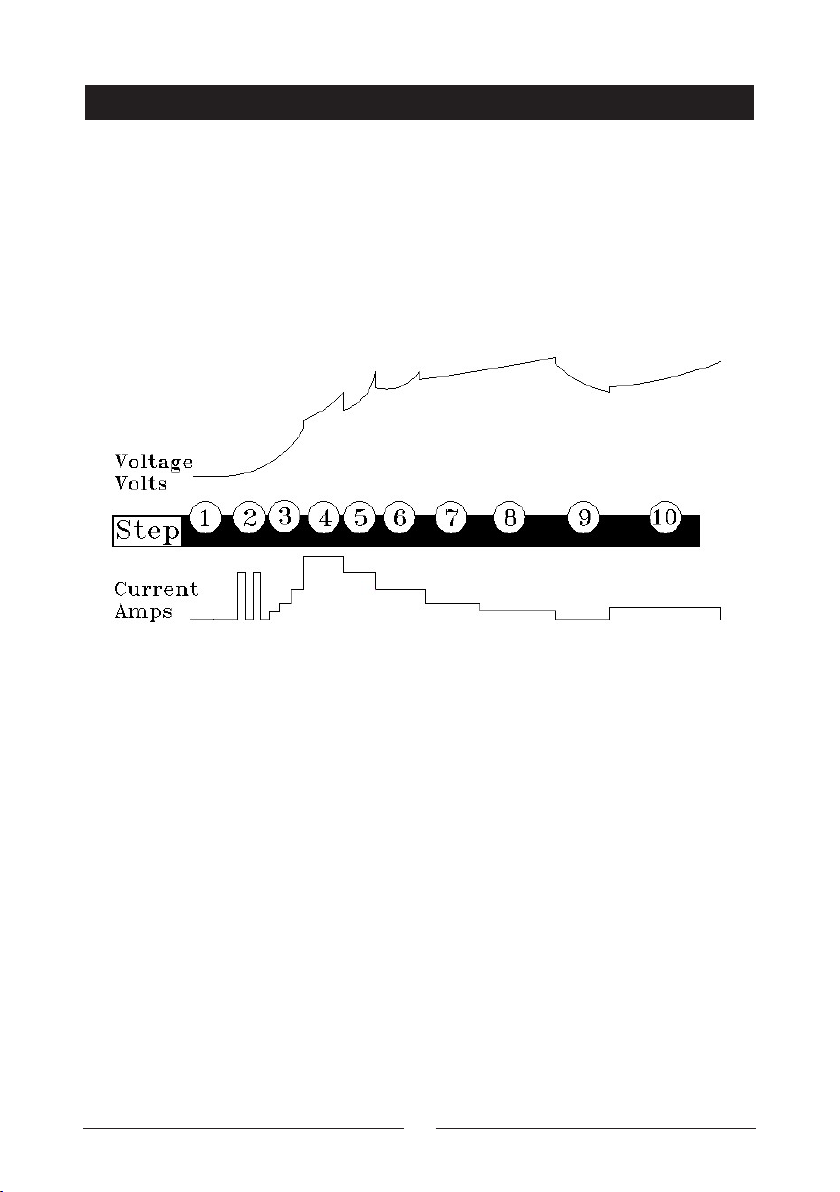
special design of the appliance (also named „ten-phase-charging strategy“)
enables the recharging of the battery to almost 100 % of its original capacity.
Connecting the battery for a long period to the battery charger is also a
good way of ensuring that your battery is kept in optimum condition. The
“ten-phase-charging strategy” as follows:
Step 1: Check
Checks the battery voltage to make sure battery connections are good and
the battery is in a stable condition before beginning the charge process.
Step 2: Recovery
Initializes the Recovery process, if needed, for deeply discharged or sulfated
(desulfation) batteries by pulsing small amounts of current.
Step 3: Soft Start
Slow charge and protect for deeply discharged or sulfated (desulfation)
batteries by multi -phase of current.
Step 4-7: Bulk
The Bulk charging process continues using both a High Rate and Medium
Rate charge and returns 80% of battery capacity, Indicated by the 20%, 40%,
60%, 80% and 100% LCD.
Step 8: Absorption
Brings the charge level to 80%, The battery charger will deliver small
amounts of current to provide a safe, ecient charge and limit battery
gassing.
Table des matières
Autres manuels PowerTech Chargeur de batteries

PowerTech
PowerTech MB-3632 Manuel utilisateur

PowerTech
PowerTech MB3906 Manuel utilisateur

PowerTech
PowerTech MB-3649 Manuel utilisateur

PowerTech
PowerTech MB3904 Manuel utilisateur

PowerTech
PowerTech MB3902 Manuel utilisateur

PowerTech
PowerTech MB3910 Manuel utilisateur

PowerTech
PowerTech ZM9037 Manuel utilisateur

PowerTech
PowerTech MB-3690 Manuel utilisateur

PowerTech
PowerTech ZM9037 Manuel utilisateur

PowerTech
PowerTech MB3912 Manuel utilisateur


