MRC Rova-M-C3 Instructions de fonctionnement

User’s Operating Manual
Recirculating Cooler
Rova-M-C3
3, Hagavish st. Israel 58817 Tel: 972 35595252, Fax: 972 3 5594529
MRC.4.21

Congratulations!
You have made an excellent choice!
First of all, MRC thanks you for the trust you have placed. This operating
manual has been designed to help you gain an understanding the principles of
operating and possibilities of our bath liquid circulation unit. For optimum utilization
of all functions, we recommend that you thoroughly study this manual prior to
beginning operation.
Safety Warnings
1) Take care your unit is operated only by qualified persons.
2) Make sure you read and understand all instructions and safety precautions
listed in this manual before installing or operating your unit. If you have any
questions of your unit or the information in this manual, contact MRC.
3) Performance of installation, operation, or maintenance procedures other
than those described in this manual may result in a hazardous situation
and may void the manufacturer's warranty.
4) Transport the unit with care. Sudden jolts or drops may cause damages in
the interior of the unit.
5) Observe all warning labels.
6) Never remove warning labels.
7) Never operate damaged or leaking equipment.
8) Never operate the unit without bath fluid in the bath.
9) Always turn off the unit and disconnect the mains cable from the power
supply before performing any service or maintenance procedures, or
before moving the unit.
10) Always empty the bath before moving the unit.
11) Never operate equipment with damaged mains power cables.
12) Refer service and repairs to a qualified technician.
Because of upgrade of productions, the contents of the operating manual may
have some differences between the newest production you buy, please consult the
on-the-spot service people when you operate the unit for the first time. In your
afterwards operation, please contact with us in time if there is any question, we will
serve you sincerely. In addition, owing to editor’s limited level, defections may not
be avoided. Those constructive suggestions are welcome.

Table of Contents
Chapter I System Introduction................................................................................- 1 -
Chapter II Installation Instruction...........................................................................- 2 -
Chapter III User’s Guide............................................................................................- 4 -
3.1 Preparations before Operation.................................................................... - 4 -
3.2 Controller Panel............................................................................................... - 5 -
3.3 Operation Guide...............................................................................................- 7 -
3.3.1 Switching on........................................................................................... - 7 -
3.3.2 Setting the Setpoint Temperature..................................................... - 7 -
3.3.3 Start/Stop Compressor........................................................................ - 9 -
3.3.4 Start/Stop Pump.................................................................................. - 10 -
3.3.5 PID Adjustment.................................................................................... - 10 -
3.3.6 Switching off.........................................................................................- 11 -
3.4 Advanced Application Mode....................................................................... - 11 -
3.5 Common Alarms............................................................................................ - 13 -
3.6 Hardware Port (Optional).............................................................................- 15 -
Chapter IV Trouble Shooting Guide....................................................................... - 16 -
Appendix I Parameter Database...........................................................................- 17 -
Appendix II Warning Information......................................................................... - 21 -

Recirculating cooler
- 1 -
Chapter I System Introduction
The recirculating cooler, also called as chiller, draws heat from bath liquid via the
cooling system for instruments or equipments that need to be cooled (Water is a
common bath liquid, synthetic bath liquid, such as glycol water is used for lower
temperature) to ensure instruments or equipments to work properly under the
regular temperature. A close medium circulation is formed between the unit and
the instrument depending on the pump’s pressure inside the unit, and the
temperature sensor detects the medium temperature to realize the control of the
cooler.
The recirculating cooler is applied vastly for a variety of laboratory test
equipments such as rotary evaporators, X-ray diffractometer, ICP emission
spectrometer, ICP-MS, graphite furnace atomic absorption spectrometer,
ED-XRF, electron microscope, medical CT, medical physiotherapy unit,
production test unit, precision grinder, computer numerical control machine,
machining center, laser equipment etc.
This cooler is an integral unit with parts such as condenser, compressor,
evaporator and pump inside the same case.

Recirculating cooler
- 2 -
Chapter II Installation Instruction
The recirculating cooler shall be equipped indoor with good environment. The
principles of choosing the location as following:
Location Principle
1
Firm ground or experiment table in a dust-free and cool
environment with good ventilation
2
Far from droplets or steam
3
Far from the location that influx, viscous flow, leak of fuel gas may
happen
4
Far from high frequency devices such as high frequency welding
machine
5
Far from the location where acidic solutions used frequently
6
Far from the location where special sprayer (sulfide contained)
used frequently
As for convenience and safety of maintenance and installation, space between
the indoor unit and obstacles should be ensured.
Ensure the measurements during indoor installation:
1)The distance between the bath top and top obstacles shall be at least 300mm;
2)The distance between two bath sides and obstacles shall be at least 500mm;
3)The distance between bath back and obstacles shall be at least 500mm;
4)The distance between bath front and obstacles shall be at least 1000mm;
The following picture shows the space requirements for installation:
(Measurement unit: mm)

Recirculating cooler
- 3 -
Unit installation:
Unpack the unit and check the packing list to ensure accessories to be complete.
Please contact with our sales services for solutions when there is a shortage.
Move the unit from the wooden packing base to spacious position and check for
damages incurred during transit. Push the unit to the installation position after
confirmation and ensure it is stable and safe, then install the external circulating
loop pipelines.
Attention
Please ensure correct collection of the external circulating water
loop (That is, the water outlet of the unit should be connected to
the water inlet pipe of the instrument needs to be cooled; the
return pipe of the instrument should be connected to the water
inlet ).
Please pay attention to joint leakage after injection of the
bath liquid. If leakage happens, please deal with it in time.

Recirculating cooler
- 4 -
Chapter III User’s Guide
3.1 Preparations before operation
1. Please clean the water tank and workspace before operation.
2. Make sure the flange bolts of the external flexible hose tightened.
3. Power connection: connect the chiller’s power outlet with the single phase
power of the workspace (please referring to duty plate of the unit). The
requirement of the power supply shall be grounded single phase three
wire, whose earth resistance shall not be bigger than 0.1Ω. Electric power
supply of single unit shall be at least 10 Ampere.
4. Bath liquid injection: bath liquid should be injected for the first time
operation. It will be better the injection volume over the water level switch
10 to 20mm. To avoid blockage and incrustation in pipelines, please use
deionized water or dedicated bath liquid. It is necessary for you to clean
the water tank and change the bath liquid in water tank regularly to
prevent germs.
5. Automatic feed inlet is used to connect with user’s bath liquid supply
system to realize automatic fluid supplement without supervision. User
can voluntarily connect the inlet with bath liquid supply system via
standard pipeline. Automatic feed inlet system starts in a low water level
state with alarm generated. If user’s instrument has already connected
with the external bath liquid supply, the automatic fluid supplement
process will automatically start. The process will automatically delay 10
seconds to stop after reach the water level.
Remark 1:Bath liquid shall be injected as soon as the orifice unit starts,
which should be slowly injected with funnel diameter no less than
300mm, and stop injection after water level alarm stops.
Remark 2:Different temperature range should apply for corresponding
bath liquid. Reference as following:
Glycol water or alcohol is applied commonly when working temperature
is under 5℃.
Deionized water is applied usually when working temperature is between
5℃and 80℃.
15% Glycerin solution is applied commonly when temperature range is

Recirculating cooler
- 5 -
between 80℃and 90℃.
Silicone oil is applied commonly when temperature range over 90℃.
Warning
Bath liquid over 35℃should not be directly cooled via
cryogenic circulator. That is, the compressor could not start
when the temperature of the bath is over 35℃.
3.2 Controller Panel
Above is the picture of the unit’s controller panel:
There are two 4-digit LED displays. The following one is main display, the Top
one is the auxiliary display. The former usually shows real-time temperature, the
latter shows target temperature or alarm code and some other related
information.
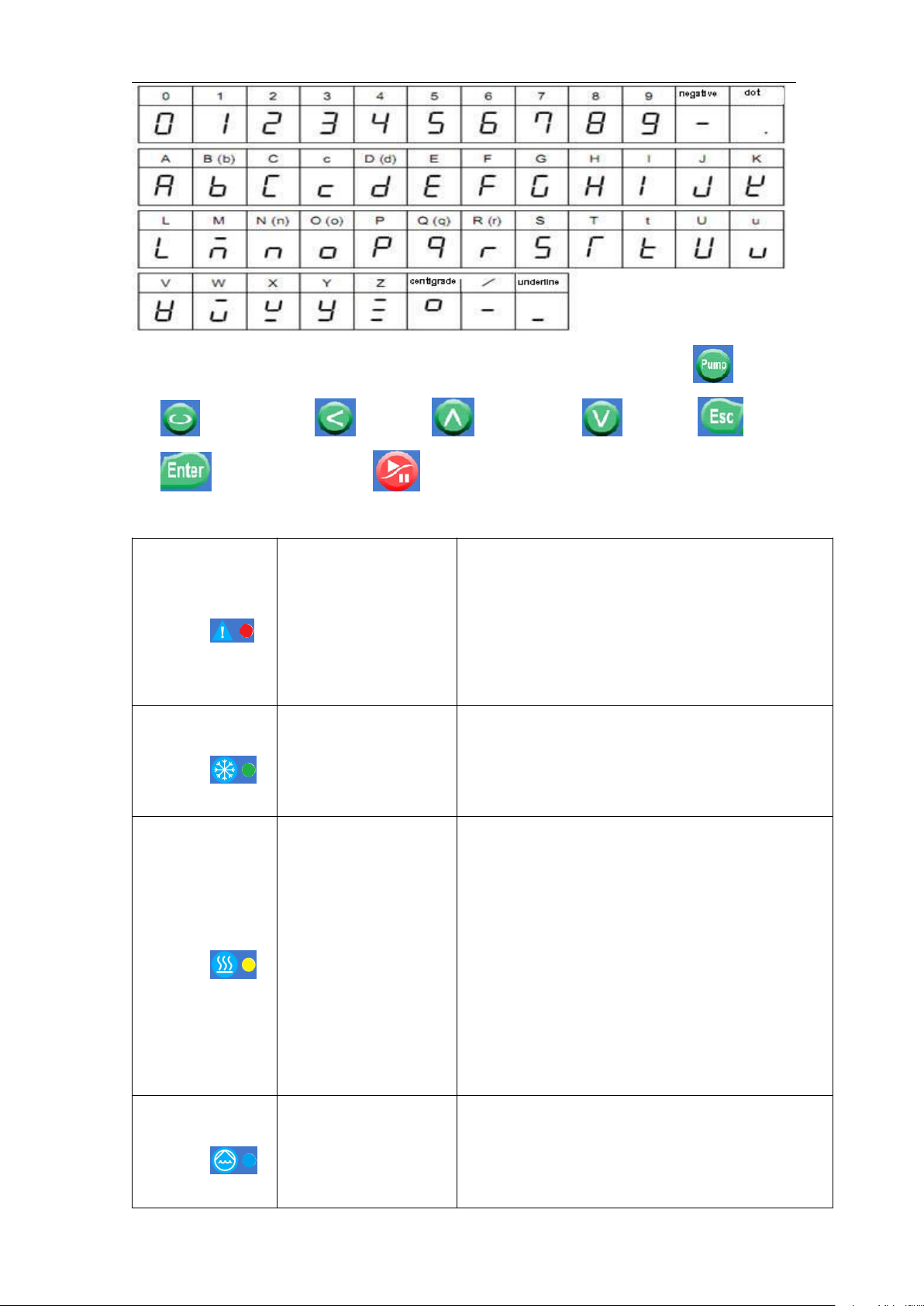
The digital display tube shows and their meanings as following:

Recirculating cooler
- 6 -
There are 8 keys on the controller panel, which are Pump key , Menu
key , Left-shift key , Add key , Reduce key , Esc key , Enter
key and Start/Stop key .
There four indicators function as following:
Warning
indicator
Red light flashes
Low water level alarm. No water flow alarm.
Protection delay alarm. High temperature
and low temperature alarm
Cooling
indicator
Green light
Cooling system working indicator
Heating
indicator
Yellow light
Heating system working indicator (heating
function is usually customized by user).
Standard unit is not available of the
function. This indicator only lights on when
heating function is available.
Pump
indicator
Blue light
Water circulation system working indicator

Recirculating cooler
- 7 -
3.3 Operation guide
3.3.1 Switching on
1. Turn on the leakage protector.
2. Turn on the power switch. Then the unit begins to initializing interface.
When initializing finished, the unit enters standby mode with a buzzer
beep;
3. Press Start/Stop key. Check the fluctuation of the outlet pressure gauge
and the vibration of the pump.
Attention
In case of abnormal noise when pump works, please stop
immediately and check; if pump can not start with power
on, please cut the power at once and check to remove the
faults.
3.3.2 Setting temperature
There are two temperature setting modes: menu set and direct set. Users
can set the temperature by operating the Add key and Reduce key
Table des matières
Autres manuels MRC Accessoires