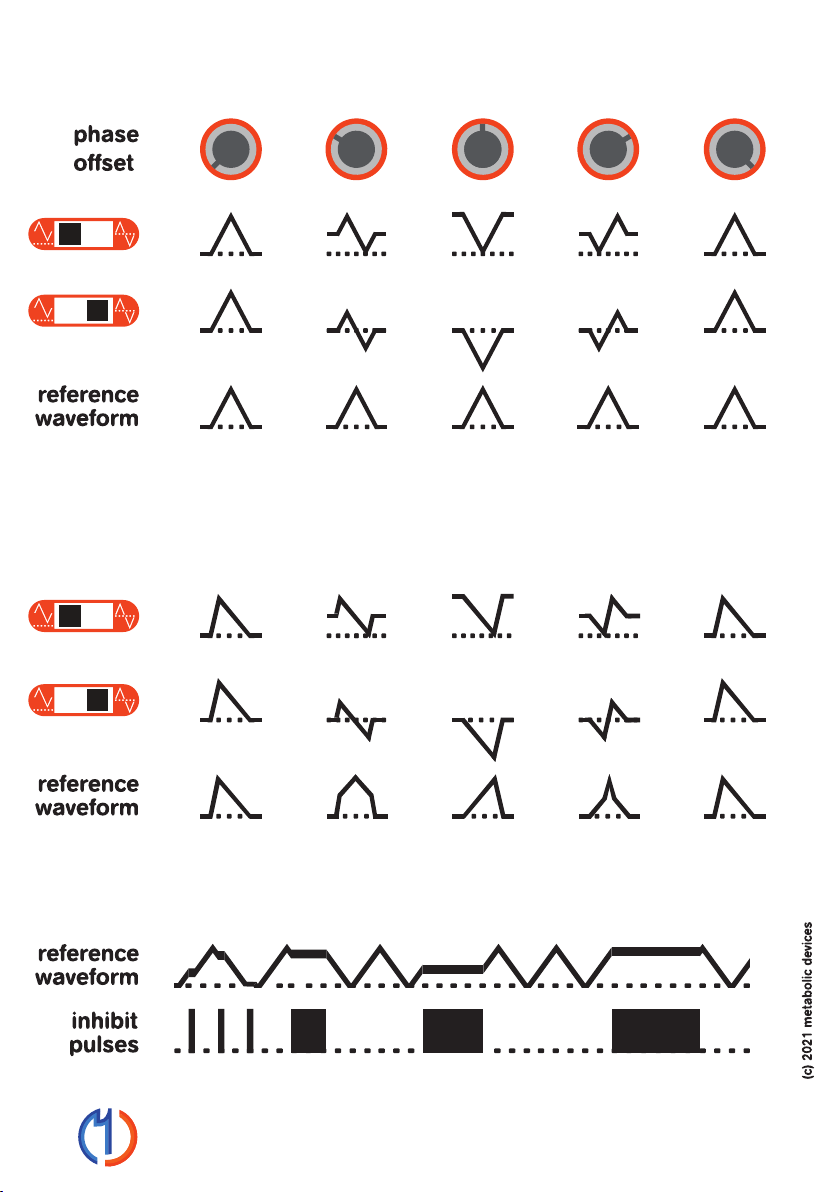
The
Reverse / Alternate Attack & Decay
button provides a handy
way to audition how an LFO would sound with the attack and decay
times swapped. When the led is on, the Attack controls are now assigned
to Decay, and the Decay controls are now assigned to Attack. When
alternating, Moonwalker will generate the envelope with Attack & Decay
times as normal, and then swap them on the next cycle. They are
returned to normal on the next cycle, and the pattern continues to alter-
nate between normal and swapped as long as this mode is enabled. As
a free running LFO, alternating mode effectively makes Attack & Decay
frequency controls for two consecutive waveforms. A short button press
enables reverse, and a long press enables the alternating mode. Button
presses take effect on the next trigger so as not to interrupt playback.
The
Not Decay Output
is the pulse wave output of Moonwalker so it
provides a hard edge switching LFO signal rather than the sloped LFO
available at the Reference and Phase Offset outputs. It goes to +5v when
Moonwalker is in the attack segment of the Reference Output and to 0v
during decay.
The
Manual Trigger
button can be used to activate
Inhibit
when a trig-
ger source is not available.
In the top part of the Attack / Decay range, the
Inhibit
rate is relatively
fast and moves towards 0v where it will hold until the inhibit pulse goes
low. In the middle of the range it will move very slowly in either direction
and will look like plateaus in the waveform. In the lower part of the range
it will move towards 10v and the effect is lessened because we are
already at the end of the range.
Activating
Inhibit
is a great way to add complexity and interest to a
repeating LFO. To get stepped waveforms, drive inhibit with the pulse out
from another LFO and set it’s width to very wide. Set the Moonwalker
frequency fairly fast, but set the other LFO 3 or 4 times faster. Sync the
other LFO using the Not Decay out from Moonwalker to get a consistent
number of steps for every cycle and start them at the same time. If you
modulate the frequency of both LFO’s using their v/oct inputs, the
number of pulses per cycle stays consistent.