
Mentalab Explore+ Manuel utilisateur
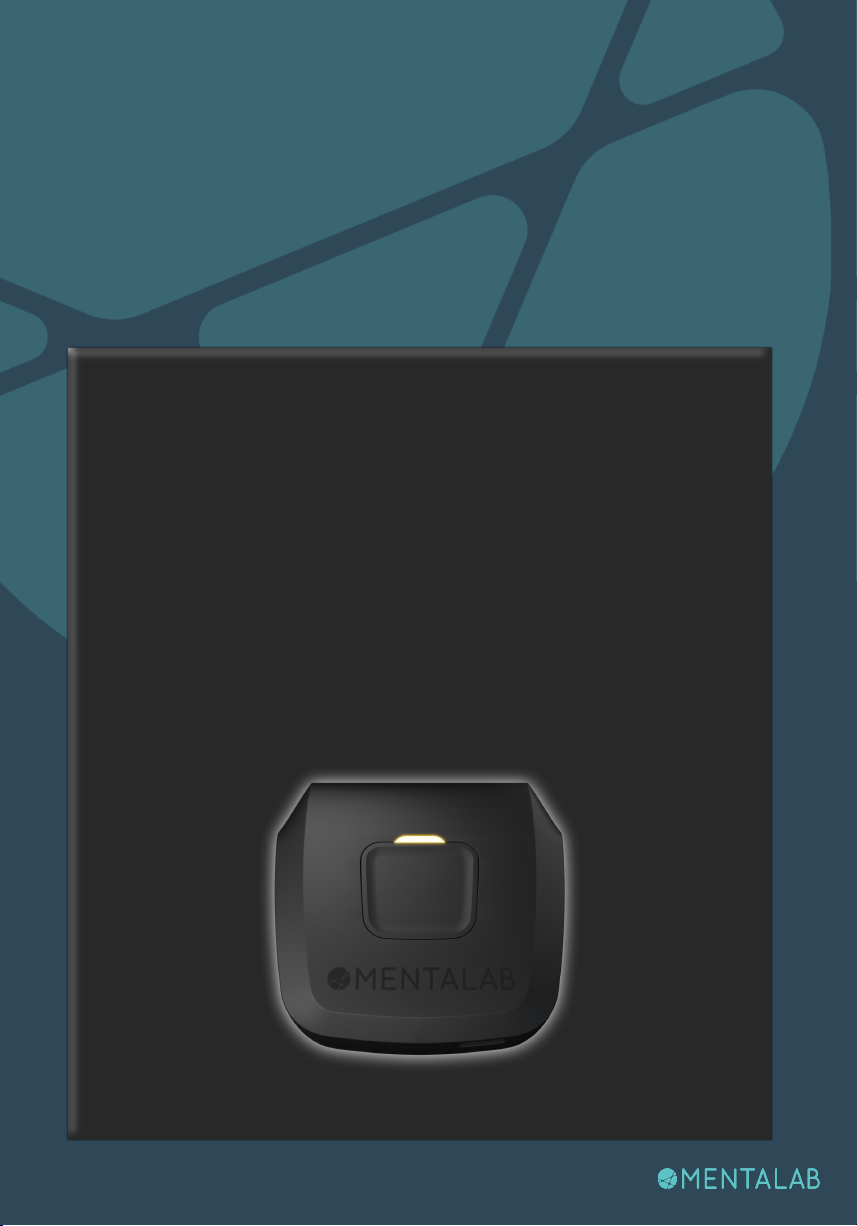
Mentalab
Explore+
Quick Start Guide

2
23
It’s Explore Plus
32 channels
1kHz streaming
2kHz ofine recording
μS precision
Triggers via USB-C
Remote updates
Internal memory
Thank you for purchasing
Mentalab Explore+
Building upon years of experience designing
ExG systems, Mentalab Explore+ represents the
height of mobile EEG design.
Providing exceptional data quality, fast set-up
times, remote updates, internal memory, open-
source APIs, and much more, Explore+ was
designed from the ground up to meet the needs of
researchers.

Getting started
This guide contains basic information to help you
start streaming and recording data with your
Mentalab Explore+ amplier.
For more extensive information regarding safety and
usage, please refer to the user manual. Further
guidelines and instructional videos can be found at
wiki.mentalab.com.
Typical package contents
• Mentalab Explore+ amplier
• Electrodes of your choice
• Cap of your choice
• Shockproof case
• USB-C cable
• Elastic cap
• Electrode gel
• Bluetooth dongle
• Cleaning set
Bluetooth ID
To locate your amplier’s MAC address – its Bluetooth ID – look
at the label on the back of the amplier. The last four digits on
the label are the amplier’s Bluetooth ID.
Bluetooth ID cont.
For example, the label below corresponds to an amplier whose
Bluetooth ID (MAC address) is Explore_1438:
Getting started
Explore+ 8 Explore+ 16 Explore+ 32
No. channels 8 16 32
SPS (Hz)
Ofine Up to 2k Up to 1k
Online Up to 1k 250
Weight (g) 27 36
Battery life (hrs) 4 – 10
Diff. input range (mVPP) 800 (±400 mV)
Input impedance (GΩ) 1
Resolution (bits) 24
RMS noise (μV) <1
Interface USB-C
Flash memory (MB) 512 4000
Bluetooth range (m) ~10
5
4
095e80/1438
F C C I D : T 7 V P A N 1 0

7
6
Getting started
Start-up and data collection
1. Charge your amplier via USB. A green LED indicates
sufcient battery. Disconnect from the power source prior to
use.
2. Position the electrodes in the cap, attach cables to dry
electrodes, and connect the cable set to the amplier. Each
channel records against a unipolar reference electrode. Use
Velcro to secure your amplier to an EEG cap.
3. Push the power button to start the amplier. It will now
record data to internal memory.
4. Two blue blinks per second indicate that the amplier is
advertising via Bluetooth, MAC address Explore_XXXX.
5. Once a Bluetooth connection to the host machine has been
established (see Section: API), your Explore+ amplier will
start transferring data via Bluetooth. Use Explore's open-
source APIs to access impedance values, visualize the signal
stream, change device settings, and more.
6. Press the amplier’s button once to set an event marker. A
pink LED signal indicates that a marker has been set.
7. Turn off the amplier after use. To do this, hold down the
amplier’s button for three seconds until the LED blinks red
three times. Always shut down your Explore+ amplier
before connecting it to a host machine via USB.
Instructions
The following table describes Explore+'s LED light codes.
LED color Blinking pattern Indicates
Red
Yellow
Green
Solid at start-up
Start-up in progress. Color
indicates battery level.
(green: > 60%, yellow: > 30%)
Blue Solid at start-up Start-up in progress.
Blue Blinking 2x / sec Bluetooth visible and advertising.
Blue Blinking 1x / sec
Bluetooth visible and connected to
host machine. Online mode in
progress.
Green Blinking 1x / 3 sec Bluetooth is inactive. Ofine mode
in progress.
Pink Blinking 1x / sec
Not enough space in memory.
Press the button three times to free
up space.
Light pink One-time ash
Button pressed. Marker with
timestamp corresponding to button
event stored and transmitted
Red Flash 3x Amplier shut down.

9
8
Connection
To pair your Explore+ amplier with a mobile or computer, use
your host machine’s standard Bluetooth menu. Explore+ transfers
data online as soon as a Bluetooth connection is established.
If the connection is lost, Explore+ will revert to advertising mode,
ready to reconnect. Explore+ will remain in this mode for four
minutes before moving to ofine mode.
Data
Explore+ samples ExG data at 250 Hz (default) with a 24-bit
resolution. The amplier also records and transmits temperature,
battery voltage, accelerometer, gyroscope, and magnetometer
data. This means you can derive the absolute orientation and
status of your amplier at all times.
Explore+ stores data in binary les (.BIN sufx). To retrieve your
data, connect your amplier to a computer via USB. To delete
les, format the memory using our open-source APIs. Please
refer to the user manual or website for more details.
Software
Capture and visualize data using Explore's APIs written in
Python, Java, and MATLAB. Everything is open-source.
explorepy, written in Python, is our most mature API. It provides
an extensive set of tools that allow you to build customized
biosignal applications.
Software cont.
For detailed instructions on how to install and use explorepy, see:
https://explorepy.readthedocs.io.
Explore Desktop provides a user-friendly graphical interface for
explorepy. It allows you to measure impedances, visualize data,
push to LSL, and set event markers.
Event triggers
Explore+ supports three kinds of event triggers.
1. Amplier button press.
2. TTL pulse: Requires a USB TTL pulse generator (Mentalab
trigger stick), a trigger isolator, and a USB to USB-C cable.
Generates minimal latency event markers.
3. Software markers: Use Mentalab APIs or external software
like LSL and OpenViBE to generate programmatic markers.
Instructions Instructions

11
10
Mentalab is a biomedical technology company from
Munich, Germany. Mentalab Explore+ is a high-end,
mobile measurement device for biosignal
applications.
Mentalab Explore+ is used by researchers and
scientists around the world in applications ranging
from brain-computer interfaces to sleep and
neuropsychology research.
Mentalab Explore+ is not designed for medical use.
It should not be used for diagnosis or treatment in a
medical context.
Our team is always happy to support you in
developing your own innovative solutions.
Contact
https://mentalab.com
https://github.com/Mentalab-hub
https://explorepy.readthedocs.io
Mentalab GmbH, Weinstr,. 4, 80333 Munich
Mentalab US LLC, 2670 Worden St #19, San Diego, CA 92110

Ce manuel convient aux modèles suivants
3
Table des matières


