
Melbourne MTC-49407 Manuel utilisateur

1
LOW ANGLE BLOCK PLANE
Owner’s Manual
V3/22
Record the invoice number and date of purchase in your manual for
future reference.
Invoice Number: ................................................................
Date of Purchase: .............................................................

2
Sole length 165mm
Solo Width 43mm
Weight 750g
Blade Bed Angle 12°
Blade Steel M2 HSS
Blade Width 35mm
Blade Thickness 3.4mm
Included Blade 25° Bevel Angle
Block Plane
Specifications: MTC-49407
Product
Code
Bevel
Angle
Effective
Cutting Angle
MTC-49506 25° 37°
MTC-49513 38° 50°
MTC-49520 50° 62°
Additional Blades

3
CONTENTS
Introduction 4
Melbourne Tool Company 4
Section 1: Safety 6
General Safety Rules 6
Section 2: Component Diagram 7
Section 3: Operation 8
First Use 8
Sharpening Blade 8
Setting the Blade 9
Mouth Adjustment 10
Bevel Angles & Grain Direction 11
User Guide 11
Section 4: Maintenance 13
Section 5: Troubleshooting 14
Ensure the blade is sharp 14
Tear-out 14
The plane leaves tracks on a board’s surface. 14
The plane is hard to push 14
Section 6: Warranty 15
Melbourne Tool Company Warranty Statement 15
Disclaimer 16
Manual Accuracy 16
Technical Support 16

4
INTRODUCTION
Melbourne Tool Company
The most human thing you can do is make things.
And there is no more natural way to-do this than work with wood.
Yet wood working is not without its challenges, it takes focus and
discipline to learn the craft. Good makers stick at it and work hard
because nothing else really matters.
Woodworking also requires great tools.
Tools that are genuine, accurate and accessible. Knowing this led to the
creation of the Melbourne Tool Company. Designed and developed in
Melbourne Australia, for all you passionate woodworkers out there.
Low-Angle Block Plane
Your MTC Low Angle Block Plane is the essential tool in your woodworking
kit. The three blade types available makes everything from trimming tricky
end grain through to chamfering and smoothing figured timbers a breeze.
Comfortable to hold with one hand or two, you will be reaching for your
MTC block plane just about every time you’re at the bench.
Welcome to the MTC family.

5

6
SECTION 1:
SAFETY
General Safety Rules
For your own safety, please read and understand
this instruction manual before installing and
operating the tool.
Owner’s Manual:
Read and understand this owner’s manual before using the tool
Handle With Care:
Hand tools include sharp blades that will cause serious injury if handled
improperly. Dropping the tool will likely cause damage to the tool and
anything it lands on, including but not limited to your toes.
Keep the Tool Sharp:
A blunt tool will require excessive force to be used, which greatly
increases the chance of injury.
Awkward Positions:
Keep proper footing and balance at all times when using the tool.
Arrange the workpiece so that you can bring the tool to the work in a
comfortable manner.
Experiencing Difficulties?
If at any time you experience difficulties in performing the intended
operation, stop using the tool and consult this owner’s manual. For further
retailer from which you purchased the tool.

7
Diagram
SECTION 2:
COMPONENT DIAGRAM
1. Toe
2. Front Knob
3. Mouth Adjustment Lever
4. Mouth Adjustable
5. Blade
6. Blade Bed
7. Sole
8. Lever Cap
9. Lever Cap Screw
10. Lever Cap Wheel
11. Depth & Lateral Adjustment
Wheel
12. Adjuster Pin
1.
2.
5.
8.
10.
11.
12.
3.
4.
6.
7.
9.

8
First Use
Your plane ships with a coating of rust-inhibiting oil to ensure it arrives to
you in good condition, but this must be removed prior to use.
Disassemble the plane by loosening the lever cap wheel and removing
the lever cap, blade, and adjuster assembly, taking care with the sharp
edge of the blade.
Unscrew the Front Handle completely, and remove the Toe and Mouth
Adjuster.
Using a clean rag, wipe all components to remove all but the lightest
coating of oil.
Reassemble the plane, noting the correct orientation of the blade (bevel
facing up) and taking care not to damage the edge.
Do not over-tighten the lever cap wheel – it only needs a quarter-turn or
so once the slack is taken out.
SECTION 3:
OPERATION
Sharpening the Blade
The blade is ground to the correct angle but will require sharpening
before use.
Periodically check the condition of the blade and resharpen as required
– A sharp blade is the single biggest factor in enjoying the use of your
plane, and the quality of the surface it produces.
When replacing the blade, check the bed is free from wood shavings and
any build-up of wax or oil.
9
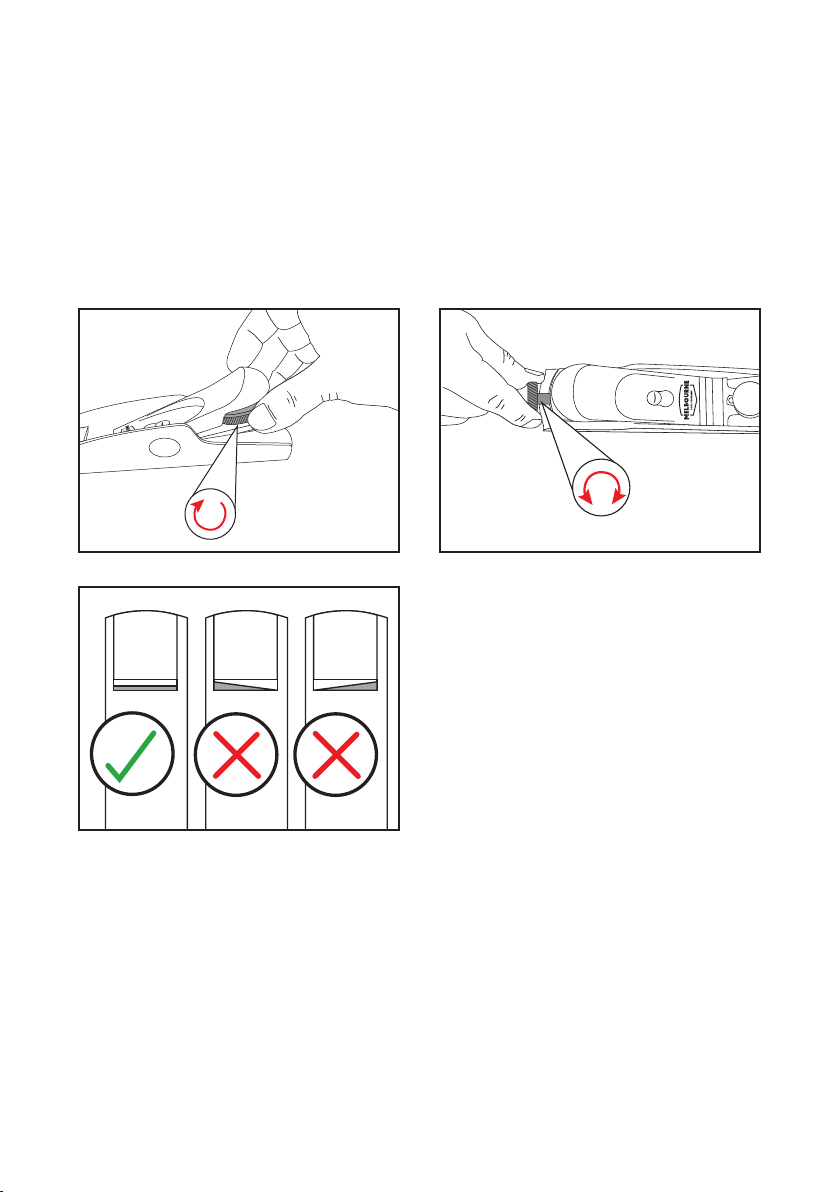
The Depth & Lateral Adjustment Wheel controls both the projection of the
blade below the sole and the lateral angle of the blade.
Turning the wheel clockwise advances the blade, while turning it
anticlockwise retracts it. Pushing the wheel to the left skews the blade to
the right, and vice versa.
Setting the blade
1. Loosen the lever cap wheel just enough so that adjustments can be
made without excessive force.
2. Open the mouth of the plane to avoid advancing the blade into the
mouth.
3. Place the plane on a flat timber surface and advance the blade until it
just touches the surface.
4. Holding the plane upside-down, check the blade is parallel to the
mouth opening.
5. Tighten the lever cap wheel (do not over-tighten) and take a test cut.
Repeat the procedure to advance the blade as necessary.
Depth & Lateral Adjustment
Blade Mouth Adjustment
Tighten or Loosen

10
Mouth Adjustment
The Toe pushes down on the wood fibers in front of the blade, preventing
the wood from splitting and tearing out ahead of the cut.
To maximise the effect of the Toe, set it so that the mouth opening is as
small as possible while still allowing a shaving to escape. The deeper the
cut you are taking, the thicker the shaving will be, and so the wider the
mouth will need to be.
To adjust the mouth opening, loosen the front handle and swing the Mouth
Adjustment Lever right or left to move the Toe forward or backward. Take
care not to move the Toe into the blade. Tighten the front handle to lock
the position of the Toe.
Mouth Adjustment
Adjusting the front handle. Swinging the mouth lever.
Table des matières


