
LONCIN 25ZB21-1.2Q Manuel utilisateur


2
Thank you for purchasing a water pump.
This manual covers the operation and maintenance of water pump: 25ZB21-1.2Q。
The information and specifications included in this publication were in effect at the time of
approval for printing.
General-purpose Engine Co., Ltd. Reserves the right to make changes at any time
without notice and without incurring any obligation.
No part of this publication may be reproduced without written permission.
This manual should be considered a permanent part of the pump and should remain with
the pump if it is resold.
The illustrations in this manual are based in: 80ZB20-3.1Q
The illustration may vary according to the type.
Keep this owner’s manual handy, so you can refer to it at any time. This owner’s manual is
considered a permanent part of the water pump and should remain with the water pump if
resold.
If a problem should arise, or if you have any questions about the pump, consult an
authorized dealer.
Nomenclature
Based in: 25ZB21-1.2Q
25 ZB 21 – 1.2 Q
Gasoline Engine
Rated Power 3.1kW
Rated Discharge Head
Centrifugal Pump
Water Inlet/Outlet Diameter

3
CONTENTS
1.INFORMATION ……………………………………………………………………………2
2. COMPONENT …………………………………………………………………………… 6
3. CONTROLS ……………………………………………………………………………7
4. CHECK BEFORE OPERATION …………………………………………………………9
5. OPERATION ……………………………………………………………………………10
6. MAINTENANCE ……………………………………………………………………………14
7. STORAGE/ TRANSPORTING …………………………………………………………23
8.
..
.TROUBLESHOOTING …………………………………………………………………26
9. TECHNICAL & CONSUMER INFORMATION ………………………………………27
10. SPECIFICATIONS ………………………………………………………………………29
11. ENGINE TYPE WITH OIL ALERT AND WITHOUT ELECTRIC STARTING
………………………………………………………………………………………30
12.OPERATION ……………………………………………………………………………31

4
1.INFORMATION
Thank you for purchasing a water pump.
The information and specifications included in this publication
were in effect at the time of approval for printing.
No part of this publication may be reproduced without written
permission.
This manual should be considered a permanent part of the pump
and should remain with the pump if it is resold.
The illustrations in this manual are based in: 25ZB21-1.2Q
The illustration may vary according to the type.
Keep this owner's manual handy, so you can refer to it at any time.
This owner's manual is considered a permanent part of the water
pump and should remain with the water pump if resold.
If a problem should arise, or if you have any questions about the
pump, consult you authorized dealer.

5
Your safety and the safety of others are very important. And using this
water pump safely is an important responsibility.
To help you make informed decisions about safety, we have provided
operating procedures and other information on labels and in this
manual. This information alerts you to potential hazards that could hurt
you or others.
Of course, it is not practical or possible to warn you about all the
hazards associated with operating or maintaining a water pump. You
must use your own good judgment.
You will find important safety information in a variety of forms,
including:
Safety Labels on the pump.
Safety Messages preceded by a safety alert symbol and one of three
signal words, DANGER, WARNING, or CAUTION. These signal words
mean:
You WILL be KILLED or SERIOUSLY HURT if you don't follow
instructions.
You CAN be KILLED or SERIOUSLY HURT if you don't follow
instructions.
You CAN be HURT if you don't follow instructions.
Your pump or other property could be damaged if you don't follow
instructions.
Safety Headings such as IMPORTANT SAFETY INFORMATION.
Safety Section such as PUMP SAFETY.
Instructions how to use this pump correctly and safely.
This entire book is filled with important safety information, please read
it carefully.

6
IMPORTANT SAFETY INFORMATION
This water pump is designed to pump only water that is not intended for
human consumption, and other uses can result in injury to the operator
or damage to the pump and other property.
Always make a pre-operation inspection before you start the engine.
You may prevent an accident or equipment damage.
Most accidents can be prevented if you follow all instructions in this
manual and on the pump. The most common hazards are discussed
below, along with the best way to protect yourself and others.
Operator Responsibility
It is the operator's responsibility to provide the necessary safeguards to
protect people and property. Know how to stop the pump quickly in
case of emergency.
If you leave the pump for any reason, always turn the engine off.
Understand the use of all controls and connections.
Be sure that anyone who operates the pump receives proper instruction.
Do not let children operate the pump. Keep children and pets away from
the area of operation.
Pump Operation
Pump only water that is not intended for human consumption. Pumping
flammable liquids, such as gasoline or fuel oils, can result in a fire or
explosion, causing serious injury. Pumping sea water, beverages, acids,
chemical solutions, or any other liquid that promotes corrosion can
damage the pump.
Refuel With Care
Gasoline is extremely flammable, and gasoline vapor can explode.
Refuel outdoors, in a well-ventilated area, with the engine stopped and
the pump on a level surface. Do not fill the fuel tank above the fuel
strainer shoulder. Never smoke near gasoline, and keep other flames
and sparks away. Always stored gasoline in an approved container.

7
Make sure that any spilled fuel has been wiped up before starting the
engine. After refueling, make sure the tank cap closed properly and
securely.
Hot Exhaust
The muffler becomes very hot during operation and remains hot for a
while after stopping the engine. Be careful not to touch the muffler while
it is hot. Let the engine cool before transporting the pump or storing it
indoors.
To prevent fire hazards, keep the pump at least 3 feet (1 meter) away
from building walls and other equipment during operation. Do not place
flammable objects close to the engine.
Carbon Monoxide Hazard Exhaust gas contains poisonous carbon
monoxide. Avoid inhalation of exhaust gas. Never run the engine in a
closed garage or confined area.
8
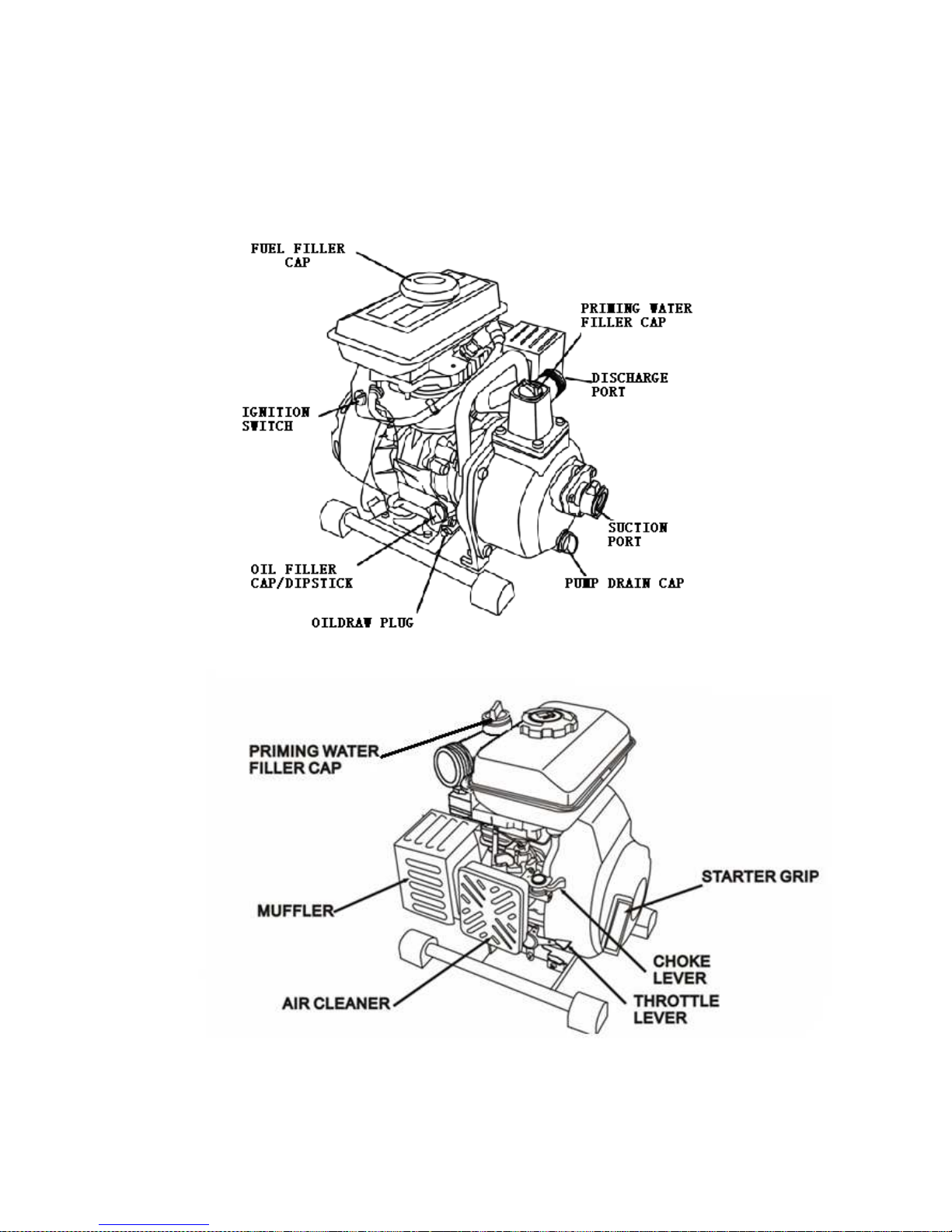
2. COMPONENT
`
9
3. CONTROLS
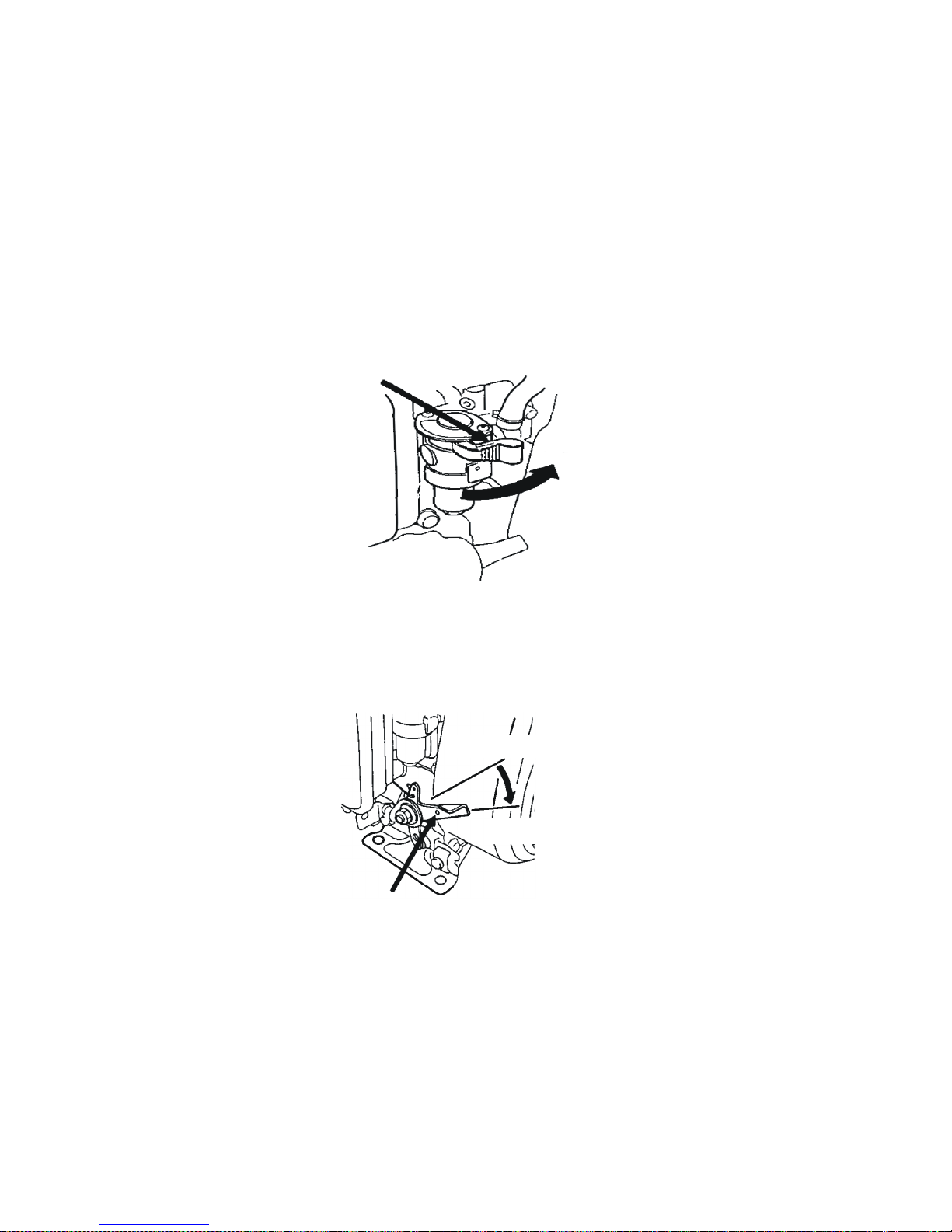
Fuel Valve Lever
The fuel valve opens and closes the passage between the fuel tank and the carburetor.
The fuel valve lever must be in the ON position for the engine to run.
When the engine is not in use, leave the fuel valve lever in the OFF position to prevent
carburetor flooding and to reduce the possibility of fuel leakage.
Throttle Lever
The throttle lever controls engine speed.
Moving the throttle lever in the directions shown makes the engine run faster or slower.
Engine Switch
The engine switch enables and disables the ignition system.
The engine switch must be in the ON position for the engine to run.
Turning the engine switch to the OFF position stops the engine.
FUEL VALVE
O N
T H R O T T L E L E V E R
H I G H SPEE D
L O W SPE E D

10
Choke Lever
The choke lever opens and closes the choke valve in the carburetor.
The CLOSE position enriches the fuel mixture for starting a cold engine.
The OPEN position provides the correct fuel mixture for operation after starting, and for
restarting a warm engine.
Some engine applications use a remotely-mounted choke control rather than the
engine-mounted choke lever shown here.
Recoil Starter Grip
Pulling the starter grip operates the recoil starter to crank the engine.
ENGINE SWITCH
OFF
O N
OFF
O N
CHOKE LEVER
Ce manuel convient aux modèles suivants
1
Table des matières
Autres manuels LONCIN Pompe à eau

Manuels Pompe à eau populaires d'autres marques


Sykes AmeriPumps
Sykes AmeriPumps GP100M Guide de dépannage

DUROMAX
DUROMAX XP WX Series Manuel utilisateur

BRINKMANN PUMPS
BRINKMANN PUMPS SBF550 Manuel utilisateur

Franklin Electric
Franklin Electric IPS Manuel utilisateur

Xylem
Xylem e-1532 Series Manuel utilisateur

Milton Roy
Milton Roy PRIMEROYAL Manuel utilisateur