Level421 TT-30x0-s Mode d'emploi

TT-30x0-s
Installation &
Comissioning
Manual
for DVB-RCS network standard on
Eutelsat, Panamsat, Hellassat, Europstar
and Newskies satellites
This document is intended for providing instructions on installing, operating, and field servicing
of the TT-30X0 ™ terminal system.
Revision: V5.1, Issued: Sunday, July 17, 2005

TT-3xx0 – installation and commissioning
guide
Proprietary and confidential!
For Level421 installers use only !
2
Installing and commissioning a Level421 TT-30x0-s terminal
Step 1: Check if basic Equipment if complete
A typical TT-3020-s ™ remote terminal system consists of the following
components:
Component Part No. Qty1
1. Antenna:
Location dependant must be
approved by Level421, including
antenna Feedhorn
Location
dependant
0,9/ 1,2 or 1,8
meter size
1
2. Mount:
Antenna mount, to connect
antenna to
Antenna specific 1
3. RCST/ Satellite Modem
Viasat terminal
Linkstar 1
4. BUC/ Radio/ Block Up Converter
All satellites
BUC 2 Watt or 3 Watt
NJT5024F (2W) or
NJT5076F (2W) or
NJT5016F (2W) or
NJT5037 (3W) or
1
5. LNB:
For Lo Band Satellites
DRO, 12.25 - 12.75 GHZ
L.O. 11.3 Ghz
For High Band Satellites
DRO 10.95 – 11.7 Ghz
L.O. 10 Ghz
NJR C21545A
NJR 2184
F/H/HW/HA Type
or
Norsat 4708 C
NJR 2154
A/H/HW/HA Type
1
6. OMT/ Block Down Converter
Waveguide which connects LNB,
BUC and Feedhorn to the
outdoor RF unit
Antenna specific
1
7. Transceiver (alternatively)
Instead of BUC/LNB/OMT, for Hi
and Lo Band Satellites
KR 1226 (2 W)
KR 1426 (4W) 12
8. IFL Cables:
RG6 75 Ohm low loss, 100dB
shielded with water proved F
Connector CAP system
100 meter roll
with cap kit box 1
1Quantity is per line item.
2optional instead of BUC/LNB & OMT /all in one device
3Optional requirements, must be manufactured locally or organized seperately
Additional components are supplied if you have bough a bundle, including our
Performance Enhancement Gateway and additional Voice over IP components.

TT-3xx0 – installation and commissioning
guide
Proprietary and confidential!
For Level421 installers use only !
3
Step 2: Check RF Head parts
LNB
The LNB provides the low noise amplification and down conversion from
Ku-band to L-Band. The down converted signals are then routed to the
RCST via coaxial cable. Based on the satellite downlink frequency bands,
the LNB is available to receive the frequencies in Megahertz.
It is required that your measurement equipment you use for calibrating
the antenna is capable of resolving the L- Band frequency, as this is the
frequency you will see on your spectrum analyzer when installing the
antenna.
There are many different LNBs available with 12,75, 10 Ghz, 11,3 Ghz
and 5,15 Ghz Oscillator frequency. So have a look on your LNB to
verify that you have the correct model in your delivery.
10 Ghz For 10.95 – 11.7 Ghz
11.3 Ghz For 12.25 – 12.75 Ghz
5.15 Ghz For 3.4 – 4.2 Ghz
NJR LNB Type:

TT-3xx0 – installation and commissioning
guide
Proprietary and confidential!
For Level421 installers use only !
4
Norsat LNB Type:
The frequency is depending on the satellite or the transponder you need
to adjust your antenna on. Please find in the appendix a table with an
overview on all satellite frequencies which are used by our services.
L-band Freq = Fcrt - LNB Local Oscillator frequency (in MHz)
Where: Fcrt = RF downlink frequency of known carrier, in MHz
LNB Local Oscillator Frequency varies for different bands
Please check that you do not have an outdated manual, as this may lead
you to adjust the antenna to a wrong carrier frequency. Depending on
grade of service and Hub operator, these values may change without
prior notice. It is a good idea to check these values again with us by mail
prior you start your installation.
BUC
The BUC (Block up converter) accepts transmit signals from the RCST and
provides up conversion to the satellite uplink frequency and transmits
them to the satellite.
For the TT-3XX0 ™ ODU, the BUC includes a Solid State Power Amplifier
available as Ku-Band transceivers for 2-, or 3- Watt. The RCST provides a
24VDC source to power these units. For the 4-Watt Ku-band NJRC
manufactured BUC, the RCST is equipped with an external power supply
adapter to satisfy the additional power requirement. Level421 has
decided only to supply the 2 Watt and 3 Watt version for several reasons.

TT-3xx0 – installation and commissioning
guide
Proprietary and confidential!
For Level421 installers use only !
5
A 4 Watt version is available as compact transceiver which from its
concept is superior than a separate BUC.
The 4 Watt transceivers do satisfy their power requirements due to a
higher efficiency by the RCST as well. Separate NJRC BUC do require
complex additional and fault intensive power supplies.
The NJRC transmitter is not the most modern one. Nevertheless it is
reliable also under extreme climatic conditions and our STANDARD
product. The output power is 2 Watt in this version. It is certified in most
European countries. Please keep in mind, that transmitters higher than 2
Watt are not certified in most EU countries and therefore might not be
available in your region in which you want to operate your system.
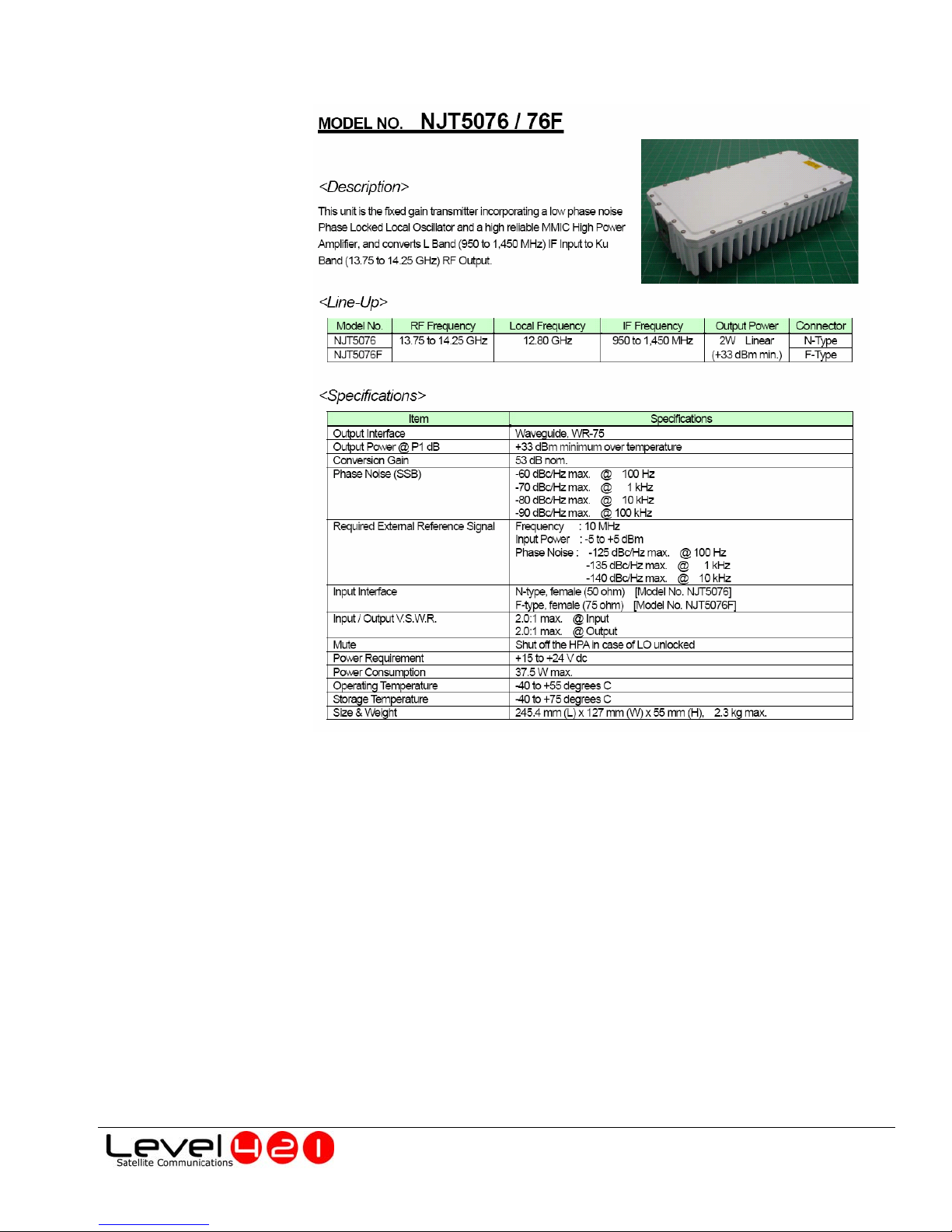
The 2 Watt STANDARD version has the following specifications:
For W6 satellite, Indian Sea Footprint a transmitter with extended
frequency range of 13.75 to 14.25 Ghz is required. This transmitter is
shipped with all systems for this satellite footprint. It also has 2 Watt
transmit power.
Please see the specifications on the next page.

TT-3xx0 – installation and commissioning
guide
Proprietary and confidential!
For Level421 installers use only !
6
We also do supply a 3 Watt BUC from NJRC. This is the NJT5037 model,
which is smaller and has a slightly higher transmit power output.
This is especially available for regions in which there is high humidity in
the air, like in some regions in Africa or in areas, where footprints
smoothly fade out on the upstream side.
Please see the specifications on the next page.

TT-3xx0 – installation and commissioning
guide
Proprietary and confidential!
For Level421 installers use only !
7
Transceiver
A Transceiver integrates Receive LNB, OMT and BUC in
one box and is therefore quite compact. It is the
modern version of the separated versions of BUC/ OMT
& LNB above. Level421 has started shipment of this
new product, so it might be that you already receive a
transceiver with your equipment shipment. A 2 Watt
and a 4 Watt Version is available. As some satellites are not yet approved
with the new transceivers, you also might have received not a transceiver
with your shipment.
In comparison to the NJRC BUC, the Skyware transceiver for safety
switches off the ODU if not on signal. So as default the ODU LED will stay
OFF. In order to activate the transceiver, please enter the save boot
parms and bring the unit pointed correclty to the satellite. Afterwards the
ODU LED should show up in green.
Please refer to the next pages for technical specifications:

TT-3xx0 – installation and commissioning
guide
Proprietary and confidential!
For Level421 installers use only !
8
2 Watt Transceiver – LNB / OMT part specifications:

TT-3xx0 – installation and commissioning
guide
Proprietary and confidential!
For Level421 installers use only !
9
2 Watt Transceiver – BUC Part specifications:

TT-3xx0 – installation and commissioning
guide
Proprietary and confidential!
For Level421 installers use only !
10
4 Watt Transceiver - LNB / OMT Specifications:
Ce manuel convient aux modèles suivants
1
Table des matières