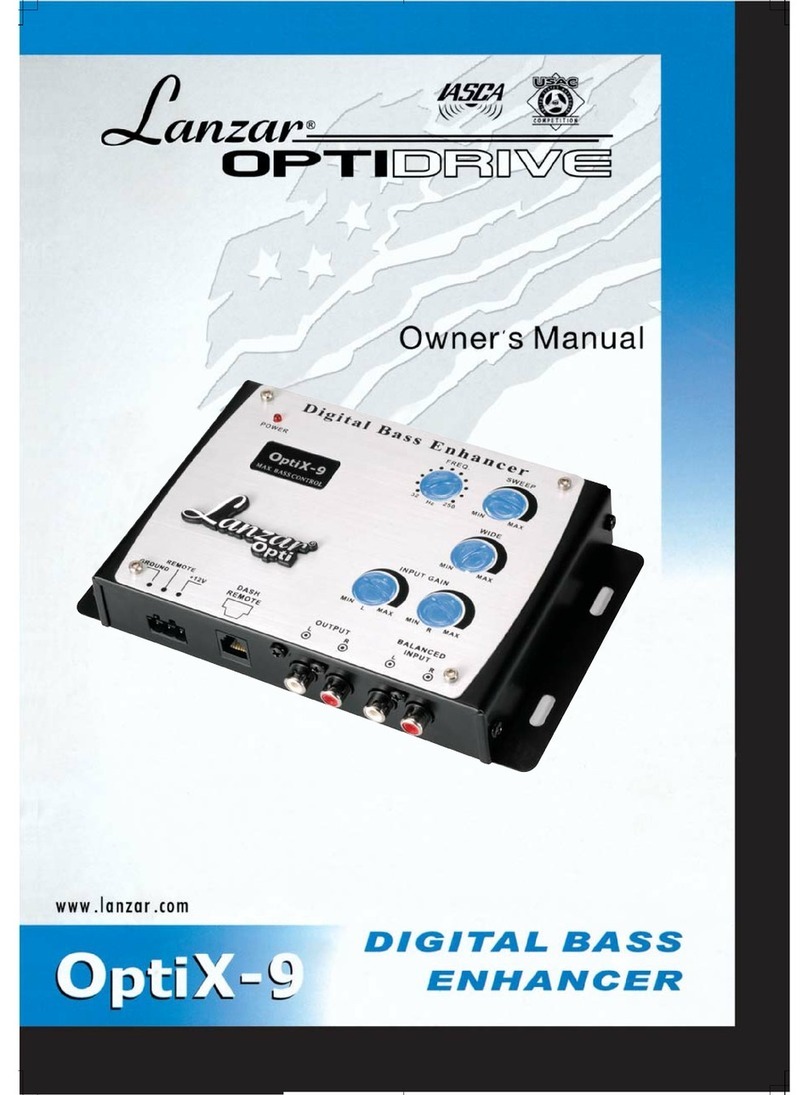
Lanzar OPTIDRIVE OPTIX-10OPTIX-10 Manuel utilisateur

www.lanzar.com 10-Channel Active
Electronic Crossover Network
with Subwoofer Level Control
user’s manual
OptiX-10
OptiX-10

Congratulations on your purchase of a new Lanzar Opti signal processor. Opti mobile electronics are some of the most advanced
car audio products available. These quality audio products are designed and engineered to afford you years of uncompromising
musical service. Lanzar has utilized the latest electronic technologies in order to deliver a superb listening experience.
The X10 Active Crossover offers the listener the ability to enjoy the finest in mobile audio. The X10 unleashes the effortless,
natural and open quality of the real performance. Car audio systems which utilize passive crossovers feed the music through
chokes and capacitors, which creates a “bottleneck”through which the music must pass. Portions of the program material may
pass through at different speeds, creating distortion –some of the music doesn’t make it through at all!
With the Lanzar Opti X10 you’ll hear all the dynamics in the bass, and still hear delicacies like fingers sliding across guitar
strings. The X10 also allows the user to group amplifiers and separate speakers in discrete assemblages so they play as one
cohesive unit, in harmony with each other. The X10 becomes the music conductor in the system, balancing volume, assigning
the proper part of the music to a specific instrument, delaying some sounds so they reach your ear just as the rest of the music
does, with the sole purpose of creating the illusion that there is only the music.
INTRODUCTION...

general features
precautions
features and specifications
system wiring
mounting and installation
noise check and system adjustment
troubleshooting
2
3
4-6
7-11
12-13
14
15
table of contents

10 Crossover Channels
Blue Light Illumination
4 Channel Inputs
Signal Pass-through for Additional Processors
Remote Bass Level Control
High Channels: Separate Front and Rear Frequency and Gain Controls
Mid Channels: Separate Front and Rear Frequency and Gain Controls
Sub Channels: Frequency and Gain Control
Selectable Q Settings for Front and Rear Channels
Subwoofer Stereo/Mono Switch
High Channel and Subwoofer Phase Inverters
Bass Boost Frequency and Level Control
Gold-Plated Connectors and Terminals
2
general features

3
Precautions
To prevent short circuits, be sure to disconnect the negative battery ground lead before wiring the system up.
When you finish the installation, be sure to make one more check to be sure everything is done correctly.
Reinstate all car parts that were removed.
Reconnect the negative battery ground lead.

4
features and specifications

5
features and specifications
1. F/R INPUT SWITCH
2. FRONT & REAR CHANNEL MID CUT Q
SELECTORS
3. FRONT & REAR CHANNEL MID CUT
CONTROLS
4. Front & Rear Channel High-Pass
Phase Inverters
5. Front Frequency & Gain Controls
6. Rear Frequency & Gain Controls
7. Subwoofer Frequency & Gain Controls
8. Subwoofer Phase Inverter &
Stereo/Mono Switches
9. Bass Boost Level & Frequency
Controls
10. Front Channel Output Terminals
In the “2CH”position, rear inputs are split and directed to the front and rear channels simultaneously. This feature should be used when the head unit
has only one pair of output jacks.If the source unit has independent front and rear channel outputs, disengage the parallel input by sliding the switch to
the “4CH”position.
The Q slide switches select Q values of 1, 3 or 6 on the 180Hz Mid Cut filters. The maximum amount of cut possible (at 180Hz) with the Mid Cut Controls
increases with Q value : at Q=1, cut is -10dB; at Q=3, cut is -13dB; and at Q=6, cut is -17dB, Lanzar suggests that for the wider gentler attenuation which
is effective in larger vehicles, one should use a low Q value, which affects a wider band of frequencies. In smaller vehicles, setting a higher Q value is
usually preferable, which affecting a narrower band of frequencies.
For best results, you may wish to use the Mid Cut controls and Q Selectors in conjunction with the PHASE switches, in different combinations.
These controls is permit the frequencies around 180 Hz to be attenuated or cut the amount set by the Q selector. In the 180 Hz frequency range, by a
maximum of 10dB. In this frequency range many automobile sound systems require attenuation, due to the acoustic peak that exists in the acoustical
frequency response of typical vehicles. This acoustical peak in response is usually a result of the relatively small interior listening volume of an automobile,
as well as the listener's close proximity to the bass speakers.
Positioning the switch to “180”position shifts the signal 180˚out of phase relative to the front and rear output signals.
There are 3 frequency controls for the front channels. Mid High Pass Control sets the low crossover point for the midrange drivers, between 40Hz and
240Hz. Mid Low Pass Control locates the high crossover point for the midrange drivers between 1.6kHz and 8kHz. High Pass Control sets the low crossover
point for the high frequency drivers between 1.6kHz and 8kHz. There are Front Gain Controls for both the midrange drivers and the high frequency drivers.
There are 3 frequency controls for the rear channels. Mid High Pass Control sets the low crossover point for the midrange drivers, between 40Hz and 240Hz.
Mid Low Pass Control locates the high crossover point for the midrange drivers between 1.6kHz and 8kHz. High Pass Control sets the low crossover point
for the high frequency drivers between 1.6kHz and 8kHz. There are Rear Gain Controls for both the midrange drivers and the high frequency drivers.
The Subwoofer Frequency Control is used to select a crossover point between 40Hz and 240HZ. At the selected frequency the bass begins to roll off a
12dB per octave. A Subwoofer Output Gain Control adjusts the output signal level for the sub channel.
Positioning the Subwoofer Phase Switch to “180”position shifts the signal 180˚out of phase relative to the front and rear output signals. This is especially
valuable in minimizing some of the “tubbyness”that is characteristic of many vehicles. The Stereo/Mono Switch sums the signal, in the mono mode, to
provide a mono output for those users who are utilizing a single channel subwoofer design.
These controls are used to equalize the subwoofer channel. The Bass Boost Frequency Control is used for selecting a frequency between 40Hz and 120Hz.
The Bass Boost Level Control adjusts the gain from 0 to +12dB.

6
features and specifications
Crossover Frequencies
-Front High-Pass
-Front Mid High-Pass
-Front Mid Low-Pass
-Rear High-Pass
-Rear Mid High-Pass
-Rear Mid Low-Pass
Crossover Slope Rate
Subwoofer Boost
Boost Frequency
Mid Cut
Mid Cut Q:
Distortion
Frequency Response
Signal-to-Noise Ratio (A)
Separation
Power Source
Dimensions
1.6K - 8KHz
40Hz - 240Hz
1.6KHZ - 8KHz
1.6KHZ - 8KHz
40Hz - 240Hz
1.6KHZ - 8KHz
12dB per octave
Single octave 0dB - 12 dB
at 40 - 120Hz (variable)
-10dB (180Hz Q=1)
1, 3, 6
0.01% THD at 1 volt output
10Hz - 30KHz
±
3 dB
95dB
60dB
14.4 Volts DC
Negative ground
9-21/32”W x 10-5/8”D x 1-1/2”H
(245 x 270m x 38mm)
11. Rear Channel Output Terminals
12. Subwoofer Output Terminals
13. Subwoofer Level Remote Control
Terminal
14. Power Indicator
15. Front Inputs
16. Rear Inputs
17. Dual Inputs/Outputs
18. Dual SUB IN & F/R MIX Switch
This terminal may be used to connect the Remote Subwoofer Level Control. This enables
the user to have easy access to adjust the bass levels to compensate for increased road
noise or recording variations.
This indicator lights up when the internal power supply is activated and the unit is operational.
To be connected to the Front outputs of the head unit. Make sure the Dual Input Switch is
in the “4CH”position.
To be connected to the Rear outputs of the head unit. If your head unit has only one set of
outputs connect them to the Rear set of inputs.
When used as inputs, these terminals are connected to the sub out of the source unit.
When used as outputs these terminals are connected to the Rear channel inputs of another
electronic crossover in a multi-crossover system.
When this switch is in the “F/R MIX”position, the stereo sum of the front and rear input
signals is routed to the Dual In/Out terminals. This summed signal can then be used by
the subwoofer channel or become output to another electronic crossover. In the “SUB IN”
position the Dual In/Out terminals become the input terminals for the subwoofer channel.

7
System wiring
2-CHANNEL 3 WAY SYSTEM
REAR CHANNEL
Speakers FRONT CHANNEL
Speakers
Head unit (Stereo, DVD Player, Tape Deck, etc.)
TO REAR
OUTPUT
TO SUB
OUTPUT
to
REMOTE
OUTPUT
from
HEAD
UNIT
BATTERY
GROUND
TO LINE OUT
OF HEAD UNIT
TO FRONT
OUTPUT
SUB CHANNEL
Speakers

8
System wiring
2-CHANNEL MULTIPLE CROSSOVER SYSTEM
TO REAR
MID OUT
TO SUB
OUTPUT
Head unit (Stereo, DVD Player, Tape Deck, etc.)
SUBWOOFER
Speakers
REAR MID-WOOFER
Speakers
TO FRONT
MID OUT
TO REAR
HIGH OUT
TO FRONT
HIGH OUT
GROUND
BATTERY
TO REAR
OUT OF HEAD UNIT
to
REMOTE
OUTPUT
from
HEAD
UNIT
SUPER TWEETER
Speakers
MIDRANGE
Speakers
SUPER TWEETER
Speakers
Ce manuel convient aux modèles suivants
1
Table des matières
Autres manuels Lanzar Crossover