
Itho HRU ECO 4 Manuel utilisateur
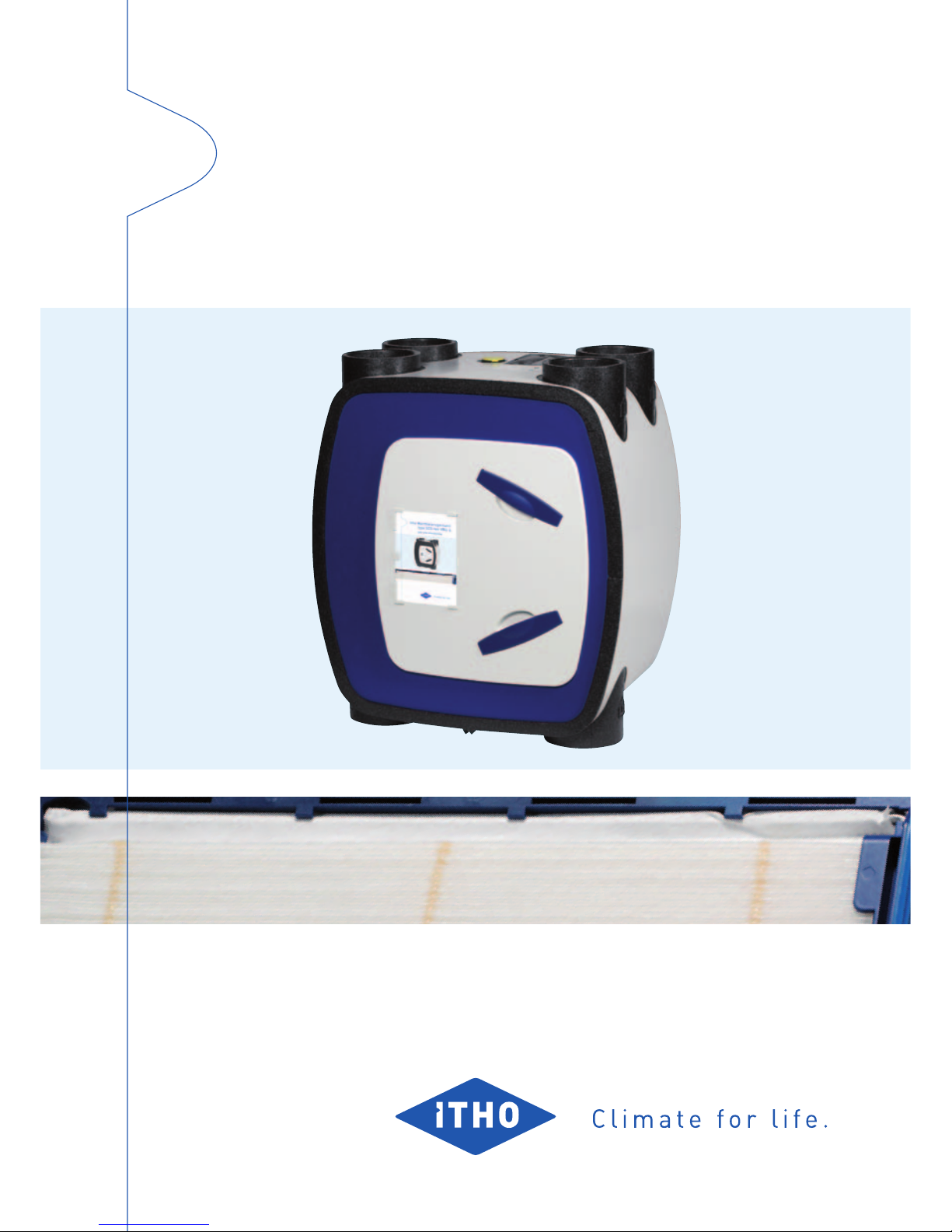
1010/ED
HRU ECO 4
user manual

2

Safety
- Do not place objects on top of the appliance.
- Regularly inspect the appliance for visible defects.
If any faults are found, contact Itho UK Ltd. immediately.
- The appliance must only be installed by a professionally
qualified person.
- Ensure that the electrical system to which the appliance
is connected complies with applicable standards.
- Use a multi-polar switch with a minimum contact gap
of 3 mm to install the appliance.
- Switch of the appliance at the main switch.
a) If the appliance does not function correctly.
b) Before cleaning the outside of the appliance.
c) If the appliance is not to be used for any length of
time.
- Be careful to avoid damaging the electric circuit.
- Do not use the appliance to control activation of water
heaters, room heaters etc., nor should it discharge into
the flues of any such appliances.
- Ensure that the appliance discharges into a single duct
(dedicated to this product) which is routed to the
outside.
- The air to be extracted from the dwelling must be clean
(i.e. free of grease, soot, chemical and corrosive agents,
explosive or flammable mixtures).
- Keep the appliance intake and outlet grilles free to
ensure optimum airflow at all times.
WARNING
- Do not use this appliance for functions other than those
described in the booklet.
- After removing the appliance from its packaging, ensure
that it is complete and undamaged. If in doubt contact
Itho UK Ltd. Do not leave the packaging within reach of
children or the infirm.
- Certain fundamental rules must be observed when
using any electrical appliance, including
a) Never touch appliances with wet or damp hands.
b) Never touch appliances while barefoot.
c) Do not allow children to use the appliance without
supervision.
d) Supervise infirm persons when using the appliance.
- Store the appliance out of the reach of children and
infirm persons if you decide to disconnect it from the
power supply and no longer use it.
- Do not operate the appliance in the presence of
inflammable substances or vapours (alcohols,
insecticides, petrol, etc).
CAUTION
The following general instructions are important:
- Follow the safety instructions to prevent fan damage
and personal injuries.
- Maintenance instructions must be followed to prevent
damage and/or excessive wear and tear.
- The specifications in this manual may not be modified.
- The unit may not be modified.
- The motor module is only suitable for a 230 V 50 Hz a.c
system fitted with a 3 amp fuse.
- Do not expose the appliance to the weather
(rain, sun, etc).
ITHO
|
hru eco 4
3

Safety
Electronic components
The HRU ECO 4 contains parts which may be live. Consult a
professionally qualified installer in the event of an alleged
fault. All repairs and maintenance work should be carried
out by a professionally qualified installer.
Maintenance
The ventilation unit should be inspected regularly for
contamination. Electrically discharge the unit before
carrying out any work on it. First isolate the unit from
the mains supply and make sure that the unit is not
re-connected or the supply plug is not reinserted in the
socket by yourself or anyone else before you have
completed the work.
Rotating parts
The HRU ECO 4 contains rotating mechanical parts.
These parts will keep on turning for a few seconds after
disconnecting the unit from the supply. For this reason
wait at least 10 seconds after isolating the product before
opening the unit. The fan will not be moving after these
10 seconds have elapsed.
Sharp edges of the ducts
The valves and grilles in your home should also be cleaned
regularly. These can be removed from the wall or ceiling.
Beware of protruding duct sections. These can be very
sharp.
Replacing the valves and grilles
The valves should always be placed back in their original
locations. Do not turn the valve during the cleaning
process; or make sure to mark the setting before cleaning
the valve. If the valves are switched or set differently, the
ventilation volumes will no longer be correct and the
ventilation system will not work optimally. The bathroom
may then remain humid for too long, your toilet may be
very cool or your kitchen may smell mouldy.
44

1. Why use balanced ventilation? 6
2. The correct use of your ventilation
system 7
3. Operation of the balanced
ventilation system 8
4. Bypass and frost protection 9
5. Grilles 10
6. System control 11
7. Maintenance 13
8. Warranty conditions 15
9. Manufacturer’s statement 17
10. EU Declaration of Conformity 18
11. Troubleshooting 19
Subject to changes without notice.
No rights can be derived from this user manual.
Table of contents
Safety
ITHO
|
hru eco 4
5

Moisture content of the home
Incorrect use of the ventilation system by the resident in
combination with today’s well- insulated homes gives
humidity an open field. The moisture content in the homes
increases and can cause health, humidity and mould
problems. A family of four persons produces 14 to 20 litres
of moisture per day just by breathing, sleeping, cooking,
washing, dishwashing, bathing, watering plants, etc. Many
products, such as textile, carpets, parquet, newspapers
and cigarettes, contain substances that harm the health of
the residents. All the moisture such as water vapour and
aromatic substances should be removed from the homes.
Ventilation is necessary
In the past people built houses which were not air-tight,
which leaked air, for example, at the connection point of
the wall and the floor or roof. Cracks were always visible
around windows and doors. All these openings ensured
that large volumes of air moved in and out of the buildings.
When the wind was blowing the complete air content of
the home was refreshed three to four times an hour.
This ensured very good ventilation of the home, but a lot
of energy was lost.
Construction methods have changed. Floors, walls and
roofs are, when possible, constructed with a layer of
insulation. The insulation ensures that there are nearly
no cracks and the air- tightness is increased. It is a
misconception to think that there is still enough ventilation
in a home without some type of ventilation system.
Ventilation is absolutely necessary in an air-tight home
to prevent problems related to humidity, mould and the
health of the residents.
1 Why use balanced ventilation?
6

Some health information:
- 5 to 20% of people have an airway disorder.
The number of house dust mite has increased a
hundredfold in the past 25 years.
- The number of people suffering from Chronic
Non-Specific Lung Disease has doubled in the last
15 years.
Research has proven that fighting moisture in homes
greatly contributes to the decrease of allergic reactions
of people with an airway disorder. The correct use and
maintenance of your balanced ventilation system makes
this possible!
Ventilation requires energy. The correct use of the
ventilation system can limit energy loss as much as
possible.
Your home has a Itho UK Ltd supplied Itho balanced
ventilation system with heat recovery. This system can
contribute extensively to a healthy interior climate and an
optimum comfort level. Another advantage is that the
electricity costs are lower than that of any other ventilation
system. The balanced ventilation system can, however,
only function correctly when used and maintained in a
responsible manner.
2 The correct use of your ventilation system
ITHO
|
hru eco 4
7

Optimum efficiency
The heat exchange is highly efficient. Independent tests at
the Building Research Establishment show that upto 91%
of the discharged warmth is reused within the home. The
heat loss is, therefore, only about 9%.
The central unit of the balanced ventilation system in your
home is the HRU ECO 4 (heat recovery unit). This unit has
two motors. One motor for air extraction and one for air
supply.
Air is extracted from the kitchen, bathrooms,
en-suites, utility rooms and toilets and, if required, from a
storage room.
In large dwellings, more than one unit may be required
and installed.
Air extraction and air supply
The contaminated air is filtered and fed through the heat
exchanger before it is discharged outside. The fresh
outside air is also filtered and fed through the heat
exchanger before it is allowed into the home. Two air flows
are led alongside each other in the heat exchanger (the air
flows are, therefore, not intermingled). Thus, energy is
saved as the heat of the discharged air is transferred to
the fresh air intake. The air flows through the ventilation
ducts to the bedrooms, living room and, if required, the
hallway, i.e., every room with an intake grille.
3 Operation of the balanced ventilation system
Overflow protection
The installation design assumes there is a 10 mm space
between the bottom of all internal doors outside door and
the floor covering. If the floor covering is thicker, the doors
should be shortened.
Notwithstanding the heat exchange, which preheats
fresh outside air, the balanced ventilation system
should not be seen as a heating system. It is a
ventilation system that contributes to the comfortable
and healthy climate of your home.
8

Balancing the air flow
In a balanced ventilation system the volume of air coming
from outside equals the amount of air discharged from the
home. The outside air suction fan, therefore, turns faster
when the frost protection is triggered. Thus, the volume of
air coming from outside remains the same as the amount
of air discharged from the home. The total volume of air
intake increases proportionally with the volume of air
taken in from the home by the frost valve. Opening the
frost valve is not sufficient when the outside temperature
is even lower. The intake fan will turn more slowly and,
after some time, the discharge ventilator will turn faster.
The air, therefore, remains above freezing. This results in
a temporary imbalance of the ventilation (the volume of air
coming from outside is no longer equal to the amount of
air discharged from the home). When the outside
temperature increases, the unit automatically resets the
fans to the initial values. The ventilation is thus once again
balanced.
Electronic components
The electronic components are important parts of the unit.
The electronic components control the operation of the
unit when you set the mode switch. The motor is set to the
speed that ensures the desired ventilation. The electronic
components consist of a basic printed circuit board and an
optional radio frequency module. This can be used to
extend the ventilation unit with radio frequency operation.
The user should not touch the electronic components.
These components may be live.
Bypass
The Itho heat recovery unit HRU ECO 4 is delivered as
standard with a 100% bypass valve. This valve is completely
integrated in the unit and ensures that, if required, the
fresh outside air flows directly to the air supply system
instead of through the heat exchanger. In this case there is
no heat transfer between the warmer discharge air from
the home and the colder intake air that is drawn into the
home. The fresh outside air is blown directly into the
home. This is definitely an advantage in the summer, when
the outside air is often cooler than the air within the home.
Frost protection
The unit includes, as standard, frost protection. This
protection ensures that the unit does not freeze during the
winter. The frost protection consists of a unique frost valve
integrated at the top of the unit. The frost protection is fully
automatic.
Frost protection operation
In the heat recovery unit the fresh (colder) outside air
is partly heated by the air discharged from the home.
The exchange of heat takes place when both air flows are
led through the heat exchanger. The discharged air may be
cooled to a temperature very near freezing by the cold air
entering the unit from outside. In this case, the unit will
regularly open the frost valve and take in warm air from
the home. This warm air is mixed with the cold air that is
taken in from outside. The temperature of the intake air is,
therefore, higher and the discharge air in the heat
exchanger will also be safely above freezing. The unit
will thus not freeze.
4 Bypass and frost protection
ITHO
|
hru eco 4
9

Extraction grilles
Intake grilles
5.1 Grilles
The volume of air that has to be extracted is specified in
the Building Regulations. The volume of air flowing into
the home has to be in balance with the extracted volume.
The volume of air extracted from and supplied to the home
should, in other words, be equal. The minimum air volume
per room is also determined by the Building Regulations.
The set volume of air is determined based on achieving
an optimum home climate without wasting energy.
The air intake and discharge per room are not equal.
The extraction and intake grilles all have their own fixed
positions and settings.
5 Grilles
The setting of the grilles should not be changed.
Changing the settings may disrupt the operation of
the complete ventilation system. Grilles and valves
should not be switched with each other.
KLV
TR
10
Table des matières


