Hyundai HYB60 Manuel utilisateur

LEAF BLOWER
Model HYB60
User Manual

Page 2
Rev 2

CONTENTS
1. SAFETY 4 - 7
2. COMPONENT LOCATIONS 8
3. ASSEMBLY 9 - 10
4. FUELLING 10 - 11
5. STARTING AND STOPPING THE ENGINE 11 - 12
6. OPERATING INSTRUCTIONS 13
7. MAINTENANCE 14 - 18
8. SPECIFICATIONS 18
9. DECKARATIONS OF CONFORMITY 19
Page 3
Rev 2

1. SAFETY.
1.1. The operator of the machine is responsible for and has a duty of care in making sure that
the machine is operated safely and in accordance with the instructions in this user manual.
Please note the following safety points
1.1.2. The machine should never be left it in a condition which would allow
an untrained or unauthorised person/s to operate this machine.
1.1.3. All due care and diligence should be taken by the operator for the safety of and
with regard to those around whilst using the machine
1.2. Some or all of the following PPE, Warning Signs and symbols may appear throughout this
manual and you must adhere to their warning/s. Failure to do so may result in personal
injury.
Warning Signs and Symbols –FOLLOW safety messages to avoid or reduce risk of injury or death.
DANGER - indicates a
hazard which if not
avoided could result in
serious injury or death.
WARNING - indicates a
hazard which if not
avoided could result in
serious injury or death.
CAUTION - indicates a
hazard which if not
avoided might result
in minor or moderate
injury.
NOTE - indicates a
situation that could
easily result in
equipment
damage.
READ MANUAL
KEEP BYSTANDERS AWAY
BE AWARE OF BLOWN
OBJECTS
KEEP NAKED FLAMES AWAY
FROM FUEL
VIBRATION - KEEP FUEL CAP
TIGHT
DO NOT DIRECT OUTLET
TOWARD PEOPLE
Page 4
Rev 2

1.3. Carbon monoxide.
1.3.1. Carbon monoxide is a colourless and odourless gas. Inhaling this gas can
cause death as well as serious long term health problems such as brain damage.
1.3.2. The symptoms of Carbon monoxide poisoning can include but not limited to the following;
1.3.2.1. Headaches, dizziness, nausea, breathlessness, collapsing or loss of consciousness.
1.3.2.2. Carbon monoxide symptoms are similar to flu, food poisoning, viral infections and
simply tiredness. It is quite common for people to mistake this very dangerous poisoning
for something else.
1.3.3. To avoid Carbon monoxide poisoning DO NOT Use Petrol/Diesel powered equipment inside
a home, garage, tent, camper van, mobile home, caravan or boat. The list is not exhaustive if
you are in any doubt contact your dealer.
1.3.4. If you think you or someone around you has been affected by carbon monoxide poisoning;
1.3.4.1. Get fresh air immediately, by opening doors and windows, turning off the machine
and leaving the affected area.
1.3.4.2. See your doctor immediately or go to hospital - let them know that you suspect
carbon monoxide poisoning.
1.3.5. DO NOT use in an enclosed area or a moving vehicle.
1.4. General fuel safety.
1.4.1. Fuel Safety additional information can be obtained from the Health and Safety Executive.
1.4.2.
All fuels are flammable.
1.4.3. Keep away from all ignition sources i.e. heaters, lamps, sparks from grinding or welding.
1.4.4. Hot work on tanks that have contained fuel is extremely dangerous and should not be
carried out.
1.4.5. Keep work area clean and tidy.
1.4.6. Clean up all spills promptly using correct methods i.e. absorbent granules and a lidded bin.
1.4.7. Dispose of waste fuels correctly.
Page 5
Rev 2

1.4.7. Dispose of waste fuels correctly.
1.4.8. Petrol safety.
1.4.8.1. Always fuel and defuel in well-ventilated area.
1.4.8.2. Always wear correct, suitable and fit for purpose Personal Protective
Equipment (PPE), suggested items are as follows, but are not limited too.
1.4.8.3.
1.4.8.4.
1.4.8.5.
Respiratory protective equipment should be used when in an
unventilated area.
1.4.8.6. When defueling always use a propriety fuel retriever.
1.4.8.7. Always carry fuel in the correct and clearly marked container.
1.5. Additional Safety guidelines’
1.5.1. To prevent fire.
1.5.1.1. Never add fuel to the fuel tank whilst the engine is running. Wipe away any
spilt fuel or oil with a clean cloth before operating. Keep explosives and any other
flammable products away from the machine at all times.
1.5.1.2. To prevent fire and to provide adequate ventilation, keep the machine at
least one metre away from buildings and other equipment during operation.
1.5.1.3. Operate the machine on level ground. - Do not place the machine indoors
whilst the engine is still hot.
1.5.2. To prevent inhaling exhaust fumes.
1.5.2.1. Exhaust gas contains poisonous carbon monoxide which is harmful to health
and can kill.
1.5.2.2. For this reason, never use the machine in a closed area or areas with poor
ventilation.
1.5.3. To prevent burns.
1.5.3.1. The muffler and the engine body becomes very hot whilst the engine is
running or just after running.
1.5.3.2. To prevent any burns, do not touch these parts during these times.
1.5.4. Careless or improper use of any blower may cause serious or fatal injury.
1.5.4.1. If you are unsure how to use the machine you must read all of this manual and
get your dealer to demonstrate its use.
1.5.4.2 Observe all applicable local safety regulations and standards.
1.5.5. Children should never be allowed to use a blower.
1.5.5. Bystanders, especially children, and animals should not be allowed in the area
where a blower is in use.
1.5.5. The operator is responsible for avoiding injury to third parties and damage to
their property.
1.5.5. Do not lend or rent your blower without the owner's manual. Be sure that
anyone who uses your blower fully understands the information contained in this
manual.
Page 6
Rev 2

1.5.6. You must be fit to work with a blower:
1.5.6.1. You should not operate the machine if you are not well or physically unable.
if you get tired, take a break in good time
1.5.6.2. Do not operate the blower if you are under the influence of any substance
(drugs, alcohol, etc.) which might impair vision, dexterity or judgment.
1.5.7. Only attachments supplied are expressly approved for use with your specific model
are authorised.
1.5.7.1. Other attachments must not be used because of the increased risk of
accidents.
1.5.7.2 No liability will be accepted for personal injury and damage to
property caused while using unauthorised attachments.
1.5.8. Before starting check the following points:
1.5.8.1. The throttle trigger must move freely and spring back to idle position when
released.
1.5.8.2. The stop switch must move easily to "OFF"
1.5.8.3. Tightness of spark plug cap - if cap is loose, sparks may occur and ignite the
escaping fuel vapours!
1.5.9. Starting.
1.5.9.1. Start the engine at least 3 m (10 ft) from the fuelling spot, outdoors only.
1.5.9.2 To reduce the risk of breathing toxic fumes, never start or run your unit in
confined spaces.
1.5.9.3. Place the unit on firm ground in an open area.
1.5.9.4. Make sure you have good balance and secure footing and hold the unit
securely.
1.5.9.5. Your blower is a one-person unit. DO NOT allow other persons to be near the
running unit - even when starting. For specific starting instructions, see chapter
"Starting" in the owner's manual.
1.5.10. Take care in slippery conditions such as on ice, in wet or snow and on slopes or
uneven ground.
1.5.11. Watch out for obstacles, such as roots, ditches, holes or rubbish which could cause
you to trip or stumble.
1.6. Vibrations.
1.6.1. Prolonged use of the unit may result in vibration-induced circulation problems in the
hands (white-finger disease). No general recommendation can be given for the length of u
usage because it depends on several factors.
1.6.2. The period of usage is prolonged by:
1.6.2.1. Hand protection (wearing gloves)'
1.6.2.2. Breaks
1.6.3. The period of usage is shortened by:
1.6.3.1. Persons with a tendency to suffer from poor circulation
(symptoms: frequently cold fingers, itching).
1.6.3.2. Low outside temperatures.
1.6.3.3. Gripping force (a tight grip hinders circulation).
1.6.4. Continual and regular users should monitor the condition of their hands and fingers. If
any of the above symptoms appear, seek medical advice.
Page 7
Rev 2

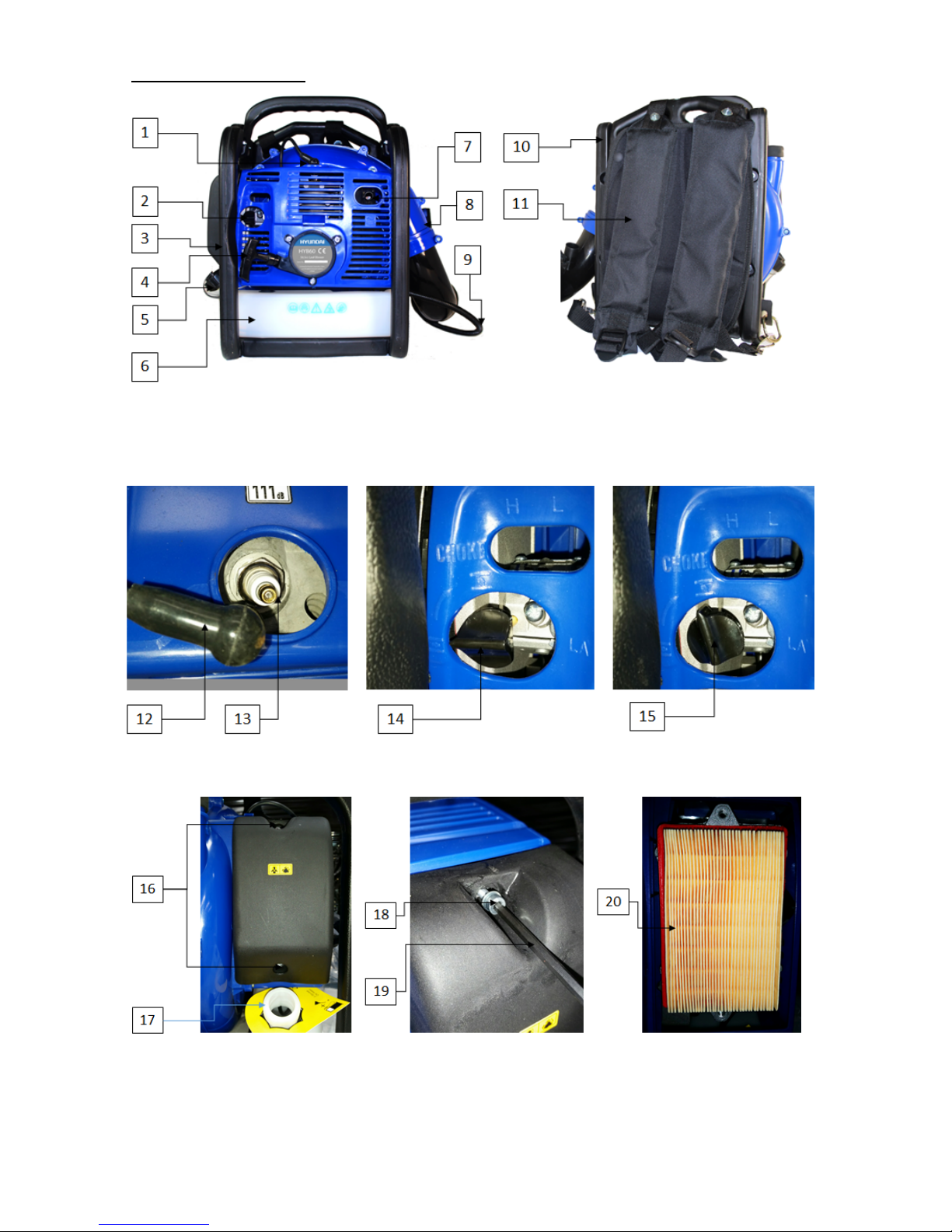
2. COMPONENT LOCATION
1. HT Lead/Spark Plug 2. Choke 3. Air filter cover 4 Recoil starter handle
5. Fuel tank cap 6. Fuel tank 7. Exhaust 8. Blower outlet
9. Control lead 10. Frame 11. Backpack harness
assembly
12. HT Lead 13. Spark plug 14. Choke (OPEN) 15. Choke (CLOSED)
16. Air filter hex bolts 17. Fuel cap 18. Hex bolt (top) 19. Allen key
20. Air filter element
Page 8
Rev 2

3. ASSEMBLY
3.1. Remove all contents from packaging as follows;
3.1.1. Unit complete with control handle x1.
3.1.2. Flexible tube x 1.
3.1.3. Flattened blower tube x 1.
3.1.4. Extension tube x 2.
3.1.5. Handbook.
3.1.6. Tool kit - 1 x Spark plug spanner c/w screwdriver handle, 1 x Allen key.
3.1.7. Safety glasses x 1.
3.1.8. Fuel/Oil mixing container x 1.
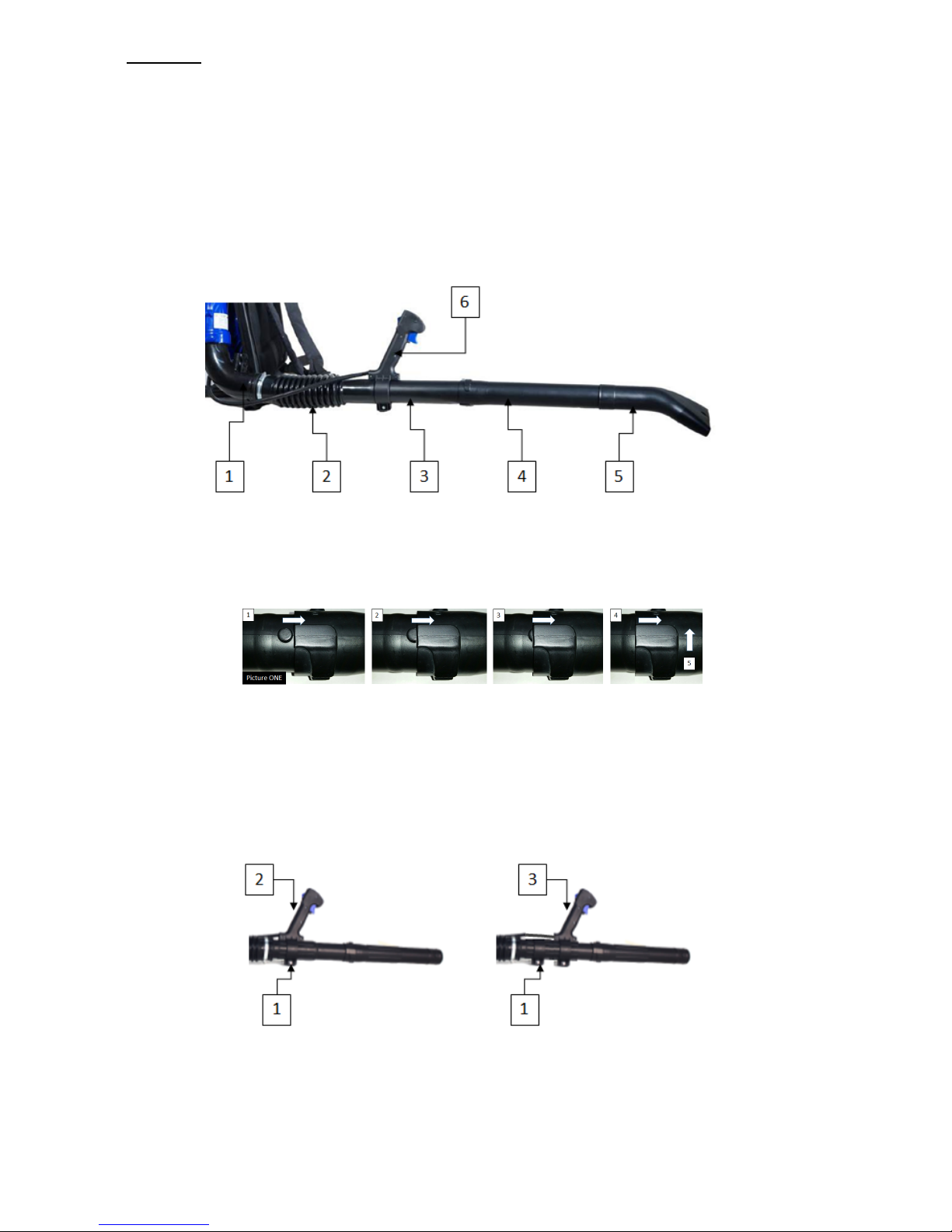
3.2. Assemble unit by;
3.2.1. connecting flexible tube (2) to main outlet (1).
3.2.2. Slide control handle over tube (3), then continue to connect tube (4) to (3),
and flattened tube (5) to tube (4). See picture 1 below on how to connect tubes (4)
(5).
3.3. Adjusting the control handle.
3.3.1. Put unit on your back.
3.3.2. Using supplied allen key undo screw (1), slide control handle (2) along
the tube (3) until it is in the desired position.
3.3.3. Once in the desired position (example (3)) using the supplied allen
key retighten the screw.
Page 9
Rev 2

3.4. Adjusting the harness straps.
3.4.1. Pull the ends of the straps (1) downward to tighten the harness.
3.5. Loosening the harness straps.
3.5.1. Lift the tabs (2) of the two sliding adjusters. Adjust the straps so that
the back-plate is held firmly and comfortably against your back.
4. FUELLING
4.1. Unsuitable fuels or lubricants or mix ratios other than those specified may result
in serious damage to the engine (piston seizure, rapid rate of wear, etc.).
4.2. Unleaded Petrol.
4.2.1 Your engine requires a mixture of petrol and engine oil. The quality of these
constituents and the mix ratio have a decisive influence on the function and service
life of the engine.
4.2.2. Mix ratio - Pre-mix 2-stroke oil with fresh unleaded petrol as follows:
Mineral based 2-stroke oil : 25:1 (40ml of oil per 1 litre of petrol)
Synthetic 2-stroke oil: 40:1 (25ml of oil per 1 litre of petrol).
4.2.3. Avoid direct skin contact with petrol and avoid inhaling petrol vapour.
4.2.3.1. Using the supplied container. Pour oil (1) into the canister first, then
add petrol (2) and mix thoroughly.
4.2.3.2. Fuel storage of mix:
4.2.3.2.1. Only mix sufficient fuel for a few months' work.
4.2.3.2.1. Store in approved safety- type fuel canisters in a dry and
safe location.
4.3. Fuelling.
4.3.1. Before fuelling, clean the filler cap and the area around it to ensure that no
dirt falls into the tank.
4.3.2. Position the unit so that the filler cap is facing up. Take care not to spill fuel
while fuelling and do not overfill the tank. After fuelling, tighten down filler cap by
hand as securely as possible.
4.3.3. Thoroughly shake the mixture in the canister before fuelling your machine.
Pressure may build up in the canister - open it carefully. Clean the fuel tank and
canister from time to time. Dispose of cleaning fluid properly at authorised disposal
location.
Page 10
Rev 2
Table des matières
Autres manuels Hyundai Ventilateur

Hyundai
Hyundai HAS3000 Manuel utilisateur

Hyundai
Hyundai HSDT55 Manuel utilisateur

Hyundai
Hyundai HYBV26-2 Manuel utilisateur

Hyundai
Hyundai HYB5200 Manuel utilisateur

Hyundai
Hyundai HASBT35 Manuel utilisateur

Hyundai
Hyundai HYSW1000 Manuel utilisateur

Hyundai
Hyundai HSEN40V-A Manuel utilisateur

Hyundai
Hyundai HY2189 Manuel utilisateur

Hyundai
Hyundai WR6022-1800Q Manuel utilisateur

Hyundai
Hyundai HYBV200 Manuel utilisateur