
Hisun HS 400-4 Manuel de référence

Introduction HS 400-4/HS 450
1-1
INTRODUCTION
Congratulations on your purchase of the HS 400-4/HS 450. This Owner’s / Operator’s manual
will provide you information regarding safe operation, operational instructions, maintenance
and care. Fully understanding this manual and following all of the instructions herein will
provide the knowledge needed to have safe and enjoyable UTV operation.
For questions regarding this UTV, please call (972) 446-0760.
IMPORTANT SAFETY MESSAGES
●READ THIS MANUAL CAREFULLY AND COMPLETELY BEFORE OPERATING YOUR UTV.
MAKE SURE YOU UNDERSTAND ALL INSTRUCTIONS.
●PAY CLOSE ATTENTION TO THE WARNING AND CAUTION LABELS ON THE UTV.
●NEVER OPERATE THE UTV WITHOUT PROPER TRAINING OR INSTRUCTION.
●THIS UTV SHOULD NOT BE RIDDEN BY ANYONE UNDER
16 YEARS OF AGE.

Introduction HS 400-4/HS 450
1-2
IMPORTANT MANUAL INFORMATION
FAILURE TO FOLLOW THE WARNINGS CONTAINED IN THIS MANUAL CAN RESULT IN SERIOUS
INJURY
OR DEATH. Particularly important information is distinguished in this manual by the following
notations:
The Safety Alert Symbol means ATTENTION!
YOUR SAFETY IS INVOLVED!
Failure to follow WARNING instructions could result in severe injury or death to
the machine operator, bystander or a person inspecting or repairing the
machine.
A CAUTION indicates special precautions that must be taken to avoid damage
to the machine.
NOTE: A NOTE provides key information to make procedures easier
clearer.

Introduction HS 400-4/HS 450
1-3
IMPORTANT NOTICE
This UTV is designed and manufactured for OFF - ROAD use only. It is illegal and unsafe to operate this
UTV on any public street, road or highway.
This UTV complies with all applicable OFF - ROAD noise level and spark arrester laws and regulations in
effect at the time of manufacture.
Please check your local riding laws and regulations before operating this UTV.
When the temperature is below -4°F (-20°C), park the UTV in a place where the temperature is higher
than -4°F (-20°C). Start the UTV after the UTV has warmed up. Please see page 7-3 on the warming up
process.
Follow the proper parking procedures when the temperature is higher than 100°F (38°C): turn off the
engine; make sure the radiator fan is on for 3 minutes before turning off the power switch.
Starting the UTV for the first time will take longer because the fuel will need reach the fuel injectors. To
start the UTV the first time, hold the ignition key on at 5-second intervals. Allow the starter to rest 15
seconds between each start attempt.

Introduction HS 400-4/HS 450
1-4
NIVERSAL SYMBOLS
As a guide to the operation of your vehicle, various universal symbols have been utilized on the
instruments and controls. The symbols are shown below with an indication of their meaning.
Safety Alert Symbol Lift Cylinder-Retract
Diesel Fuel Lift Cylinder-Extend
Engine coolant-Temperature Lift Cylinder-Float
Parking Brake Hazard Warning Lights
Battery Charging Condition Master Lighting Switch
Engine Oil-Pressure Audible Warning Device
Turn Signal/Hazard Fault indicator light of EPS system
Differential Lock 2WD/ 4WD
Position light bulb

Introduction HS 400-4/HS 450
1-5
Table of Contents
Subject Page
Introduction 1-1
Important manual information 1-2
Important notice 1-3
Universal symbols 1-4
Location of parts 1-7
Illustrated contents 1-8
Safe operation 2-1
Safety instructions 2-1
Operation 2-2
Children safety instructions 2-2
Driving on a slope 2-3
Driving in harsh conditions 2-3
Driving at high speed 2-3
Instructions for carrier 2-3
Parking 2-4
Transportation 2-4
Maintenance 2-4
Warning and caution labels 3-1
Servicing of vehicle 4-1
Specifications table 5-1
Vehicle limitations 5-3
Pre-operation 6-1
Operating the engine 7-1
Starting the engine 7-1
Cold starting 7-2
Stopping the engine 7-2
Warming up 7-2
Warm-up transmission oil in the low
temperature range
7-3
Operating the vehicle 8-1
Operating new vehicle 8-1
Do not operate the vehicle at full
speed for the first 50 hours
8-1
Changing lubricating oil for new vehicles
8-1
Subject Page
Starting 8-1
Seat belt 8-1
Head light switch 8-2
Emergency light switch 8-2
Turn signal light switch 8-2
Brake pedal 8-3
Range gear shift lever 8-4
4WD lever 8-5
Accelerator pedal 8-5
Stopping 8-5
Coolant temperature gauge 8-6
Winch mount plate 9-1
Transporting vehicle 9-1
Service intervals 9-2
Periodic service 10-1
How to open the front hood and seat 10-1
Front hood cover 10-1
Operator’s sea 10-1
How to raise the cargo bed 10-1
Raising and Lowering the Cargo Bed 10-1
Jack-up point 10-2
Front end 10-2
Rear end 10-2
Daily check 10-2
Walk around inspection 10-3
Checking and Refueling 10-3
Checking coolant level 10-4
Cleaning radiator screen 10-4
Checking brake fluid level 10-5
Checking brake pedal 10-5
Checking parking brake 10-5
Checking gauges meter and easy
checker lamps
10-6
Checking head light turn signal light etc
10-6

Introduction HS 400-4/HS 450
1-6
Checking seat belt and ROPS 10-6
Checking joint boot 10-6
Checking tire inflation pressure 10-6
Every 50 hours 10-6
Greasing 10-6
Checking engine start system 10-7
Checking wheel bolt torque 10-7
Cleaning air cleaner primary element 10-8
Checking battery condition 10-9
Adjusting toe-in 10-10
Cleaning muffler 10-11
Every 200 hour 10-11
Changing engine oil 10-11
Replacing engine oil filter 10-12
Replacing transmission oil 10-12
Checking brake pedal 10-13
Checking brake hose and pipe 10-14
Checking brake light switch 10-14
Checking radiator hose and clamp 10-14
Checking intake air line 10-14
Every 300 hours 10-15
Checking tire 10-15
Every 400 hours 10-15
Changing transmission fluid 10-15
Changing front and rear axle case oil 10-15
Every 500 hours 10-16
Replacing fuel filter 10-16
Every 600 hours 10-16
Adjusting engine valve clearance 10-16
Every 1500 hours 10-16
Checking injection and fuel pump 10-16
Every 1 year 10-16
Replacing air cleaner primary element
and secondary element
10-16
Every 2 years 10-16
Changing brake fluid 10-16
Flushing Cooling system and changing
coolant
10-16
Anti-freeze 10-17
Replacing radiator hose (water pipes) 10-18
Replacing fuel hose 10-18
Replacing brake master cylinder (inner
parts)
10-18
Replacing front brake seal 10-18
Replacing rear brake cylinder seal 10-18
Replacing intake air line 10-18
Every 4 years 10-18
Replacing brake hose 10-18
Replacing slow-blow fuses 10-18
Storage 10-19
Vehicle storage 10-19
Removing the vehicle from storage 10-20
Troubleshooting 11-1
Engine troubleshooting 11-1
Diagnostic trouble code table 11-2
Battery troubleshooting 11-3
Machine troubleshooting 11-4
Options 12-1
Emissions warranty 13-1

Introduction HS 400-4/HS 450
1-7
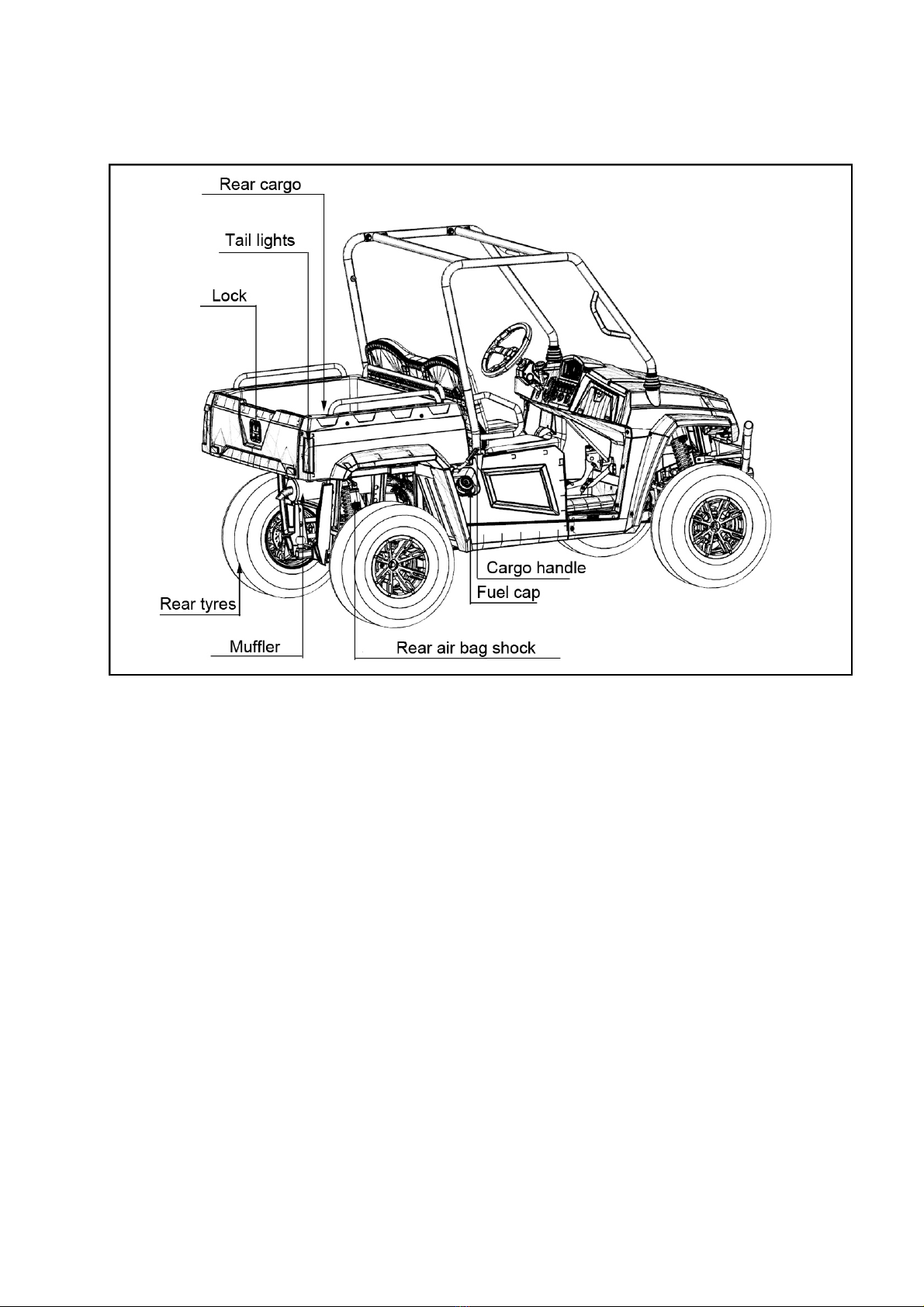
LOCATION OF PARTS

Introduction HS 400-4/HS 450
1-8
ILLUSTRATED CONTENTS
Introduction HS 400-4/HS 450
1-9

Safe Operation
2-1
All operators, including experienced UTV drivers
or passengers, should carefully read and fully
understand this Users Manual, and operate
strictly as the manual states in order to achieve
best performance and avoid accidents. Others
who will use you UTV should be trained how to
operate the UTV and be required to read this
manual before operation.
1. Safety Instructions:
1. Understand this UTV by reading this manual
and understanding all the components of the
vehicle. Only start and operate the vehicle
after finishing reading this manual.
2. Pay close attention to the warning and
caution labels on the UTV.
3. Understand completely and learn to use the
safety devices (roll-over protective structure,
seat belts), and never change original safety
devices. If safety devices are damaged,
consult your local dealer for replacement.
Always use seat belts.
① Roll-over protective structure;
② Seat belts
4. Do not wear loosen articles of clothing
during operation, as these can be drawn into
moving parts on the vehicle and could cause
a severe injury to occur.
You should wear protective devices, such as
helmet, boots, eye protection, earmuff,
gloves,
and etc.
5. Only a qualified driver should operate this
UTV. Never operate after drinking, using
drugs or controlled products, or while
fatigued.
6. Always perform the pre-operation checks as
following:
5) Check seat belt for worn or damaged, if
necessary, replace it.
6) Check brakes, throttle, brake pedal and
other mechanical parts for proper
operation. If you discover any
irregularities, replace related parts as
necessary. Periodically check the fittings
and fasteners.
7) Check engine oil level and engine coolant
level.
8) Check that the UTV is equipped to handle
the surroundings.
9) Check and keep vehicle clean. Sludge,
grease and debris can cause a fire and
severe injury.
7. Passenger quantity and loading:
1) Only the driver and one passenger inside
cab. It is suggested that children under
age of 5 not be allowed as a passenger.
2) Single-row vehicle’s loading limit is 350lbs
(159KG).Reduce loading weight according
to road condition. Never exceed the weight
limits for operation.
Ce manuel convient aux modèles suivants
1
Table des matières
Autres manuels Hisun Véhicule tout-terrain

Hisun
Hisun STRIKE 1000 Manuel utilisateur

Hisun
Hisun HS750ATV Manuel utilisateur

Hisun
Hisun HS500ATV Manuel utilisateur

Hisun
Hisun 700UTV Manuel utilisateur

Hisun
Hisun AXIS 110 Manuel utilisateur

Hisun
Hisun HS500ATV-2 Manuel utilisateur

Hisun
Hisun HS 500UTV-5/HS Manuel utilisateur

Hisun
Hisun HS800UTV Manuel utilisateur

Hisun
Hisun HS 1000UTV Manuel utilisateur

Hisun
Hisun HS 400 Manuel utilisateur


