The VTSP-3 incorporates an
infrared remote control for conve-
nient operation of many of the
preamplifier’s front-panel functions.
This remote uses 38kHz modulation
and detection of this signal initiates
the VTSP-3’s decoder circuitry, which
is otherwise dormant in order to pre-
vent the unwanted noise usually
associated with remote control cir-
cuitry. A flashing red light in the
display window indicates the initia-
tion of the remote control decoding
process in the VTSP-3. When the red
light is off, this circuitry goes to
“sleep” mode.
The VTSP-3 utilizes two extremely
low distortion precision electronic
stepped attenuators (one for each
channel) in a fashion similar to the
VTSP-1A/166, and VTSP-2. The VTSP-3
has a total of 100 volume steps, and
the precise volume level is shown as
three digits in the front-panel display
window. The use of electronic stepped
attenuators ensures continued high-
quality performance without any of
the oxidation and corrosion that
degrades conventional mechanical
VTSP-3 Vacuum Tube Stereo Preamplifier Owner’s Manual
Please read the Owner’s Manual completely BEFORE operating the unit.
stepped attenuators and volume con-
trol potentiometer wiper contacts.
At startup the display on the VTSP-3
goes through a lamp test, and then suc-
cessively displays the model of the unit
“SP3” and the time in seconds from 60
(while the filaments and high voltage
are slowly brought on) until the unit
automatically un-mutes. The input dis-
play will show the last input in use
from the last time the unit was on.
When the countdown is complete the
mute will be disengaged (if it was not
on the last time the unit was shut
down), the function displays will indi-
cate the last state of use, and the
volume will be ramped up to a rela-
tively low level of 10. At this point the
user will be able to change the settings.
The VTSP-3 incorporates circuitry
to switch the phase of the audio sig-
nal by 180 degrees for absolute
polarity control. The amber “Invert”
light on the front panel will indicate
if the phase is being inverted. The
phase switching circuitry of the VTSP-3
is designed so that no coloration is
added in either mode and the true
effects of recorded phase polarity are
audible in either mode. The invert
mode can be controlled from both the
front panel and the remote control.
Note: When the invert mode of the
VTSP-3 is switched, the unit automati-
cally mutes before changing modes in
order to prevent any unwanted
“pops” during switching. The unit
unmutes after the invert mode is
changed. The process takes less than
a second.
The display brightness of the
VTSP-3 can be dimmed from both the
remote and the front panel by push-
ing the “Display” button. Operating
the “Display” button again will return
the brightness to its previous setting.
The blue “Display” indicator on the
front panel indicates dim-display
mode.
Source input selection in the VTSP-3
incorporates gold-contact sealed relays
located at the input connectors, keep-
ing the signal path length to an
absolute minimum. This innovative
configuration eliminates the
distortion-generating wipers of con-
ventional selectors and long runs of
wire from the rear panel to the switch.
An additional benefit of using sealed
relays, the contacts are not prone to
corrosion, dirt, or the same kind of
wear as conventional selector
switches.
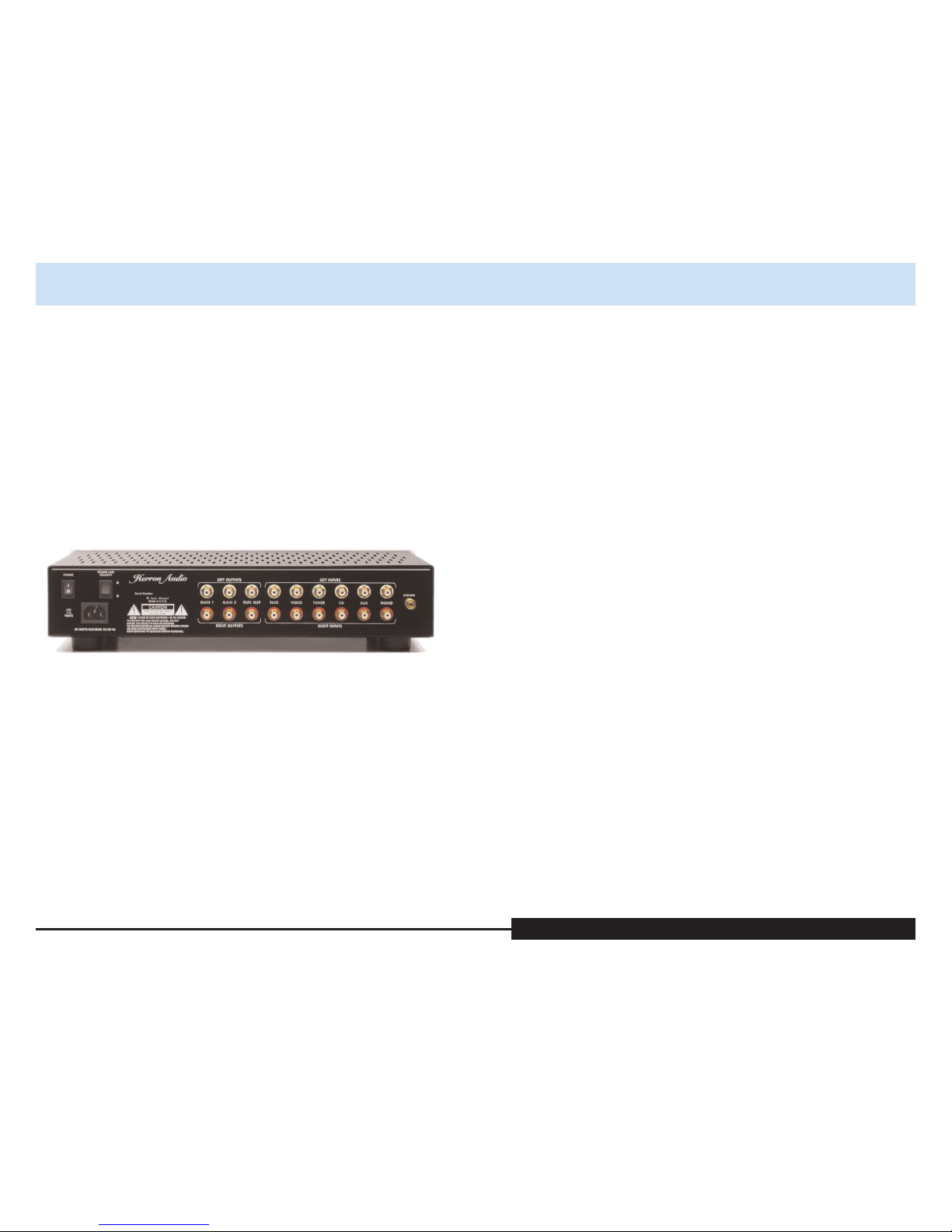
The VTSP-3 has a power-polarity
switch on the back panel for revers-
ing the power line polarity
connection to the primary of the
power transformer. This can be used
to minimize the capacitive reactance
effects from the power line on the
audio quality of the unit. This switch
can be operated while listening in
order to determine the best-sounding
power polarity setting.
The “Video” input of the VTSP-3
can be placed in unity-gain mode by
pressing and holding the “Video”
button on the front panel for a few
seconds. The volume display will indi-
cate “PAS” on the display when the
pass-through mode is initiated; only
the video input will be at unity gain.
Selecting any other input will shut off
the pass-through mode, and the vol-
ume will return to 10.
Note: The pass-through mode
cannot be selected from the remote
control.
All of the front panel display lamps
are driven from individual display
latches for each element and are not
multiplexed or flashed at high speed,
as is usually done to save parts and
two three
Features
Features