
hawos Oktini Manuel utilisateur

Grain keeps best if it is dry and
well ventilated.
The ideal way
to ensure your
stocks are in
good condition
and always at
hand.
8 hawos grain silo
hawos Kornmühlen GmbH
Ober-Eschbacher Straße 37
D-61352 Bad Homburg v.d.H.
Tel.: +49 (0) 6172 40120-0
Fax: +49 (0) 6172 40120-19
www.hawos.de
Starke Mühlen – Feines Mehl
Storing your grain the right way – with hawos grain silos
hawos grain silo
This grain silo looks good in any kitchen. The housing is made of steamed beech finished with linseed
oil. The display fronts are made of polished glass. Each storage compartment takes 5 kg of grain.
Matching under unit for hawos grain silo
Streamline your kitchen work routines! hawos grain mill can be placed under the grain silo and
the grain feeds directly into the mill hopper from the storage compartments. The board for the
bowl can be pushed in or pulled out as required.
Grain silo 2 comp. 3 comp.
Capacity 2 x 5 kg 3 x 5 kg
Housing steamed beech
Finish geölt
Weight 6.4 kg 9.75 kg
Dimensions
Height 45.7 cm 45.7 cm
Width 29.7 cm 43.5 cm
Depth 17.5 cm 19.7 cm
Under unit for grain mill
Housing steamed beech
Finish geölt
Weight 12.5 kg
Dimensions external internal
Height 67.0 cm 46.0 cm
Width 43.5 cm 39.0 cm
Depth 23.7 cm 20.5 cm
Including board 43.0 cm
Instructions for use
hawos Oktini
Congratulations
on your purchase of the
Oktini grain mill!
Design: www.2sinn.com
Safety
If the electric plug or flex of this machine is
damaged, it must be replaced by the manufac-
turer, the manufacturer’s customer service or a
similarly qualified person to avoid exposure to
danger.
hawos Oktini is equipped with a circuit breaker
to protect the motor from power overload (e.g.
if a foreign body blocks the millstones).
The motor has built-in overheating protection
which switches the motor off if it becomes
overloaded. If this happens, please remove the
plug from the mains. After a few minutes the
mill will have cooled down and can be operated
again.
Wichtige Hinweise 32 Herzlichen Glückwunsch
hawos Oktini is a grain mill that can be used
to grind all types of grain in normal household
quantities (including amaranth, emmer, kammut,
wheat, spelt, millet, soy beans and rye).
The millstones are made of a corundum and
ceramic compound and are extremely durable.
The housing is solid beech, prepared with great
care and oiled to retain an open-pore finish.
At hawos, we only use components of the
highest quality, ensuring that your Oktini grain
mill will deliver many years of reliable service.
That is why we can provide 5 years guarantee
(2 years if the mill is used commercially).
Important information
Grain for milling
Please use clean grain only. Grit or small stones
are often mixed up with the grain and can
damage the millwork.
Never mill grain more than once.
Electricity supply
Only use the mill on an alternating current
power supply. Check that the mains voltage
corresponds to the voltage shown on the base
of the mill.
Where to keep your mill
Your mill has solid beech housing that may
react to extreme climatic conditions by warping.
The best way to protect and care for your mill is
to avoid placing it close to radiators (dry heat)
or next to a cooker (steam, moisture).
Setting up the mill
Please ensure the mill is always placed on a
hard, level surface during operation (e.g. kitchen
counter). The slits for ventilation of the motor in
the base and on the lower part of the machine
must be kept free.
Please make sure that the container for
collecting the milled grain is large enough to
avoid a back-up of flour into the dispenser. The
rule of thumb is that after milling, grain has
twice the volume.
Congratulations on
your purchase of the
Oktini grain mill!
You have purchased a high quality product
with 5 years guarantee.
Please read these instructions carefully to
help ensure that your mill gives you many
years of satisfaction.
Safety first!
Never let children use the Oktini grain mill
unsupervised! Children cannot judge the
dangers posed by electrical equipment.
Please ensure that this machine is operated
only by persons with the necessary physical,
sensory and mental capacities.
Never leave the mill unsupervised
when in operation!
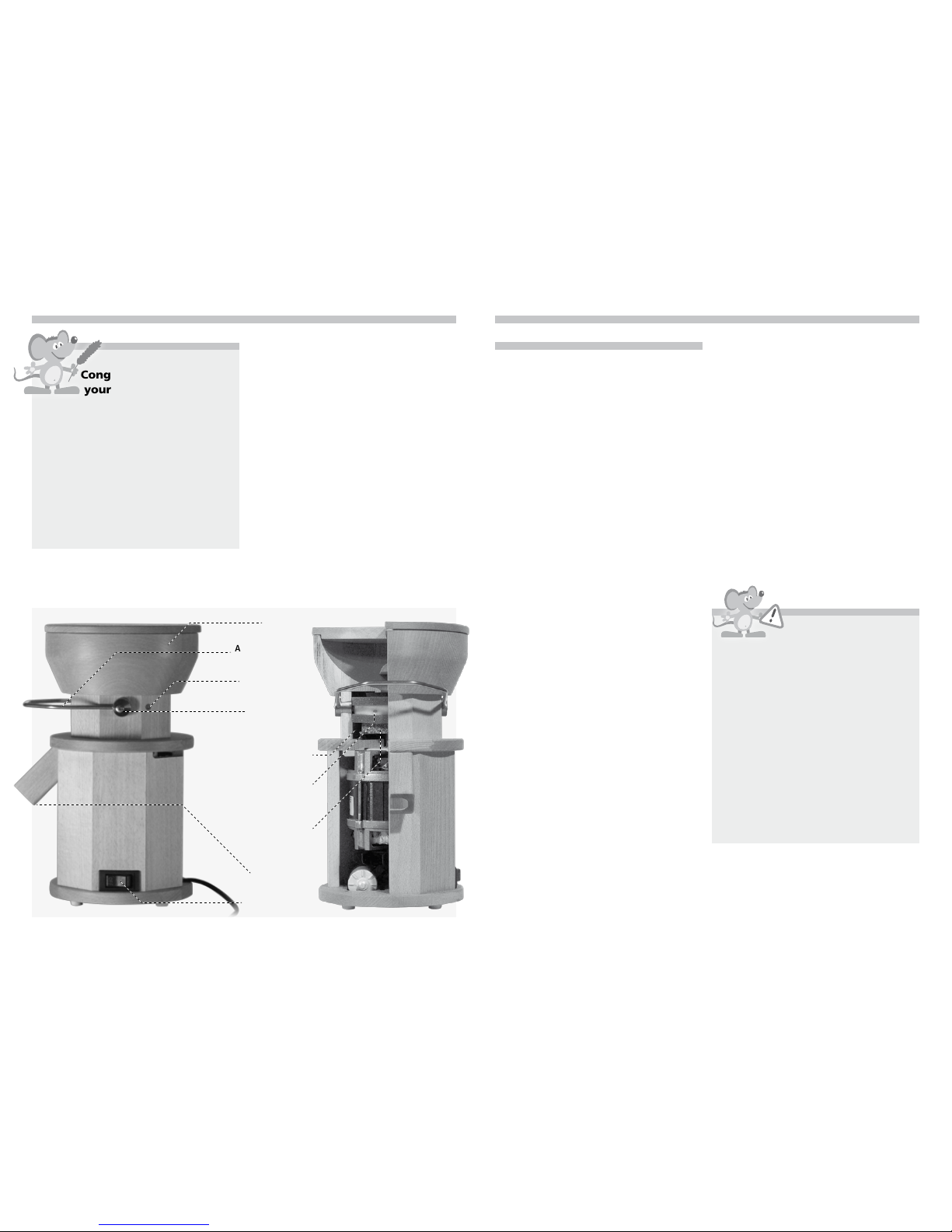
Hopper (1)
Adjustment bar (2)
Brake screws (3)
Adjustment bar
screws (4)
Mill chamber
(Upper)
fixed millstone (5)
(Lower) rotating
millstone (6)
Dispenser (7)
On/off switch (8)
Cleaning your mill / Breakdowns 54 Starting up your mill
Starting up
your mill
Please first read the
section “Important
information” (p. 3)!
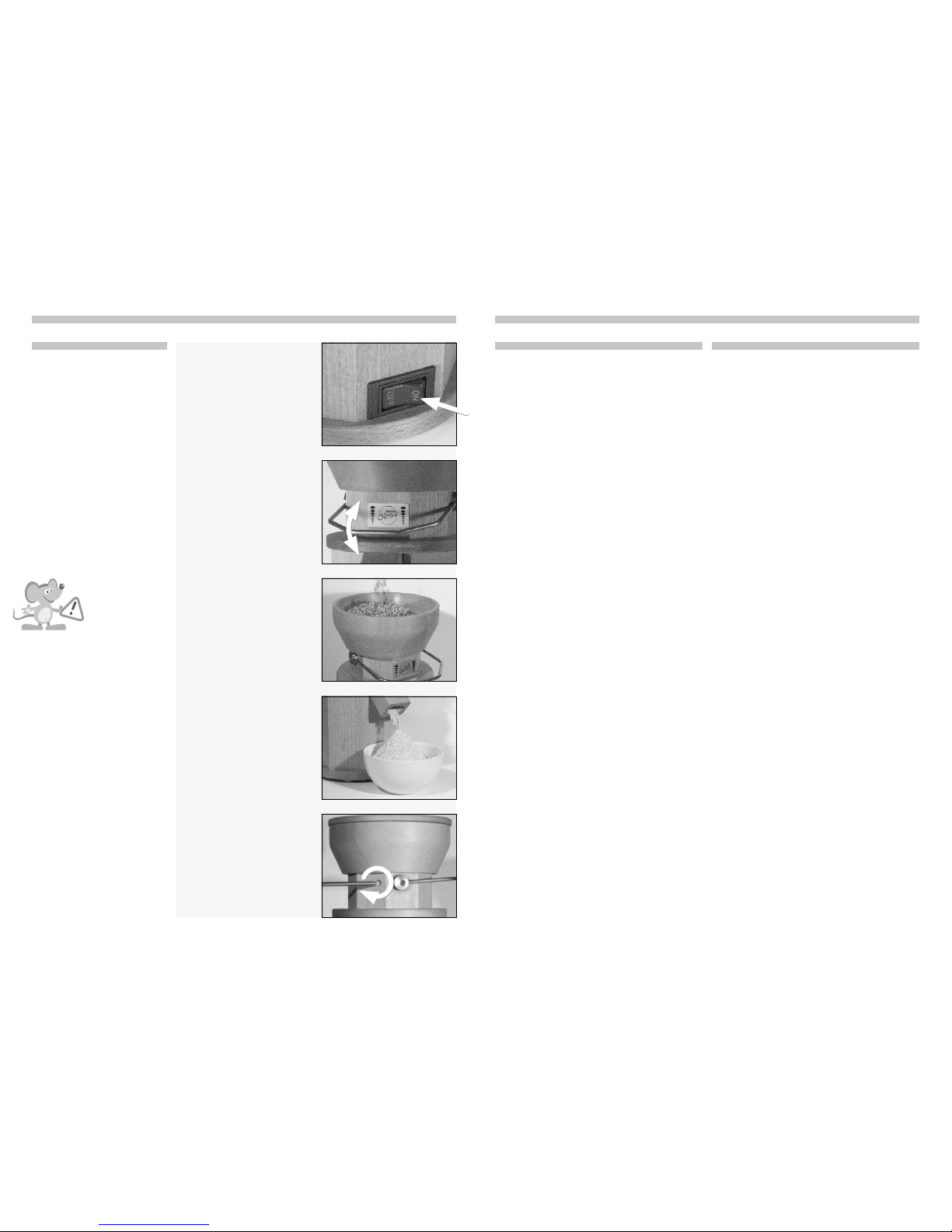
Place a bowl under the
dispensing outlet, switch the
mill on using the on/off switch
(8), set the desired degree of
grinding (2) and then put the
grain into the hopper (1).
The hopper capacity is approx.
650 g.
Use dry grain
only!
Dry grain will make a loud
cracking noise if you crush a
grain with a spoon on a hard
surface. Damp grain can be
squashed, and will then
resemble an oat flake. Rye
should be stored at least six
months after harvesting. Oily
seeds (e.g. linseed, sesame and
poppy) are too greasy and will
leave an oily coating on the
millstones. When milling maize,
please use food-quality maize
only.
Cleaning your mill
Your Oktini has an integrated brush alongside
the lower millstone which sweeps out the flour
and thereby automatically cleans the mill.
However, to ensure that you always obtain fresh
flour, we recommend that you first remove old
flour residues if the mill has not been used for
an extended period. Your vacuum cleaner is best
for this: set the mill to “coarse”, switch it on
and then hold the nozzle of the vacuum cleaner
to the flour dispenser while it is running.
The best way to clean the outer surface of the
mill is with a damp cloth. It should never be
treated with abrasive cleaners or cleaned under
running water. If required, you can rub a little
plant-based oil into the wood to nourish the
surface. Never immerse the machine in water!
What should I do if the millstones
have become greasy?
If this does not help, then open the millwork
and clean the parts. Please see section “Ope-
ning the millwork” for more information (p. 6).
Switch on machine with on/off
switch (8)
Set degree of grinding
(use the front-mounted
adjustment bar (2); can also be
adjusted during operation).
Raised bar = coarse
Lowered bar = fine
Place grain into the hopper (1)
When selecting a container to
collect the flour, remember that
milled grain has twice the
volume of unmilled grain.
If the adjustment bar moves of
its own accord during milling,
tighten the two brake screws (3).
Breakdowns
Operational problems are extremely rare with
hawos Oktini. You can deal with the following
problems yourself:
The motor fails to start: The mill is not
connected to the electricity grid. Is the plug in
the socket? Solution: Check both.
The motor makes a whirring noise:
Solution: While the machine is still in ope-
ration, set the adjustment bar (2) to “coarse”
for a moment, and then return it to “fine”.
The mill stops during use: If the motor
blocks due to improper or very intensive use,
the thermal protection device in the on/off
switch will turn the mill off automatically.
Solution: After a short cooling period of a few
minutes, the mill can be operated again. If the
problems recur, the reason should be identified,
e.g. Is the grain damp? Is the millwork clogged?
Has a foreign body become jammed between
the millstones?
The mill can no longer be set to “fine”:
A back-up of flour (e.g. due to an overfilled
bowl) can clog the millwork, or there may be
a foreign body in the millwork.
Solution: Set the adjustment bar (2) to
“coarse” while the mill is running and let the
millwork run without processing any grain.
If necessary, open the millwork and remove the
foreign body (p. 6).
The degree of grinding varies during
milling: The adjustment bar changes position
of its own accord during milling.
Solution: Tighten the two brake screws (3).
Technische Daten / Garantie / hawos Service 76 Opening the millwork
Opening the
millwork
Normally you should not need
to open the millwork. hawos
grain mills have a brush
alongside the rotating
millstone which sweeps out
the flour on each rotation.
Coarsely grinding a handful of
wheat or rice is therefore all
you need to do to clean your
mill. A description is never-
theless included below.
The use of electric screwdrivers
can break or damage parts of
the housing and the screw
heads. We therefore recom-
mend using a manual screw-
driver.
Guarantee
We provide five years guarantee for the mill and
all its parts, starting from the date of purchase.
If the mill is used commercially, the guarantee
period is two years.
hawos Service
Please call us if you have any problems.
We will be pleased to help.
Hotline: +49(0)6172 40120-0
Alternatively, email us on:
hawos Kornmühlen GmbH
Ober-Eschbacher Straße 37
D-61352 Bad Homburg v.d.H.
Germany
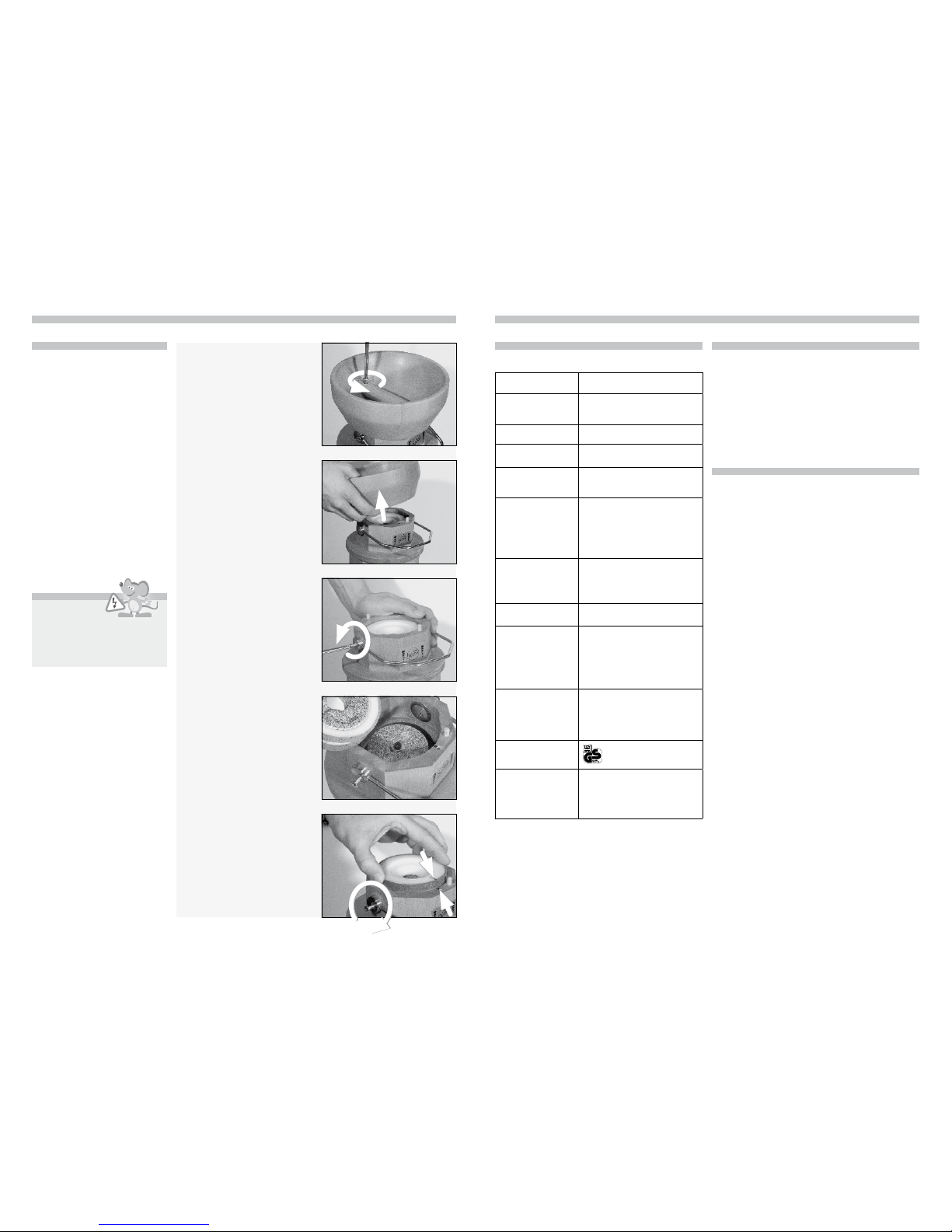
Remove the two screws which
hold the finger guard in the
hopper in place.
You can now lift out the hopper.
Ensure that you retain the foam
rubber ring. This is either loose
or attached to the hopper.
Replace it when reassembling
the machine.
Unscrew the two screws (4) to
the left and right of the
adjustment bar to a height of
approx. 12 mm.
You can now remove the upper
millstone (5).
For reassembly, follow the
instructions in reverse. When
inserting the upper millstone,
please ensure that the markings
are aligned with the markings
on the rim of the housing. Hold
the adjustment bar approximate-
ly half way between the settings
and place the millstone in the
milling chamber.
The lateral screws (4) settle
automatically into the screw-
holes if the markings are
correctly aligned and the
adjustment bar is horizontal.
Technical data
Housing Solid beech
Finishing Linseed oil varnish
Hopper capacity 650 g (wheat)
Dimensions (mm) Height 335 x diameter 190
Space under grain
discharge for bowl
115 mm
Approx. output in
g/min (fine) for
wheat with 13 %
moisture
approx. 100 g/min
(corresponds to approx.
4 minutes for the amount
required for a sponge cake)
Millwork Corundum in ceramic
millstone, mounted
horizontally, Ø 70 mm
Weight 6,65 kg
Safety Temperature control: thermal
winding cover, safety switch
to protect against power
surges
Motor output 360 Watt/230 Volt, AL 50 Hz,
smooth start even when
hopper is full
Safety certification
Guarantee 5 years,
2 years for commercial use
Caution!
Always remove the plug from
the electricity socket before
you open the housing!
Table des matières
Autres manuels hawos Appareils de cuisine


