
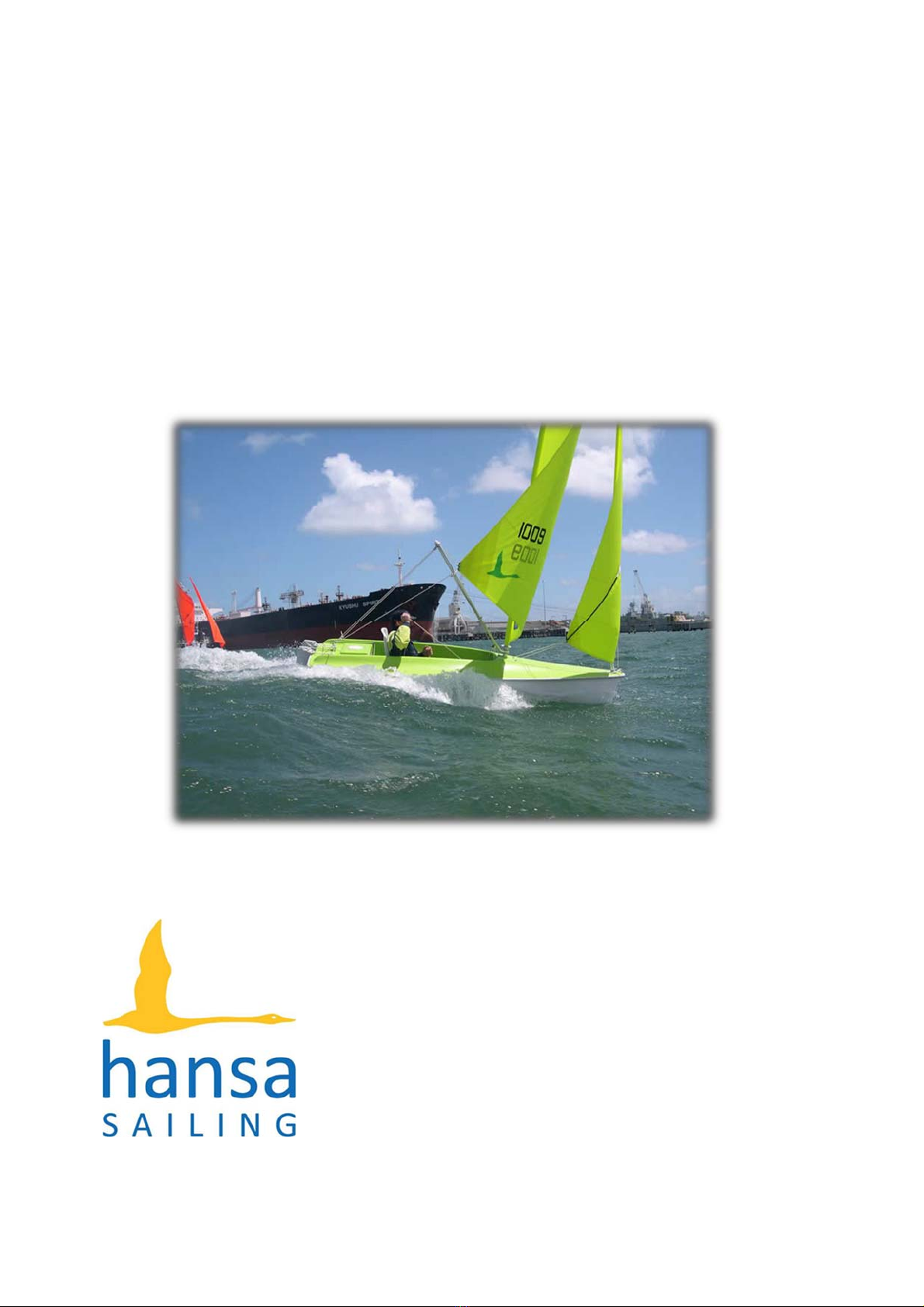
Hansa Sailing Liberty Guide de démarrage rapide
1
Liberty
Rigging Guide
Manufactured by
Hansa Sailing Systems Pty Ltd
ABN 56 079 318 031
Head Office: 4/4 Cumberland Avenue
SOUTH NOWRA NSW 2541 AUSTRALIA
Postal: PO Box 5048 NOWRA DC NSW 2541
Telephone: +61 2 4403 0595
Facsimile: +61 2 4403 0598
Email: admin@hansasailing.com
Website: www.hansasailing.com

2
Index
Introduction ……………………………………………………………………………………………………….3
Description of Craft: The Liberty
Specification ……………………………………………………………………………………………………...5
General ……………………………………………………………………………………………………………6
Maintenance & Repairs ………………………………………………………………………………………….7
Safety Recommendations …………………………………………………………………………….………...8
PART ONE
Special Features of the Liberty ……………………………………………………………………………..….9
PART TWO
How to Rig a Liberty
Stepping the Mast, fitting the boom ………………………………………………………………………….12
Stepping the Foremast …………………………………………………………………………………………14
Setting up Main and Jib Sheets ……………………………………………………………………………….15
Reefing the Main ………………………………………………………………………………………………..16
Reefing and Furling the Jib …………………………………………………………………………………….17
Steering …………………………………………………………………………………………………………..18
Launching ………………………………………………………………………………………………………..19
PART THREE
Liberty Servo Assist System—Overview ……………………………………………………………………..19
Control Box ………………………………………………………………………………………………………20
The Batteries …………………………………………………………………………………………………….21
The Helm Winch ………………………………………………………………………………………………...21
The Mainsheet Winch …………………………………………………………………………………………..22
The Jibsheet Winch ……………………………………………………………………………………………..22
Controllers ………………………………………………………………………………………………………..23
Maintenance and Troubleshooting …………………………………………………………………………….24
Adjusting the steering …………………………………………………………………………………………...25
Changing between manual and servo assist systems ………………………………………………………25

3
Introduction
This manual has been compiled to help you to operate your craft with safety and pleasure. It contains de-
tails of the craft, the equipment supplied or fitted, its systems, and information on its operation and mainte-
nance. Please read it carefully, and familiarise yourself with the craft before using it.
If this is your first sailing craft, or you are changing to a type of craft you are not familiar with, for your own
comfort and safety, please ensure that you obtain handling and operating experience before assuming
command of the craft. Your Hansa Sailing Distributor, National Sailing Federation or Yacht Club will be
pleased to advise you of nearby sailing schools or instructors.
Personal Floatation Devices (PFD’s)
There are many types and variety of buoyancy aids available, manufactured to different sets of standards.
The PFD is a personal item of safety equipment, designed specifically to assist in preserving a person’s
life when in the water. Most PFD’s provide sufficient buoyancy to help you float with your head above the
water.
All sailors and volunteers should wear a PFD at all times whilst on, or near water.
Care
PFD’s are subject to normal wear and tear. Each one should be checked regularly and if in doubt about its
serviceability it should be replaced. If they become wet from salt water they should be hosed down with
fresh water and allowed to dry.
PFD’s and Children
A properly designed PFD of the correct size will keep a child’s mouth and nose clear of the water. A child
should be taught how to put on a device and should be allowed to try it out in the water. It is important
that the child feels comfortable and knows what the PFD is for and how it functions.

4
Safety Precautions
If sailed with care, this boat is unlikely to capsize in normal use, provided that the sail area is adjusted to
suit the prevailing conditions and the main sheet is not belayed. Whilst Hansa sailing craft have inherent
design features ensuring maximum stability thereby reducing the chance of capsize, it should be remem-
bered that these are small keelboats and under certain weather, water and sailing conditions sensible pre-
cautions should be taken:
• Always reef the sails according to the weather conditions.
• Always have a manned safety boat in the sailing area.
• Always cancel sailing activities if inclement weather conditions dictate.
• Always lock centreboard in position with long centreboard locking pin provided.
Man Overboard
In the event of man overboard, use the centreboard handle as a handhold. Board over the port or star-
board sides.
Towing
The strong point for towing is the main mast. Pass the tow line through the guide ring at the bow and at-
tach to the mast with a bowline.
The safety of the sailors should come first under all circumstances

5
Description of Craft: The Liberty
Specifications
Length 3.6 mtrs.
Beam 1.35 mtrs.
Draft 1mtr.
Hull Weight 72 kg
Load Maximum number of people: 1
Maximum weight of people 120 kg.
Maximum weight of additional load 30 kg.
Centreboard Weight 72 kg
Sail Plan Mainsail and free standing, self-tacking Jib.
Sail Area Mainsail 4.5 sq. mtrs (unbattened and reefable to .5 sq. mtr).
Jib 1.75 sq. mtrs (full roller reefing).
Masts Main (unstayed 5.6 mtr. Incorporating reefing drum in foot).
Jib (unstayed 3.5 mtr. Incorporating reefing drum in foot).
Hull Positive buoyancy.
Heavily rockered for easy manoeuvrability.
Strong construction with solid bonded hull/deck joins. Seating design keeps
helm weight low, plus weighted centre board makes the boat uncapsizable.
Seating Fibreglass adjustable seat.
Controls Steered by manual joystick.
Mainsail is reefed and un-reefed by a single hauling line. Jib is reefed and un
-reefed by a single hauling line.
Mainsail and Jib controlled by manual mainsheets.
Electric Controls Servo-assist electric controls can be fitted to the Liberty.

6
General
The boat has an engraved plate fitted on the starboard side of forward cockpit, showing the manufacturer,
boat design category, maximum person capacity, maximum additional load and the CE Mark.
The parameters shown on this plate should not be exceeded.
Steering is by a manual joystick located between the helm’s legs, moving it to the left to go left and to the
right to go right.
The sail area can be reduced or increased whilst under way using a reef furling system operated by haul-
ing on a single continuous line. (For further information on reefing see: “How to Rig a Liberty, later in this
guide).
Parts of a Liberty:
Main Mast
Fore Mast
Boom
Centreboard
Rudders x 2
Rubber Box x 2
Rudder Box Pin x 2
Installed reefing system
Mainsail
Foresail (Jib)
Bobbin
Mainsheet
Outhaul
Traveller
Painter
Jib Sheet with clew sheave
Jib strut downhaul
Jib Strut and Claw
Boom vang
Items with Servo Assist – As above, plus:
Main sheet winch
Jib sheet winch
Helm winch
Control box
Rubber bungs
Batteries x 2,
Battery Y Connector,
Battery Charger (if 240V),
Controller
Controller holder

7
Maintenance
It is recommended that the boat is covered when not in use to prevent UV and other weather damage. A
specially designed cover is available from Hansa Sailing Systems for this purpose.
If sails are to be left furled on the mast when the boat is not in use it is recommended that these are cov-
ered using a protective sail sock to prevent UV and other weather damage. These are available Hansa
Sailing Systems.
Do not let water remain in the boat when not in use. This can accelerate the deterioration of running rig-
ging, finishes and electrics where applicable.
Winter Storage: Remove electrics, remove and fold sails and fully cover the boat.
Repairs
Contact Hansa Sailing Systems or the nearest Hansa Sailing Distributor for advice and replacement parts.
Fibreglass repairs should be done professionally.

8
Safety Recommendations
Hansa Sailing craft are designed with a hull form and other features which combine to give considerable
stability. There is a simple set of rules which should be followed to maintain the boats’ excellent safety
record and prevent any accidents. The stability of Hansa Sailing craft rely upon the following:
Centreboards
It is most important that the centreboard be locked in the fully down position when sailing. The hole locat-
ed one-third down the centreboard is to enable the short pin to be inserted laterally and facilitate move-
ment of the boat with the centreboard inserted.
The Liberty centreboard weighs 72kg and therefore must not be lifted manually. Always use a
hoist to place the centreboard into position.
Under no circumstances should the boat be sailed with the centreboard fixed in the raised position.
There is a long pin provided to lock the centreboard fully lowered so that even in a “knock down” it re-
mains in place.
Seating
Because the placement of sailors’ weight affects stability it is important that people remain seated low in
the boat. If a sailor needs support from strapping, use only quick release Velcro ™ straps to secure a
sailor in place.
Reefing
Being a displacement type hull, the use of full sail area in strong winds does not mean more speed, but
does make the boat more difficult to manage. In fresher breezes it is recommended to reef to suit the
stronger gusts.
Towing
If a Liberty needs to be towed on the water by a safety boat, it is safer and easier to tie the boat close
alongside and remove the rudder blade so that it cannot be steered in the wrong direction.
Transferring
A stable floating pontoon system enables safe, centreboard-down transfer of sailors to and from the Liber-
ty. This avoids off the beach centreboard handling and transferring problems. A portable floating pon-
toon system is available from Hansa Sailing

9
Fig. 2
Fig. 3
The Liberty has 2 rudders which give directional control at
even extreme angles of heel
There is the option of fitting
a boom with a 3 part manu-
al mainsheet, rigged as per
the 303W, (fig 2 )
or a 2 part double ended
mainsheet (fig 3), one end
going to a servo assist
sheet winch and the other
through a conventional
swivel/deadeye/ camcleat
for manual operation, (fig
4)
Both these ends pass
through a double block at-
tached to the boom about
400mm back from the
mast. (see fig 4.
A boom vang is fitted which prevents
the boom skying when running in fresh
to strong winds. (see fig 4)
Liberty Special Features
Fig 1

10
The mainsail outhaul primarily cleats at the boom, (fig 5) but passes thru a deckeye just behind the main
mast, down to the console and turns through the boom vang/ outhaul double becket block and back to the
central of the 3 clamcleats on the port side of the console. (fig 6)
The jib is self-tacking with a diagonal strut be-
tween the clew and a claw at the mast which
holds the jib flat and prevents twisting as the
sheet is eased. (fig 7)
The jib sheet is 2 part which gives the option of one end going
to a servo assist winch and the other down to the camcleat on
the starboard side of the console for manual operation. (fig 8
shows the jib sheet winch behind mast, jib sheet and
camcleat).
Fig. 5 Fig. 6
Fig. 7
Fig. 8
Autres manuels pour Liberty
1
Table des matières
Autres manuels Hansa Sailing Bateau


Manuels Bateau populaires d'autres marques

Raymarine
Raymarine ST70 Instrument Manuel utilisateur

Pro-Line Boats
Pro-Line Boats Pro Line 19 Sport Manuel utilisateur

Jeanneau
Jeanneau CAP CAMARAT 8.5 CC Manuel utilisateur

Tiara Yachts
Tiara Yachts C49 2024 Manuel utilisateur

Monterey Boats
Monterey Boats Sport Yacht 330 Manuel utilisateur

J
J 105 Manuel utilisateur

PURSUIT
PURSUIT OS 335 Manuel utilisateur

Boston Whaler
Boston Whaler CONQUEST 345 Manuel utilisateur

Jeanneau
Jeanneau SUN ODYSSEY 41 DS Manuel utilisateur

Meridian
Meridian 490 Pilothouse Manuel utilisateur

Advanced Elements
Advanced Elements AdvancedFrame Expedition AE1009 Manuel utilisateur

Robo Marine Indonesia
Robo Marine Indonesia GEOMAR Manuel utilisateur


