
Hach AS950 AWRS Mode d’emploi
DOC026.97.80501
AS950 Refrigerated Sampler
AS950 AWRS
12/2017, Edition 5
Basic Installation and Maintenance
Installation et maintenance de base
Instalación y mantenimiento básicos
Instalação e Manutenção Básica
基本安装与维护
基本的な設置とメンテナンス

English..............................................................................................................................3
Français......................................................................................................................... 27
Español.......................................................................................................................... 52
Português...................................................................................................................... 77
中文............................................................................................................................... 102
日本語........................................................................................................................... 124
2

Table of contents
Specifications on page 3 Startup on page 18
General information on page 6 Maintenance on page 19
Installation on page 10 Troubleshooting on page 25
Additional information
Additional information is available on the manufacturer's website.
Specifications
Specifications are subject to change without notice.
Refrigerated Sampler and All Weather Refrigerated Sampler (AWRS)
Specification Refrigerated Sampler AWRS
Dimensions (W x D x
H)161 x 61 x 112 cm (24 x 24 x 44 in.) 76 x 81 x 130 cm (30 x 32 x 51 in.)
Weight 63.3 kg (140 lb) 86 kg (190 lb)
Power requirements
(includes compressor)
115 VAC, 60 Hz, 3.3 A (18 locked
rotor amps)
230 VAC, 50 Hz, 1.7 A (9 locked rotor
amps)
115 VAC, 60 Hz, 4.2 A or 6.4 A with controller
compartment heater
230 VAC, 50 Hz, 2.7 A or 4.1 A with controller
compartment heater
Overload protection Thermal overload relay, opens at
100 to 110 °C (212 to 230 °F)
115 VAC: 7.5 A circuit breaker
230 VAC: 5.0 A circuit breaker
Compressor 1/6 HP 1/5 HP
115 VAC: 115 °C (239 °F) thermal overload
protector, 7.1 locked rotor amps
230 VAC: 120 °C (248 °F) thermal overload
protector, 7.6 A peak start current
Operating temperature 0 to 50 °C (32 to 122 °F) 0 to 50 °C (32 to 122 °F); with AC battery
backup: 0 to 40 ºC (32 to 104 ºF); with
controller compartment heater: –40 to 50 °C
(–40 to 122 °F); with controller compartment
heater and AC battery backup: –15 to 40 ºC
(5 to 104 ºF)
Storage temperature –30 to 60 °C (–22 to 140 °F) –30 to 60 °C (–22 to 140 °F)
Relative humidity 0 to 95% 0 to 95%
Installation category,
pollution degree
II, 2 II, 2
Protection class I I
Temperature control 4 (±0.8) °C (39 (±1.5) °F) in ambient
temperatures at a maximum of 50 °C
(120 °F)
4 (±0.8) °C (39 (±1.5) °F)2
1Refer to Figure 1 on page 6 for the sampler dimensions.
2Radio frequency interference in the 30 to 50 MHz range can cause a maximum temperature
change of 1.3 °C (34.3 °F). Adjust the set point temperature to 2 to 10 °C (35.6 to 50 °F) to
correct this interference.
English 3
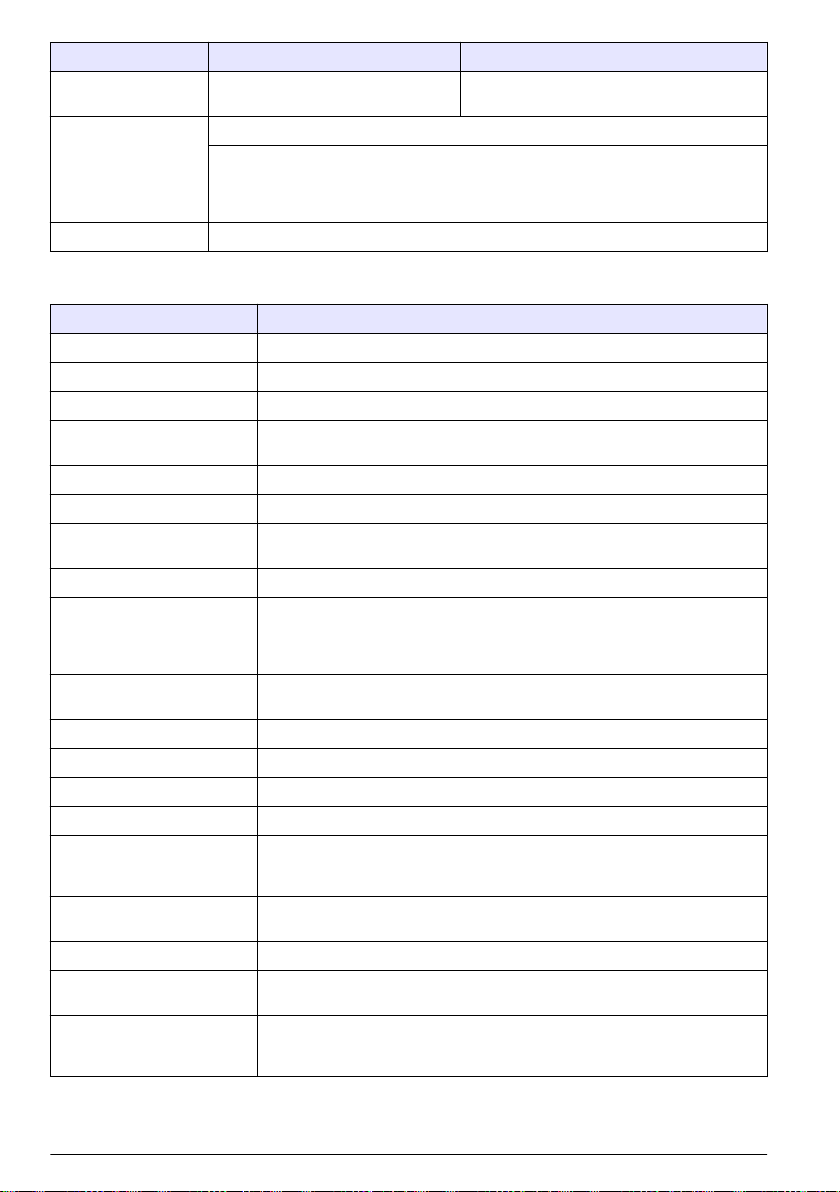
Specification Refrigerated Sampler AWRS
Enclosure 22-gauge steel (optional stainless
steel) with vinyl laminate overcoat
IP24, low-density polyethylene with UV
inhibitor
Sample bottle capacity Single bottle: 10 L (2.5 gal) glass or polyethylene, or 21 L (5.5 gal) polyethylene
Multiple bottles: two 10 L (2.5 gal) polyethylene and/or glass, four 10 L (2.5 gal)
polyethylene and/or glass, eight 2.3 L (0.6 gal) polyethylene and/or 1.9 L (0.5 gal) glass,
twelve 2 L (0.5 gal) polyethylene (AWRS only), twenty-four 1 L (0.3 gal) polyethylene
and/or 350 mL (12 oz.) glass
Certifications AC power supply: cETLus, CE
AS950 controller
Specification Details
Dimensions (W x H x D) 31.1 x 18.9 x 26.4 cm (12.3 x 7.4 x 10.4 in.)
Weight 4.6 kg (10 lb) maximum
Enclosure PC/ABS blend, NEMA 6, IP68, corrosion and ice resistant
Pollution degree/installation
category
3, II
Protection class II
Display ¼ VGA, color
Power requirements Refrigerated sampler: 15 VDC supplied by a power supply (115 to 220 VAC,
50/60Hz); AWRS: 15 VDC supplied by an integral power supply
Overload protection 7 A, DC line fuse for the pump
Operating temperature 0 to 50 °C (32 to 122 °F); Refrigerated sampler: 0 to 49 °C (32 to 120 °F);
AWRS with controller compartment heater: –40 to 50 °C (–40 to 122 °F); AWRS
with controller compartment heater and AC battery backup: –15 to 40 °C (5 to
104 °F)
Storage temperature Refrigerated sampler: –40 to 60 °C (–40 to 140 °F); AWRS: –30 to 60 °C
(–22 to 140 °F)
Storage/operating humidity 100% condensing
Pump Peristaltic high speed with spring-mounted Nylatron rollers
Pump enclosure Polycarbonate cover
Pump tubing 9.5 mm ID x 15.9 OD mm (3/8-in. ID x 5/8-in. OD) silicone
Pump tubing life 20,000 sample cycles with: 1 L (0.3 gal) sample volume, 1 rinse, 6-minute
pacing interval, 4.9 m (16 ft) of 3/8-in. intake tube, 4.6 m (15 ft) of vertical lift,
21 °C (70 °F) sample temperature
Vertical sample lift 8.5 m (28 ft) for 8.8 m (29 ft) maximum of 3/8-in. vinyl intake tube at sea level at
20 to 25 °C (68 to 77 °F)
Pump flow rate 4.8 L/min (1.25 gpm) at 1 m (3 ft) vertical lift with 3/8-in. intake tube typical
Sample volume Programmable in 10-mL (0.34 oz) increments from 10 to 10,000 mL (3.38 oz to
2.6 gal)
Sample volume repeatability
(typical)
±5% of 200 mL sample volume with: 4.6 m (15 ft) vertical lift, 4.9 m (16 ft) of 3/8-
in. vinyl intake tube, single bottle, full bottle shut-off at room temperature and
1524 m (5000 ft) elevation
4 English

Specification Details
Sample volume accuracy
(typical)
±5% of 200 mL sample volume with: 4.6 m (15 ft) vertical lift, 4.9 m (16 ft) of 3/8-
in. vinyl intake tube, single bottle, full bottle shut-off at room temperature and
1524 m (5000 ft) elevation
Sampling modes Pacing: Fixed Time, Fixed Flow, Variable Time, Variable Flow, Event
Distribution: Samples per bottle, bottles per sample and time based (switching)
Run modes Continuous or non-continuous
Transfer velocity (typical) 0.9 m/s (2.9 ft/s) with: 4.6 m (15 ft) vertical lift, 4.9 m (16 ft) of 3/8-in. vinyl intake
tubing, 21 °C (70 °F) and 1524 m (5000 ft) elevation
Liquid detector Ultrasonic. Body: Ultem® NSF ANSI standard 51 approved, USP Class VI
compliant. Contacting liquid detector or optional non-contact liquid detector
Air purge An air purge is done automatically before and after each sample. The sampler
automatically compensates for different intake tube lengths.
Tubing Intake tubing: 1.0 to 30.0 m (3.0 to 99 ft) length, ¼-in. or 3/8-in. ID vinyl or 3/8-in.
ID Teflon™-lined polyethylene with protective outer cover (black or clear)
Wetted materials Stainless steel, polyethylene, Teflon, Ultem, silicone
Memory Sample history: 4000 records; Data log: 325,000 records; Event log:
2000 records
Communications USB and optional RS485 (Modbus)
Electrical connections Power, auxiliary, optional sensors (2x), USB, distributor arm, optional rain
gauge, thermal (AWRS only)
Analog outputs AUX port: none; optional IO9000 module: Three 0/4–20 mA outputs to supply
the recorded measurements (e.g., level, velocity, flow and pH) to external
instruments
Analog inputs AUX port: One 0/4–20 mA input for flow pacing; optional IO9000 module: Two
0/4–20 mA inputs to receive measurements from external instruments (e.g.,
third-party ultrasonic level)
Digital outputs AUX port: none; optional IO9000 module: Four low voltage, contact closure
outputs that each supply a digital signal for an alarm event
Relays AUX port: none; optional IO9000 module: Four relays controlled by alarm
events
Certifications CE, cETLus
English 5

Figure 1 Refrigerated sampler and AWRS dimensions
General information
In no event will the manufacturer be liable for direct, indirect, special, incidental or consequential
damages resulting from any defect or omission in this manual. The manufacturer reserves the right to
make changes in this manual and the products it describes at any time, without notice or obligation.
Revised editions are found on the manufacturer’s website.
Safety information
N O T I C E
The manufacturer is not responsible for any damages due to misapplication or misuse of this product including,
without limitation, direct, incidental and consequential damages, and disclaims such damages to the full extent
permitted under applicable law. The user is solely responsible to identify critical application risks and install
appropriate mechanisms to protect processes during a possible equipment malfunction.
6 English

Please read this entire manual before unpacking, setting up or operating this equipment. Pay
attention to all danger and caution statements. Failure to do so could result in serious injury to the
operator or damage to the equipment.
Make sure that the protection provided by this equipment is not impaired. Do not use or install this
equipment in any manner other than that specified in this manual.
Use of hazard information
D A N G E R
Indicates a potentially or imminently hazardous situation which, if not avoided, will result in death or serious injury.
WARNING
Indicates a potentially or imminently hazardous situation which, if not avoided, could result in death or serious
injury.
CAUTION
Indicates a potentially hazardous situation that may result in minor or moderate injury.
N O T I C E
Indicates a situation which, if not avoided, may cause damage to the instrument. Information that requires special
emphasis.
Precautionary labels
Read all labels and tags attached to the instrument. Personal injury or damage to the instrument
could occur if not observed. A symbol on the instrument is referenced in the manual with a
precautionary statement.
This is the safety alert symbol. Obey all safety messages that follow this symbol to avoid potential
injury. If on the instrument, refer to the instruction manual for operation or safety information.
This symbol indicates that a risk of electrical shock and/or electrocution exists.
This symbol indicates that a risk of fire is present.
This symbol indicates that the marked item can be hot and should not be touched without care.
This symbol indicates that the item is to be protected from fluid entry.
This symbol indicates that the marked item should not be touched.
This symbol indicates a potential pinch hazard.
English 7

This symbol indicates that the object is heavy.
This symbol indicates that the marked item requires a protective earth connection. If the instrument is
not supplied with a ground plug on a cord, make the protective earth connection to the protective
conductor terminal.
Electrical equipment marked with this symbol may not be disposed of in European domestic or public
disposal systems. Return old or end-of-life equipment to the manufacturer for disposal at no charge to
the user.
Certification
Canadian Radio Interference-Causing Equipment Regulation, IECS-003, Class A:
Supporting test records reside with the manufacturer.
This Class A digital apparatus meets all requirements of the Canadian Interference-Causing
Equipment Regulations.
Cet appareil numérique de classe A répond à toutes les exigences de la réglementation canadienne
sur les équipements provoquant des interférences.
FCC Part 15, Class "A" Limits
Supporting test records reside with the manufacturer. The device complies with Part 15 of the FCC
Rules. Operation is subject to the following conditions:
1. The equipment may not cause harmful interference.
2. The equipment must accept any interference received, including interference that may cause
undesired operation.
Changes or modifications to this equipment not expressly approved by the party responsible for
compliance could void the user's authority to operate the equipment. This equipment has been tested
and found to comply with the limits for a Class A digital device, pursuant to Part 15 of the FCC rules.
These limits are designed to provide reasonable protection against harmful interference when the
equipment is operated in a commercial environment. This equipment generates, uses and can
radiate radio frequency energy and, if not installed and used in accordance with the instruction
manual, may cause harmful interference to radio communications. Operation of this equipment in a
residential area is likely to cause harmful interference, in which case the user will be required to
correct the interference at their expense. The following techniques can be used to reduce
interference problems:
1. Disconnect the equipment from its power source to verify that it is or is not the source of the
interference.
2. If the equipment is connected to the same outlet as the device experiencing interference, connect
the equipment to a different outlet.
3. Move the equipment away from the device receiving the interference.
4. Reposition the receiving antenna for the device receiving the interference.
5. Try combinations of the above.
8 English
Product overview
D A N G E R
Chemical or biological hazards. If this instrument is used to monitor a treatment process and/or
chemical feed system for which there are regulatory limits and monitoring requirements related to
public health, public safety, food or beverage manufacture or processing, it is the responsibility of the
user of this instrument to know and abide by any applicable regulation and to have sufficient and
appropriate mechanisms in place for compliance with applicable regulations in the event of malfunction
of the instrument.
CAUTION
Fire hazard. This product is not designed for use with flammable liquids.
The sampler collects liquid samples at specified intervals and keeps the samples in a refrigerated
cabinet. Use the sampler for a wide variety of aqueous sample applications and also with toxic
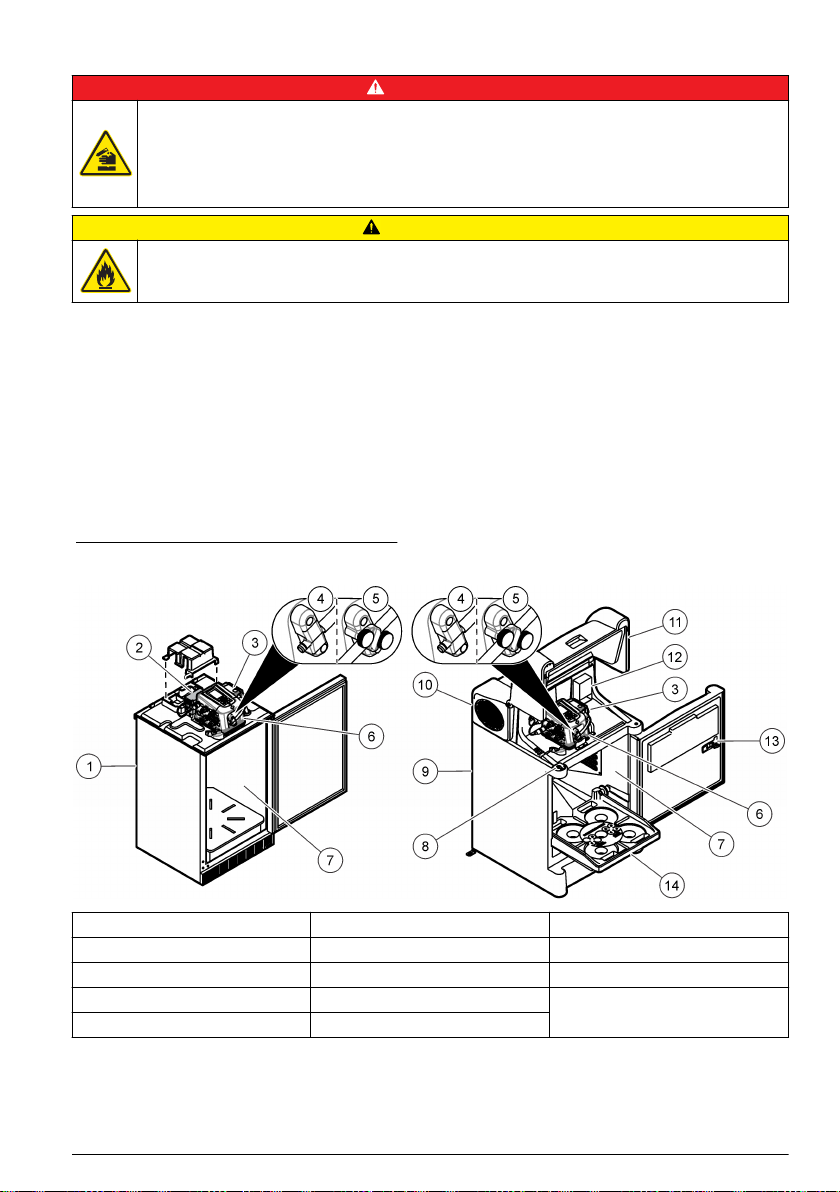
pollutants and suspended solids. Refer to Figure 2.
Lockable cabinet door (AWRS only)
Push the round button in the center of the latch to open the door. Flip the latch to close the door tight.
Two keys are supplied for the door lock. Over time, it may be necessary to tighten the adjustment
screw on the door latch.
Controller compartment heater (AWRS only)
The controller compartment heater is a factory-installed option. The heater prevents liquid from
freezing in the tubing, extends the life of the tubing and pump components and prevents the
collection of ice and snow on the cover.
Figure 2 Refrigerated sampler and AWRS
1 Refrigerated sampler 6 Controller 11 Controller cover
2 Power supply 7 Refrigerated cabinet 12 Compartment heater option
3 Pump 8 Cover latch 13 Door latch
4 Liquid detector 9 AWRS 14 Bottle tray
5 Non-contacting liquid detector 10 Access cover
English 9
Product components
WARNING
Personal injury hazard. Instruments or components are heavy. Use assistance to install or move.
The instrument weighs a maximum of 86 kg (190 lb). Do not try to unpack or move the instrument
without sufficient equipment and people to do it safely. Use correct lifting procedures to prevent
injury. Make sure that all used equipment is rated for the load, for example, a hand truck must be
rated for a minimum of 90 kg (198 lb). Do not move the sampler when filled sample bottles are in the
refrigerated cabinet.
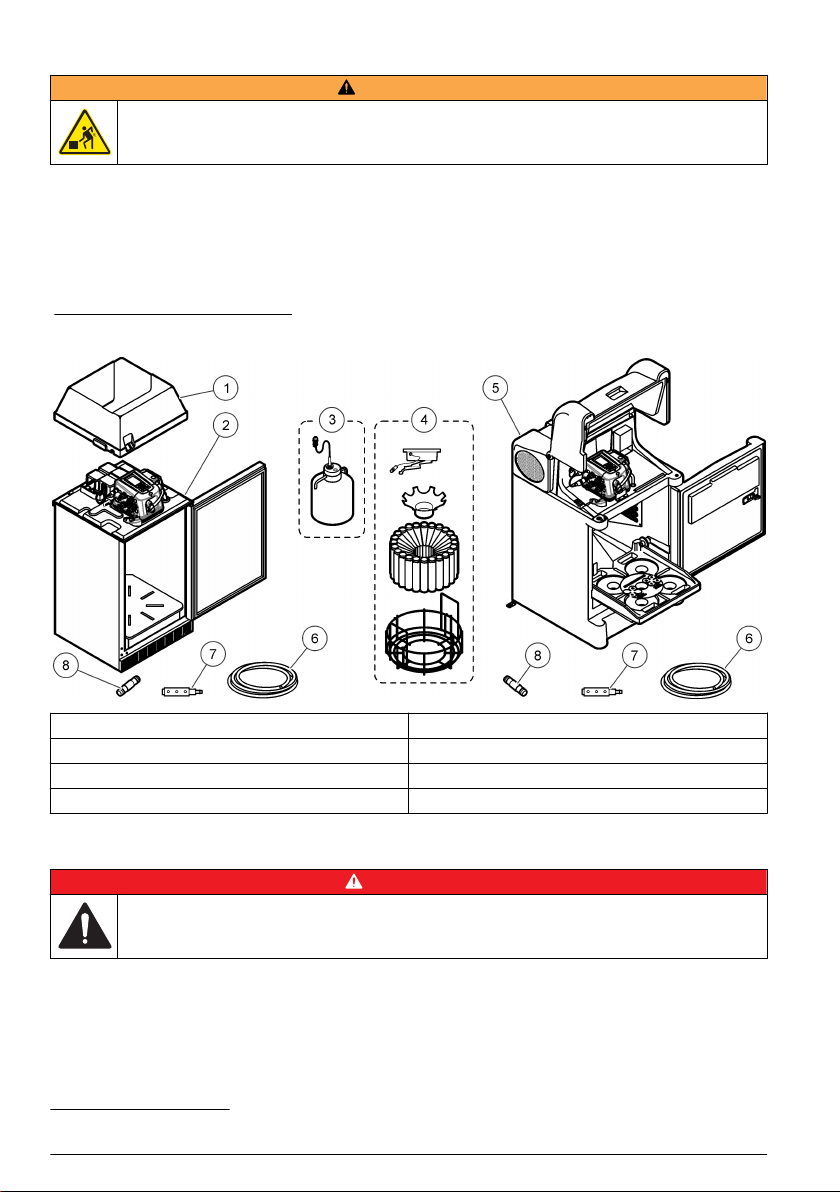
Make sure that all components have been received. Refer to Figure 3. If any items are missing or
damaged, contact the manufacturer or a sales representative immediately.
Figure 3 Sampler components
1 Optional cover 5 All Weather Refrigerated Sampler (AWRS)
2 Refrigerated sampler 6 Intake tubing, vinyl or teflon-lined
3 Components for single-bottle option 7 Strainer
4 Components for multiple-bottle option 8 Tubing coupler3
Installation
D A N G E R
Multiple hazards. Only qualified personnel must conduct the tasks described in this section of the
document.
3Supplied with controllers with the non-contacting liquid detector only.
10 English
Autres manuels pour AS950 AWRS
8
Ce manuel convient aux modèles suivants
2
Table des matières
Langues :
Autres manuels Hach Réfrigérateur


