
GSL TECHNOLOGY 24100U Manuel utilisateur

POWERBANKS STORAGE SYSTEM
User Manual
Version: 2.0
24100U (25.6V 100AH-2.56KwH)
24200U (25.6V 200AH-5.12Kwh)
24300U (25.6V 300AH-7.68Kwh)
For On / Off Hybrid Solar Storage System

- 1 -
Contents
1. Safety Precautions ............................................................................................................................................ - 2 -
1.1. Before Connecting ........................................................................................................................................................ - 2 -
1.2. During operation ........................................................................................................................................................... - 2 -
2. Battery Specifications ...................................................................................................................................... - 3 -
3. Introduction to the battery ............................................................................................................................... - 4 -
3.1. Key Features ................................................................................................................................................................. - 4 -
3.2. Interface Introduction .................................................................................................................................................... - 4 -
3.3. SOC Indicator & Status Indicator Guides ..................................................................................................................... - 5 -
3.4. Connectors .................................................................................................................................................................... - 6 -
3.5. Wake Up button ............................................................................................................................................................ - 6 -
4. Safe handling guide .......................................................................................................................................... - 7 -
4.1. System Diagram ........................................................................................................................................................... - 7 -
4.2. Tools ............................................................................................................................................................................. - 7 -
4.3. Safety Gear ................................................................................................................................................................... - 7 -
5. Installation .......................................................................................................................................................... - 8 -
5.1. Inventory of items .......................................................................................................................................................... - 8 -
5.2. Installation Location ...................................................................................................................................................... - 9 -
5.2.1. Minimum clearances .............................................................................................................................................. - 9 -
5.3. Installing the Battery Pack .......................................................................................................................................... - 10 -
5.3.1. Mounting to a wall ................................................................................................................................................ - 10 -
5.4. Parallel use of battery ................................................................................................................................................. - 10 -
6. Product Warranty ............................................................................................................................................ - 13 -
6.1. ..................................................................................................................................................................................... - 13 -
6.2. ..................................................................................................................................................................................... - 13 -
6.3. ..................................................................................................................................................................................... - 13 -
6.4. Factory Warranty Scope ............................................................................................................................................. - 13 -
6.5. Warranty conditions .................................................................................................................................................... - 13 -

- 2 -
1.Safety Precautions
It is very important and necessary to read the user manual carefully before installing or using the
battery. Failure to follow any of the instructions or warnings in this document can result in
electrical shock, serious injury, death, or may damage the battery and the whole system.
If the battery is stored for a prolonged time, it is requirement that they are charged every three to
six months, and the SOC should be no less than 80%.
The battery needs to be recharged within 12 hours, after fully discharging.
Do not expose cable outside.
All battery terminals must be disconnected before maintenance.
Do not use cleaning solvents to clean the battery.
Do not expose the battery to flammable or harsh chemicals or vapors.
Do not paint any part of the battery, include any internal or external components.
Do not connect battery with PV solar wiring directly.
Any foreign object is prohibited to be inserted into any part of the battery.
Any warranty claims are excluded for direct or indirect damage due to items above.
1.1.Before Connecting
After unpacking, please check the battery and packing list first, if the battery is damaged or spare
parts are missing, please contact the dealer.
Before installation, be sure to cut off the grid power and make sure the battery is in the turned-off
mode;
Wiring must be correct, do not mix-connect the positive and negative cables, and ensure no short
circuit with the external device;
It is prohibited to connect the battery with AC power directly;
The embedded BMS in the battery is designed for 48VDC, please DO NOT connect battery
in series;
It is prohibited to connect the battery with different type of battery;
Please ensure the electrical parameters of battery system are compatible to inverter;
Keep the battery away from fire or water.
1.2.During operation
If the battery system needs to be moved or repaired, the power must be cut off first and the
battery is completely shutdown;
It is prohibited to connect the battery with different type of battery;
It is prohibited to put the batteries working with faulty or incompatible inverter;
In case of fire, only dry powder fire extinguisher can be used, liquid fire extinguishers are
prohibited;
Please do not open, repair or disassemble the battery. We do not undertake any consequences
or related responsibility due to violation of safety operation or violating of design, production and
equipment safety standards.

- 3 -
2.Battery Specifications
Battery Specifications
Model No 24100U 24200U 24300U
Nominal Parameters
Voltage 25.6V 25.6V 25.6V
Capacity 100Ah 200Ah 300Ah
Energy 2.56KwH 5.12KwH 7.68KwH
Dimensions (L x W x H) 610 x440 x215mm 610 x440 x215mm 610 x440 x215mm
Weight 25.50kg 72.5kg 68.5kg
Basic Parameters
Life time(25°C) 20 years
Life cycles(80% DOD, 25°C) 6500 Cycles
Storage time / temperature 5 months @ 25°C; 3 months @ 35°C; 1 month @ 45°C
Operation temperature -20°C to 60°C @60+/-25% Relative Humidity
Storage temperature 0°C to 45°C @60+/-25% Relative Humidity
Lithium Battery Standard UL1741, CE, ROHS, IEC62619,IEC62133, UN38.3,MSDS
Enclosure protection rating IP21
Electrical Parameters
Operation voltage 25.6 Vdc 25.6 Vdc 25.6 Vdc
Max. charging voltage 29.2Vdc 29.2Vdc 29.2Vdc
Cut-off Discharge Voltage 20 Vdc 20 Vdc 20 Vdc
Max. charging and discharging
current 100A(2560W) 200A(5120W) 200A(5120W)

- 4 -
3.Introduction to the battery
3.1.Key Features
LiFePO4 composition – provides exceptional safety and longevity
High safety and reliability
6,000cycles/ 20 years’ service life
Consistent performance over wide temperature range
Wall-mounted, convenient installation
Integrated state-of-the-art BMS to manage and monitor battery information including voltage,
current and temperature as well as balance cell charging/discharging rates
10 years’ warranty
3.2.Interface Introduction
This section details the interface functions of front and back panel.
Front interface:
No Description Silk-screen Remark
1 Anderson connector + Output terminal
2 Anderson connector - Output terminal
3 Dial switch ADS Set the address
4 CAN CAN Inverter communication port
5 RS485 Port RS485 Parallel communication
6 Port Reset button RST For reset the batter
7 Switch OFF/ON Normal close
8 LED CAPACITY Capacity indicator

- 5 -
9 LED ALM Alarm indicator
10 LED RUN Operation indicator
11 Bracket
12 Handle
3.3.SOC Indicator & Status Indicator Guides
Chart 1: Battery Status
Chart 2: Battery Capacity
Chart 3: Battery status

- 6 -
3.4.Connectors
Charge / Discharge connectors: to connect the positive pole (+) and negative pole (-) from the
battery to the inverter via DC isolator.
Canbus Active communication portal between battery and inverter.
USB To RS485: to get dynamic monitoring data of the battery from upper computer.
Address: Reserved Address portal for multiple parallel connections.
3.5.Wake Up button
Battery On: When battery is shut down, press this RST button for 6 seconds. It is activated
when the LED lights flicker from RUN light to the lowest capacity indicator.
Battery off: When battery is activated, press this button for 6 seconds. It will be shut down
when the LED lights flicker from lowest capacity indicator to RUN light.

- 7 -
4.Safe handling guide
4.1.System Diagram
4.2.Tools
The following tools are required to install the battery pack:
Wire cutter
Crimping Modular Plier
Screw Driver
NOTE
Use properly insulated tools to prevent accidental electric shock or short circuits.
If insulated tools are not available, cover the entire exposed metal surfaces of the available
tools, except their tips, with electrical tape.
4.3.Safety Gear
It is recommended to wear the following safety gear when dealing with the battery pack:
Insulated gloves
Safety goggles
Safety shoes

- 8 -
5.Installation
5.1.Inventory of items
Thoroughly inspect the packaging upon receipt of goods. If there is any item missing or if there is any
damage to the external packaging or to the unit itself upon unpacking, please contact us immediately.
NO. Item Quantity Specification
1 Battery Pack
1 PC 2.56KwH
5.12KwH
7.68KwH
2 Wall mounted Bracket and Screws
1 SET
3 Power Cable
1 SET 35mm2 ( 4AWG) Black , Red
L 2.0 meter
Anderson 350A Standard+ M8 Termial
4 Canbus Cable
1 PC Battery canbus port to Inverter Canbus
port
L : 1.5 meter
5 Parallel com cable
1 PC Battery com port to Battery com port for
parallel 16pcs at max
L: 1.0 meter
- 9 -
5.2.Installation Location
Make sure that the installation location meets the following conditions:
The installation site must be suitable for the size and weight of the battery.
Must be installed on a firm surface to sustain the weight of battery.
The area is water proof.
There are no flammable or explosive materials in proximity
The ambient temperature is within the range from 0°C to 45°C.
The temperature and humidity is maintained at a constant level.
There is minimal dust and dirt in the area.
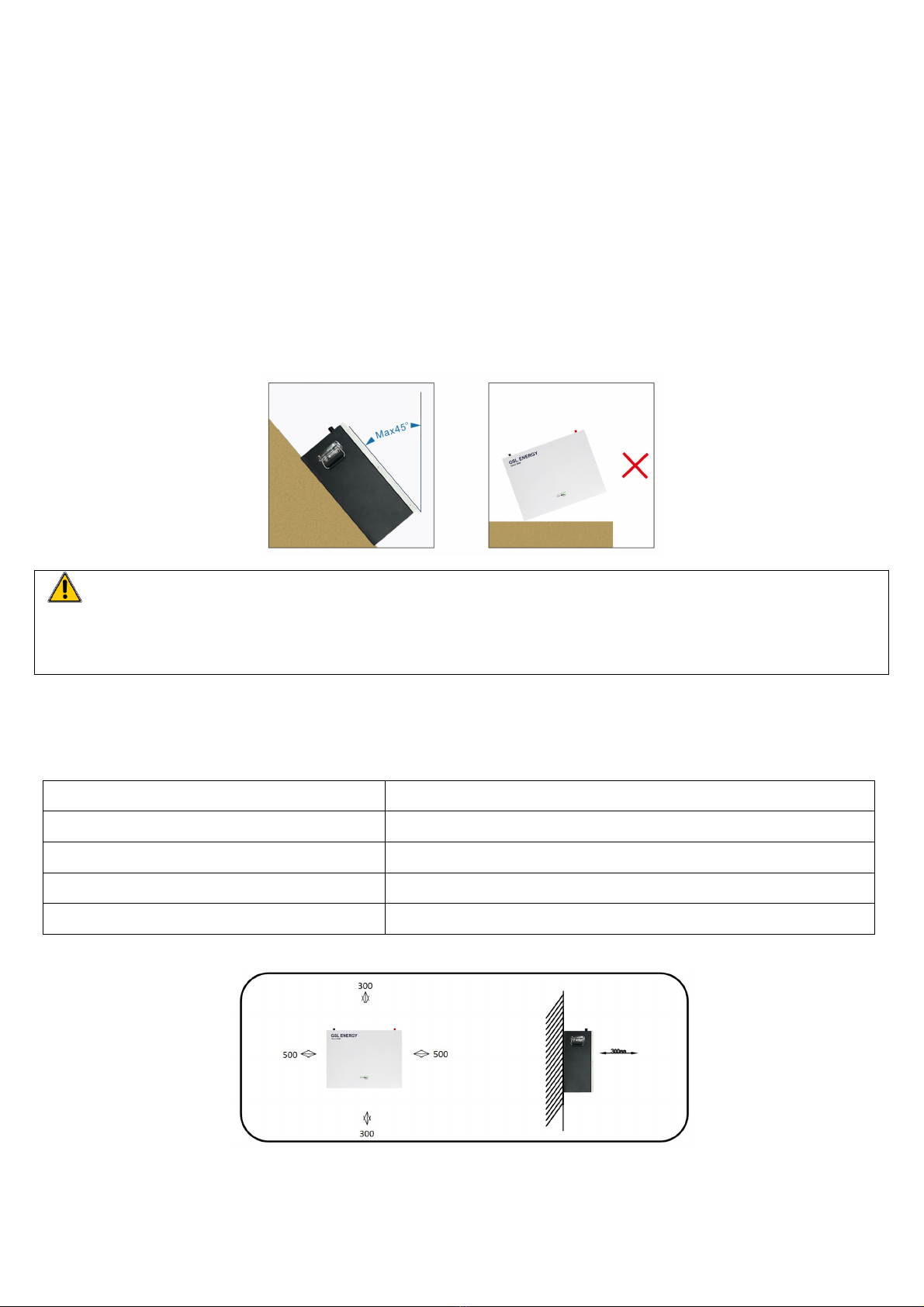
Installation must be vertical or tilted backwards by maximum 15° - avoid forward or sideway
stilt.
CAUTION
If the ambient temperature is outside the operating range, the battery pack stops operating to protect
itself. The optimal temperature range for the battery pack to operate is 0°C to 45°C. Frequent exposure
to harsh temperatures may deteriorate the performance and life of the battery pack.
5.2.1.Minimum clearances
Observe the minimum clearances to walls, other batteries or objects as shown in the diagram and
picture below in order to guarantee sufficient heat dissipation
Direction Minimum clearance (mm)
Above 300
Below 300
Sides 500
Front 300
Ce manuel convient aux modèles suivants
2
Table des matières


