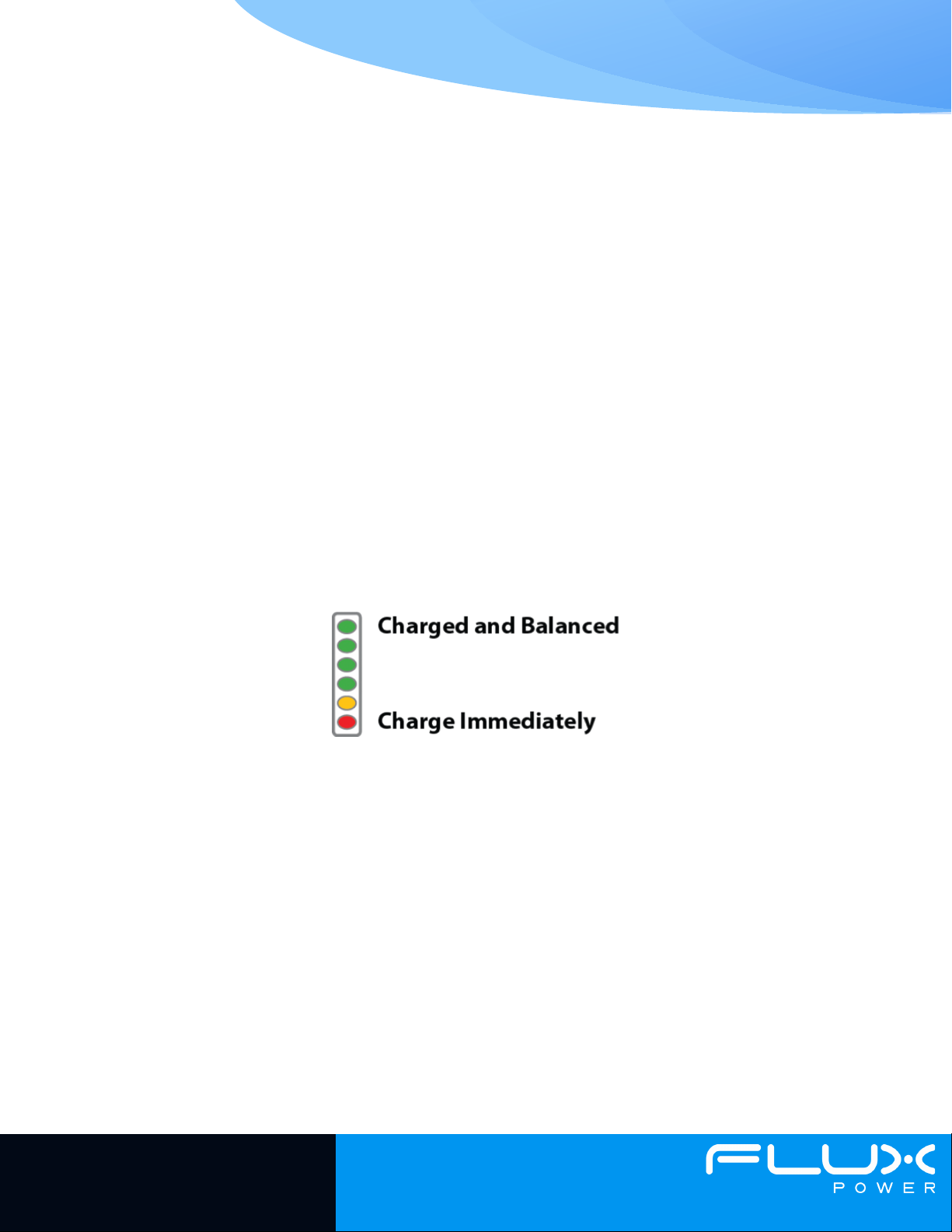
charge
Charge, Immediate
Periodically
Connect appropriate charger
4. Safety and Reliability
Flux Power LiFT Packs are completely sealed and require no watering. No electrolyte must be added and there is no
danger of acid spills or explosive vapors during normal use. In addition, the Flux Power LiFT Pack S8 is designed to
pass the UL 2580 standard.
•WARNING: Do Not Disconnect the Anderson cable connector under load.
•Not Suitable for water exposure.
•Not intended for use in a marine environment.
•For indoor use only.
•ALWAYS use proper lifting techniques and equipment when installing the battery.
•The battery does not require regular maintenance but should be plugged in overnight once per week to allow
the cells to balance.
•Do NOT attempt to open the battery, unless authorized by a Flux Power representative.
•Do NOT tamper with the main power Anderson connector.
4.1 Hazardous Material Information
Lithium-ion batteries are considered HazMat Class 9 - Miscellaneous. There are no reporting regulations required for
Flux Power LiFT Packs federally (specifically under the Resource Conservation and Recovery Act of 1976 (RCRA) and
the Emergency Planning and Community Right-to-Know Act (EPCRA)). There are hazmat regulations when shipping
lithium-ion batteries.
There are sometimes state or city regulations that differ from federal law, however, generally speaking, a Flux Power
LiFT Pack S8 under normal use has no danger of leakage, spilling, outgassing, or presenting any danger to the end
user. Federal regulations are very strict when dealing with lead-acid batteries due to the environmental impacts of heavy
metals (lead) and inherent dangers present: acid spills, explosive gases, and lead poisoning.
For more information on local regulations, contact your local EPA and fire department or contact Flux Power and we will
do our best to assist you.
4.2 What to do if a Cell Breach Occurs
If a cell breach occurs open the doors and windows to allow ventilation. Do not use water to clean up the electrolyte, but
instead use absorbent material. Place the contaminated rags in a metal bin. Avoid breathing the fumes, and in case of
fire, do not use water, use a type D, CO2, dry chemical, or foam fire extinguisher. For more information contact Flux
Power or refer to the Safety Data Sheet (SDS). The SDS is available on the Flux Power website at
www.Fluxpower.com.
The damaged pack and cleaning materials should be placed in a sealed plastic or steel container and disposed of or
recycled using the measures required by your local EPA.