
Feider Machines FMTCPRO100 Manuel utilisateur

ORIGINAL INSTRUCTIONS
PETROL TILLER
INSTRUCTION MANUAL
FMTCPRO100
BUILDER SAS
ZI, 32 rue aristide Bergès – 31270 Cugnaux - France
MADE IN PRC 2020
CAUTION: Read the instructions carefully. Be familiar with the controls and the
proper use of the equipment

ORIGINAL INSTRUCTIONS
1. SAFETY WARNING:
For your safety and safety of others please pay special attention to these precautions:
1) Training
a) Read the instructions carefully. Be familiar with the controls and the proper use of the
equipment;
b) Never allow children or people unfamiliar with these instructions to use the machine. Local
regulations can restrict the age of the operator;
c) Never work while people, especially children, or pets are nearby;
d) Keep in mind that the operator or user is responsible for accidents or hazards occurring to
other people or their property.
2) Preparation
a) While working, always wear substantial footwear and long trousers. Do not operate the
equipment when barefoot or wearing open sandals;
b) Thoroughly inspect the area where the equipment is to be used and remove all objects which
can be thrown up by the machine;
c) WARNING – Petrol is highly flammable:
Store fuel in containers specifically designed for this purpose;
Refuel outdoors only and do not smoke while refuelling;
Add fuel before starting the engine. Never remove the cap of the fuel tank or add petrol
while the engine is running or when the engine is hot;
If petrol is spilled, do not attempt to start the engine but move the machine away from
the area of spillage and avoid creating any source of ignition until petrol vapours have
dissipated;
Replace all fuel tank and container caps securely;
d) Replace faulty silencers;
e) Before using, always visually inspect to see that the tools are not worn out or damaged.
Replace worn out or damaged elements and bolts in sets to preserve balance.
3) Operation
a) Do not operate the engine in a confined space where dangerous carbon monoxide fumes can
collect;
b) Work only in daylight or in good artificial light;
c) Always be sure of your footing on slopes;
d) Walk, never run with the machine;
e) For wheeled rotary machines, work across the slopes, never up and down;
f) Exercise extreme caution when changing direction on slopes;
g) Do not work on excessively steep slopes;
h) Use extreme caution when reversing or pulling the machine towards you;
i) Do not change the engine governor settings or overspeed the engine;
j) Start the engine carefully according to manufacturer instructions and with feet well away from
the tool(s);

ORIGINAL INSTRUCTIONS
k) Do not put your hands or feet near or under rotating parts;
l) Never pick up or carry a machine while the engine is running;
m) Stop the engine:
Whenever you leave the machine;
Before refueling;
n) Reduce the throttle setting during engine shut down and, if the engine is provided with a
shut-off valve, turn the fuel off at the conclusion of working;
4) Maintenance and storage
a) Keep all nuts, bolts and screws tight to ensure the equipment is in safe working condition;
b) Never store the equipment with petrol in the tank inside a building where fumes can reach an
open flame or spark;
c) Allow the engine to cool before storing in any enclosure;
d) To reduce the fire hazard, keep the engine, silencer, battery compartment and petrol storage
area free of vegetative material and excessive grease;
e) Replace worn or damaged parts for safety;
f) If the fuel tank has to be drained, this shall be done outdoors.
Thrown Object Hazard
Objects hit by the rotating tines can be thrown from the tiller with great force and may cause
severe injury.
1) Before tilling, clear the tilling area of sticks, large stones, wire, glass etc.
2) Pieces thrown from worn or damaged-tines can cause serious injury. Always inspect the
tines before using the tiller.
Fire and Burn Hazard
Gasoline is extremely flammable and gasoline vapor can explode.
Use extreme care when handing gasoline. Keep gasoline out of reach of children.
1) Refuel in a well-ventilated area with the engine stopped.
2) Allow the engine to cool before refueling. Fuel vapor or spilled fuel may be ignited.
3) The engine and exhaust system becomes very hot during operation and remains hot
after stopping. Touching them can cause burn injuries or some materials burn.
4) Avoid touching a hot engine or exhaust system.
5) Allow the engine to cool before performing maintenance or storing the tiller indoors.
Carbon Monoxide Poisoning Hazard
Exhaust contains poisonous carbon monoxide a colorless and odorless gas. Breathing exhaust
can cause loss of consciousness and may lead to death.
ORIGINAL INSTRUCTIONS
Operation on Slope
1) When tilling on slopes, keep the fuel tank with less than half oil to minimize fuel
spillage.
2) When the tiller walks across the slope, put your effort evenly while walking up and
down the slope.
3) Be very careful when changing the direction of the tiller on a slope.
4) Do not use the tiller on a slope of more than 10°.
5) The maximum safe grade angle shown is for reference only and the details should
depend on the type of the tool. Before starting the engine, check that the tiller is not damaged
and in good condition. For your safety or safety of others, pay special attention when using the
tiller up or down hill.
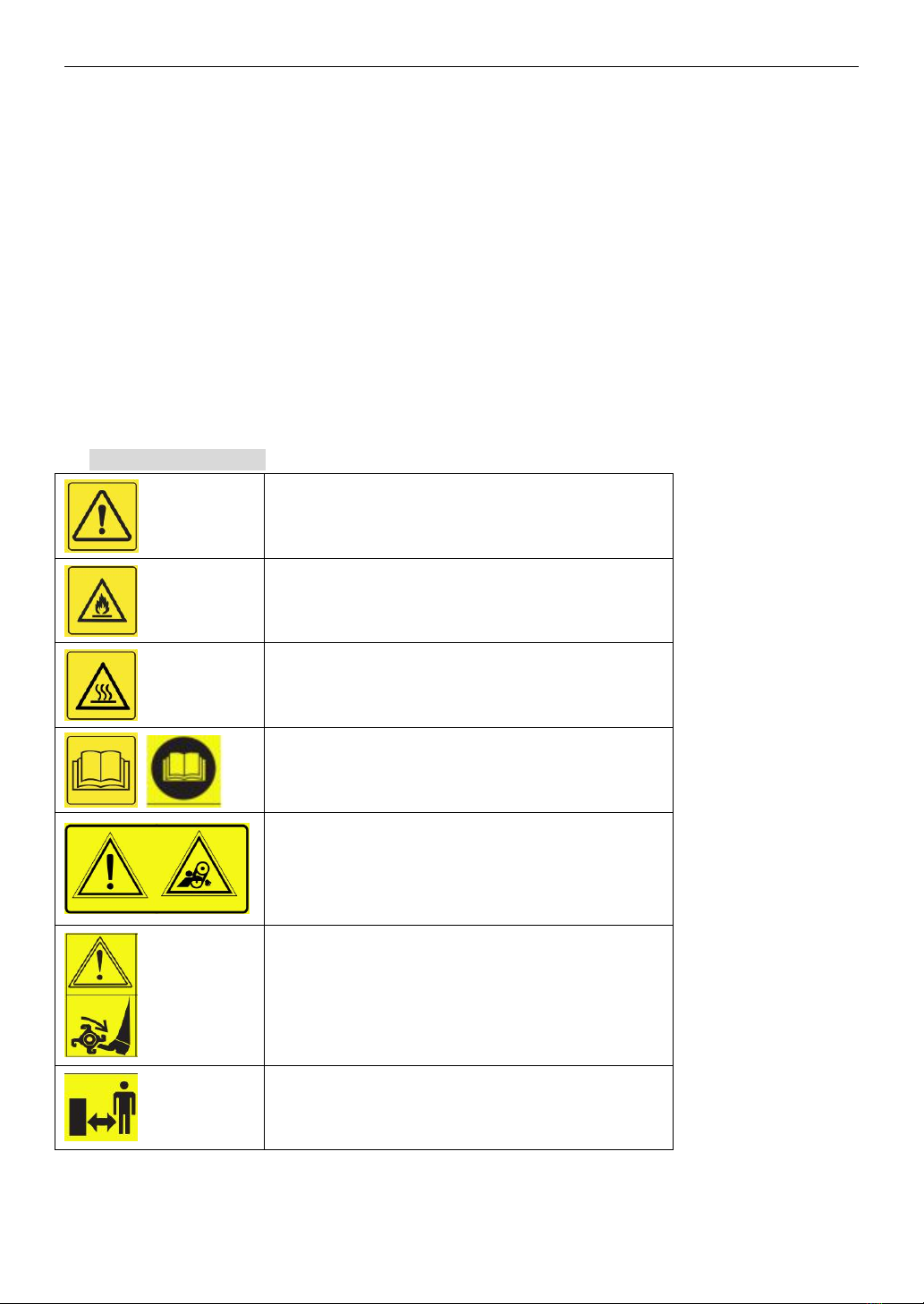
2. WARNING SYMBOL
Attention!
Caution: fire risk!
The part is extremely hot! Do not touch!
Read the instruction manual before use
Caution: Do not put your hands in belt when it
running.
Caution: rotating working tool!
Keep away from the machine.

ORIGINAL INSTRUCTIONS
Warning: Exhaust emissions are harmful to
health of body.
Add engine oil.
That the machine shall always be used in accordance with these manufacturer's instructions
the instruction handbook
The engine shall be stopped when carrying out maintenance and cleaning operations, when
changing tools and when being transported by means other than under its own power;
Some hazards can be met when working on slopes; work slowly by holding firmly the tool.
Do not transport the tool on slopes. The hazards can rise when working on difficult soil
(stony, hard, etc.). there is a risk to hit some objects, sliding, lose control for the machine
which will gives damages. Always inspect the working area before working, and always
watch what you are doing.
The adjustable part of the protective device shall be adjusted to the working depth of the tool
so that only that part of the working tool that cuts into the soil remains uncovered. This does
not apply to motor hoes.
The machine should only be operated by suitably trained persons.
During the operation of the machine safety shoes should be worn.
Always start up the machine under normal conditions
Intended use
This device is to be used only as an electric hoe for aerating lawns and grassy areas in private
home gardens and pleasure gardens. It is not intended for use in public spaces, parks, sports
fields, agriculture or forestry. Use of this device for any other purpose is considered incorrect
and unapproved. The manufacturer will not be responsible for any damage or injury resulting
from such use. The user is fully responsible for all related risks.

ORIGINAL INSTRUCTIONS
3. Tiller description
1).The main technical parameters
Power: 4 kW
Speed: 3600/min
Oil volume ( l ) :0.6.
Fuel tank capacity (l): 3.6
Power tiller
Packing SIZE (L x W x H(mm): 900x460x660
Weight: 114kg/75/kg
Working width (mm): 1000
Working depth (mm) :100-160
Guarantee sound power level: 98 dB(A)
Sound power level measured : Left: 78,9 dB(A)Right: 80dB(A)
Sound pressure level measured: 94.1 dB(A).
Vibration value:Left: 6,14m/s² Right: 5,48 m/s²K=1,5m/s²
Engine
Engine model H170F
Type:single cylinder, OHV four-stroke,forced air coolingDisplacement
212 cm3
ORIGINAL INSTRUCTIONS
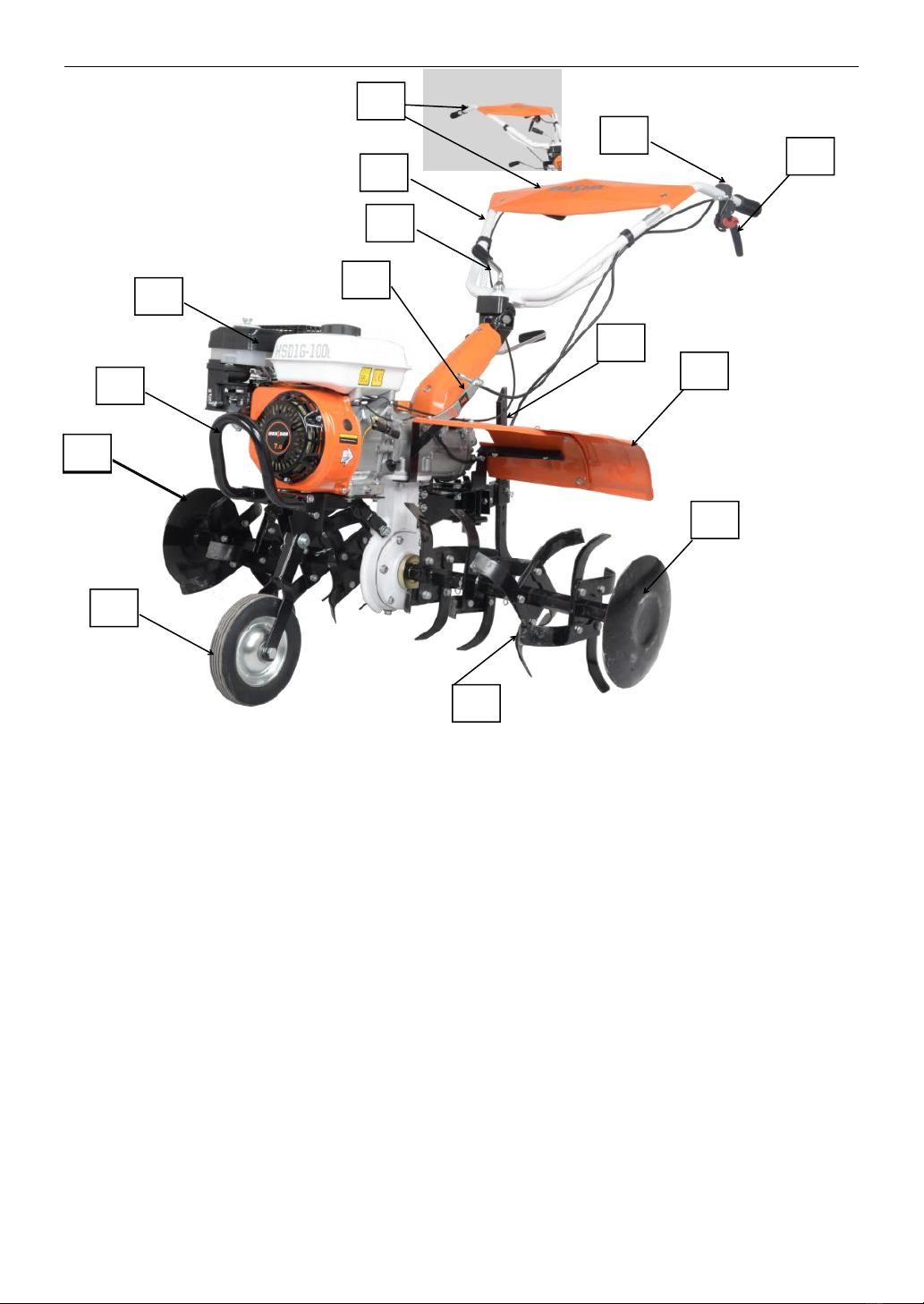
2).Know your machine
1. Handle
2. Petrol engine
3. Side disc
4. Handlebar adjustment
5. Fender
6. Blades
7. Depth regulator
8. Gear change lever
9. Clutch lever
10. ON/OFF Switch
11. Throttle switch
12.Bumper
13.Front Support wheel
1
2
3
3
5
6
7
8
9
10
11
3
12
13
4

ORIGINAL INSTRUCTIONS
3).Daily inspection
WARNING:
Always use 4-stroke quality oil engine. If you use a different type of oil, the service
life of the engine will be shortened. Keep the engine in a horizontal position. If oil is
spilled as a result of rotation, wipe clean.
4. Tiller installation and use
1). Tiller assembly
Before leaving the factory, the main parts of the power tiller have been checked. However, those
using the machine in micro cultures must contact a shop for checking and adjustment so that the
power tiller offers an improved performance. Owners must follow the following step to assemble
it:
1) The wheel must be installed in the gearbox, at the hex shaft at both sides of the
transmission shaft with locking screws.
2) Place the arm in the body in the position required on the basis of the terrain in relation to the
axis and insert the depth regulator at the basis of the tiller.
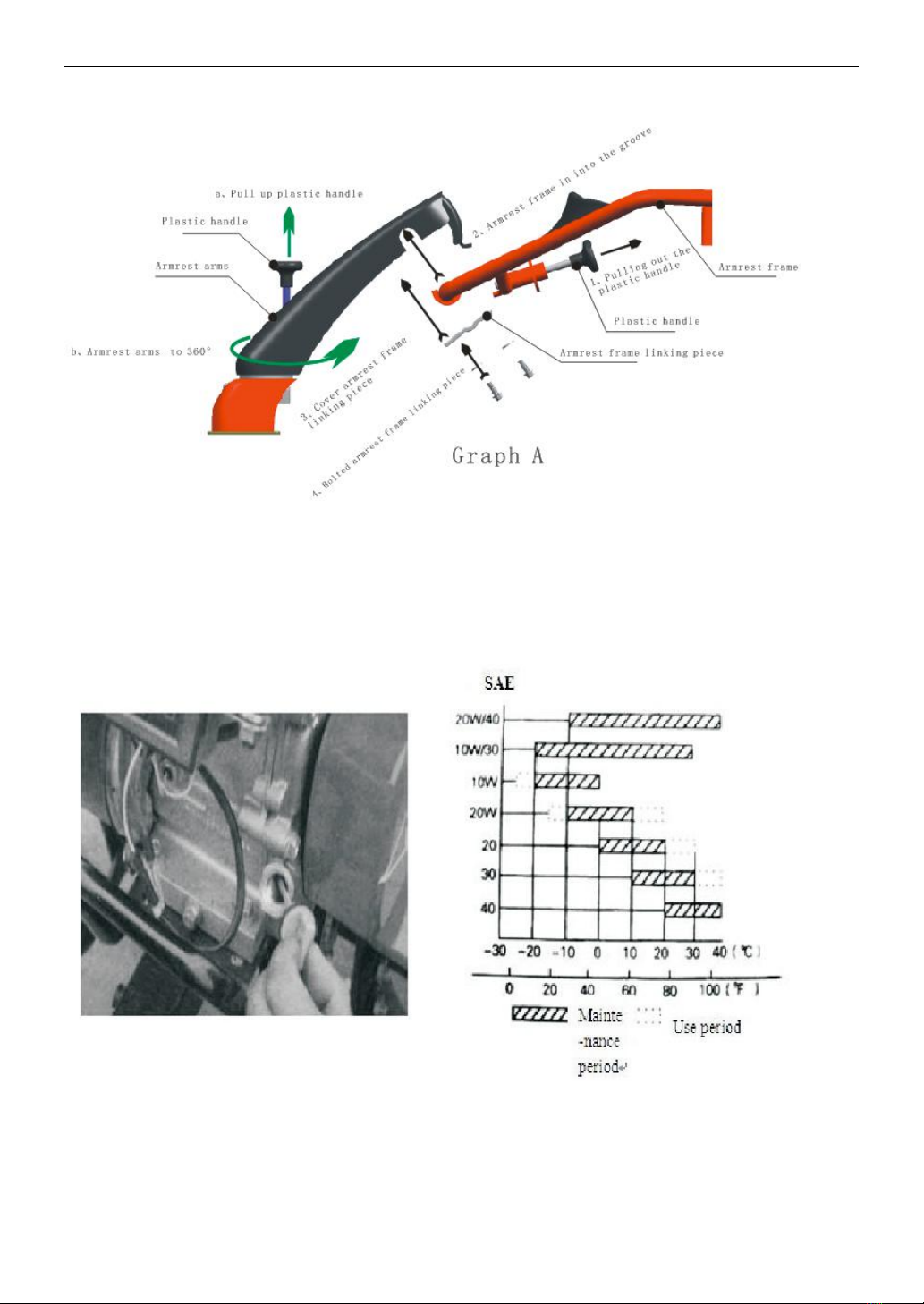
3) Armrest handle. Pull from the armrest handle at the upper section of the semicircle with the
armrest covered and the screw in relief as shown on Figure A below.
4) Pull up the armrest by pull from the plastic handle. The armrest may be 360 degrees.
5) Mount the fender on the engine fixed support and the body.
.
WARNING:
This is a 0.6 l engine. if the level of oil is below normal and you continue to use the
machine, the engine will be seriously damaged.
ORIGINAL INSTRUCTIONS
Empty the oil, check that the oil level is normal. Oil SAE15W-40 is recommended for
general lubrication and is suitable for a general environment temperature
2). CHECK OIL IN THE GEARBOX.
Place the machine on la flat surface for working. Unscrew the oil level. The normal value is
1.5 l. If too low, add oil up to normal value.
SAE15W is the recommended oil -40.
ORIGINAL INSTRUCTIONS
3) . Check air filters
If the engine were operating without a filter, engine wear would accelerate.
4) Tiller adjustment method,
(1) Assembling the handle and height adjustment
WARNING:
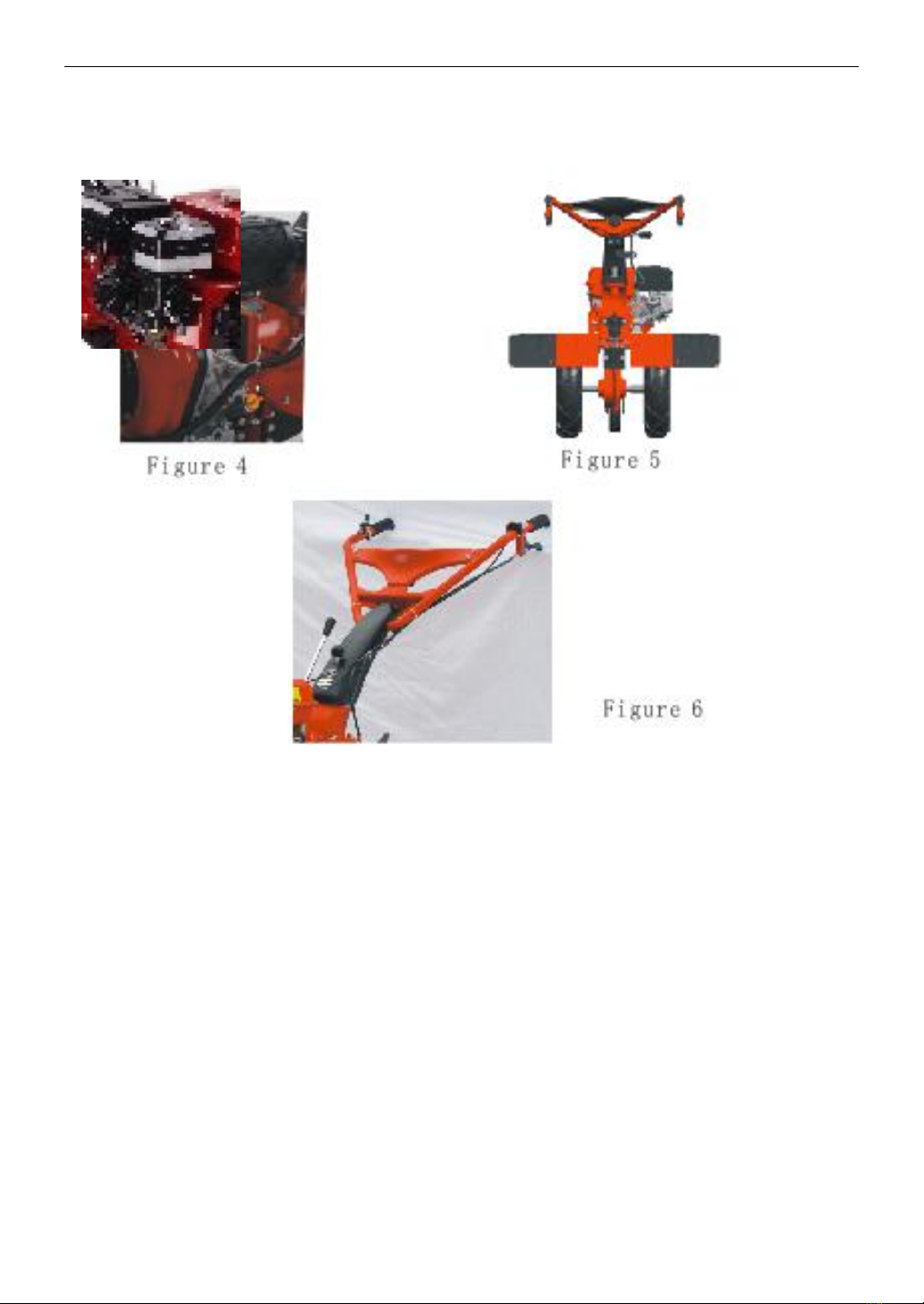
In order to adjust handle height Begin by placing the parts on a flat terrain to prevent the
machine from skidding. (Figure 5) Loosen the adjusting bolt, place the handle at waist level and
then fasten the belt adjustment. (Figure 6)
(2) Tilling depth adjustment. The height of the bar can be adjusted as well as the rotation control,
the tilling and cutting depth. (Figure 7)
Table des matières
Autres manuels Feider Machines Taller


