ESBE AB
·
BRUKSGATAN 22
·
SE-330 21 REFTELE
·
TEL: +46 (0)371 570 000
·
FAX: +46 (0)371 570 010
·
SALES@ESBE.SE
·
WWW.ESBE.SE
VAT.NO. SE556269631901
·
BANK: NORDEA
·
ACCOUNT: 4217-101200-1
·
SWIFT NDEASESS
·
IBAN: SE65 3000 0000 0421 7101 2001
Technical description CRC110 rev A
CHARACTERISTIC HEATING CURVE, GENERAL INFORMATION
Generally, an outdoor sensor based controller is always based on the characteristic heating curve.
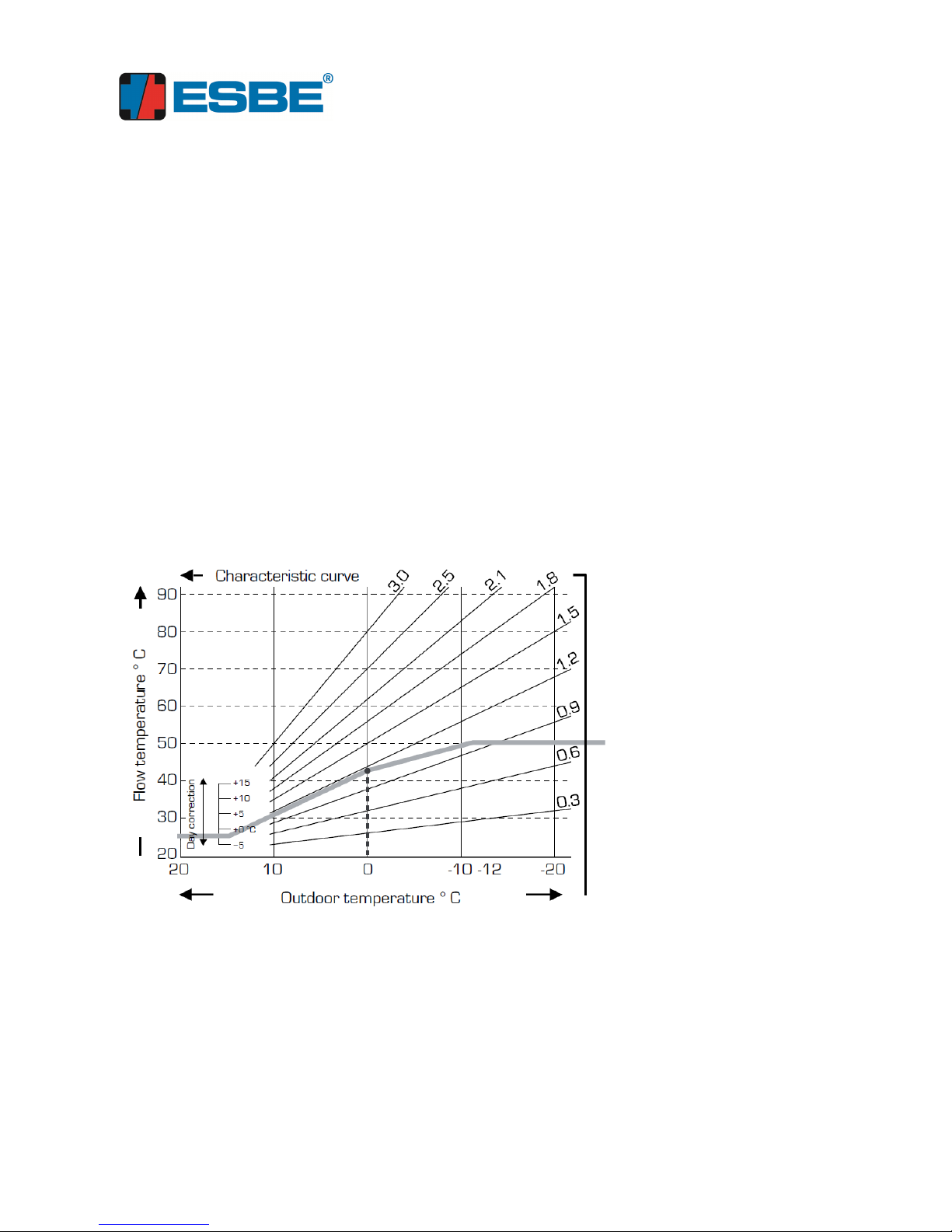
The curve describes the flow temperature to the heat circuit at a specific outdoor temperature. When
it´s gets colder outdoors, the flow temperature to the heat circuit gets warmer. The characteristic
heating curve has normally a different set-up of slopes. A steeper slope will have a higher flow
temperature compare to flatter slope at the same outdoor temperature.
Example with the graph below: At the outdoor temperature of -10ºC the curve 1.8 will supply
about 74ºC fluid to the heat circuit. On the other hand, the curve 0,6 will only supply about 38ºC
fluid to the heat circuit at the same outdoor temperature.
A characteristic heating curve normally also have the possibility to change the step of the slope at
one point (split point). The curve can be steeper before the point and more flat after the point or vice
versa. Normally there is also a lower and upper limit of the flow temperature.
Example with the graph below: The grey line shows the chosen curve. The lower limit is set to
25ºC, the upper limit to 50ºC. There is a split point at 0ºC outdoor temperature and the first part of
the curve is according to 0,9 settings and the second part of the curve is according to 0,7 settings.
If the user feels that the indoor temperature is too high or low he must change the curve settings and
in some cases also the split point. A change of the curve setting will affect the complete curve. The
CRC110 is made different and a change of the flow temperature will only affect a part of the curve
and the user doesn´t need to think about curve settings or split points. On the following pages the
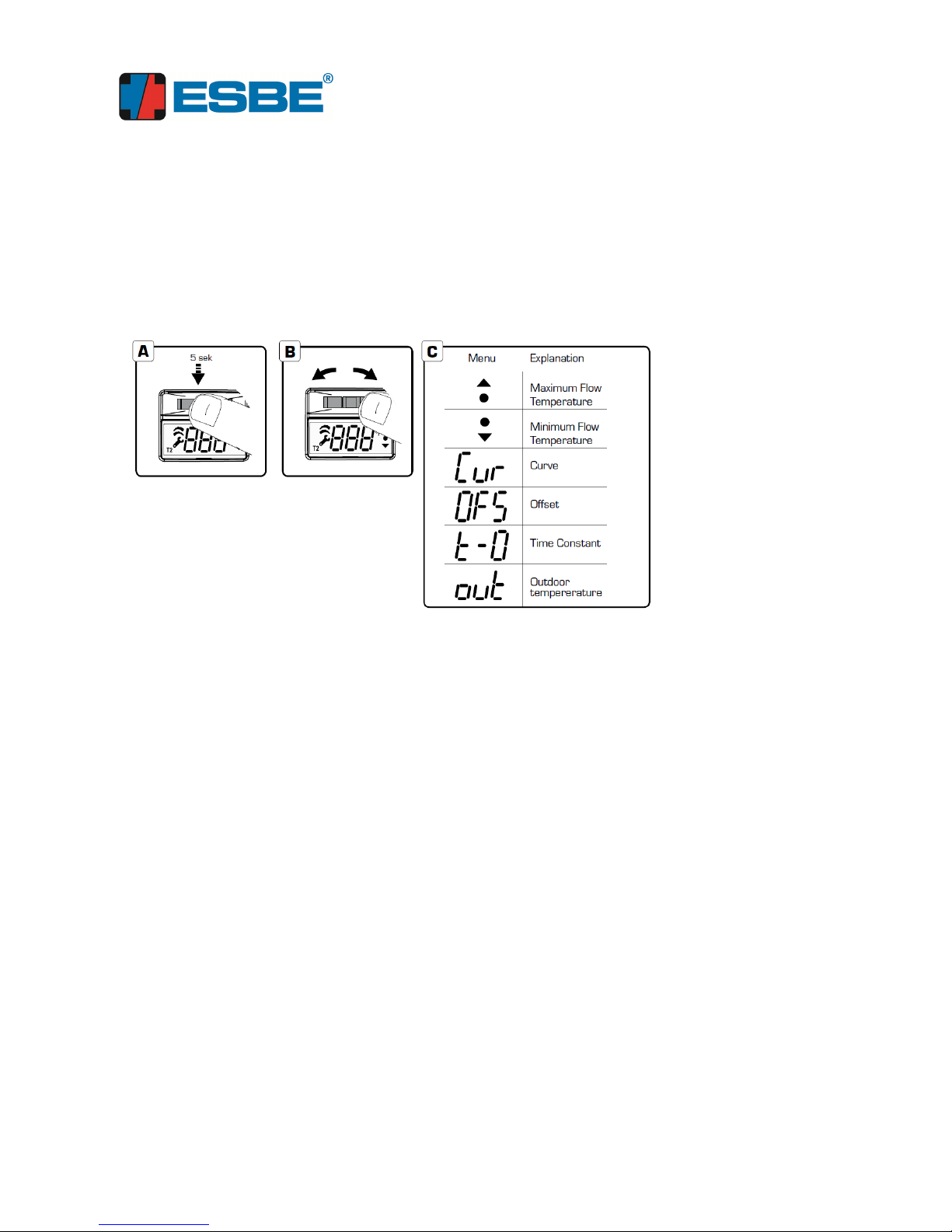
settings of the CRC110 will be presented and also how the different settings affect the curve.