10 11
VI. Inputs & Filters Controls
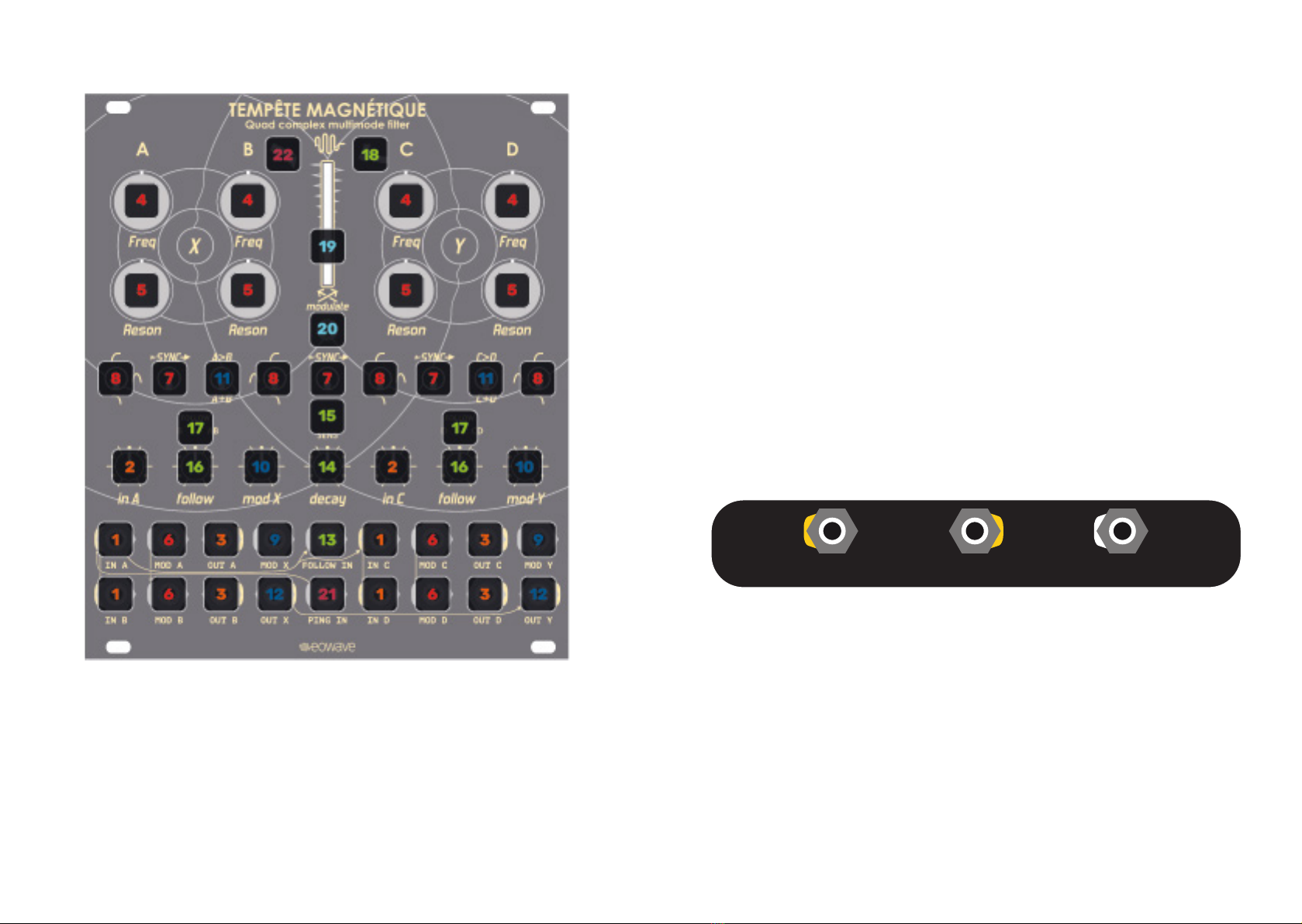
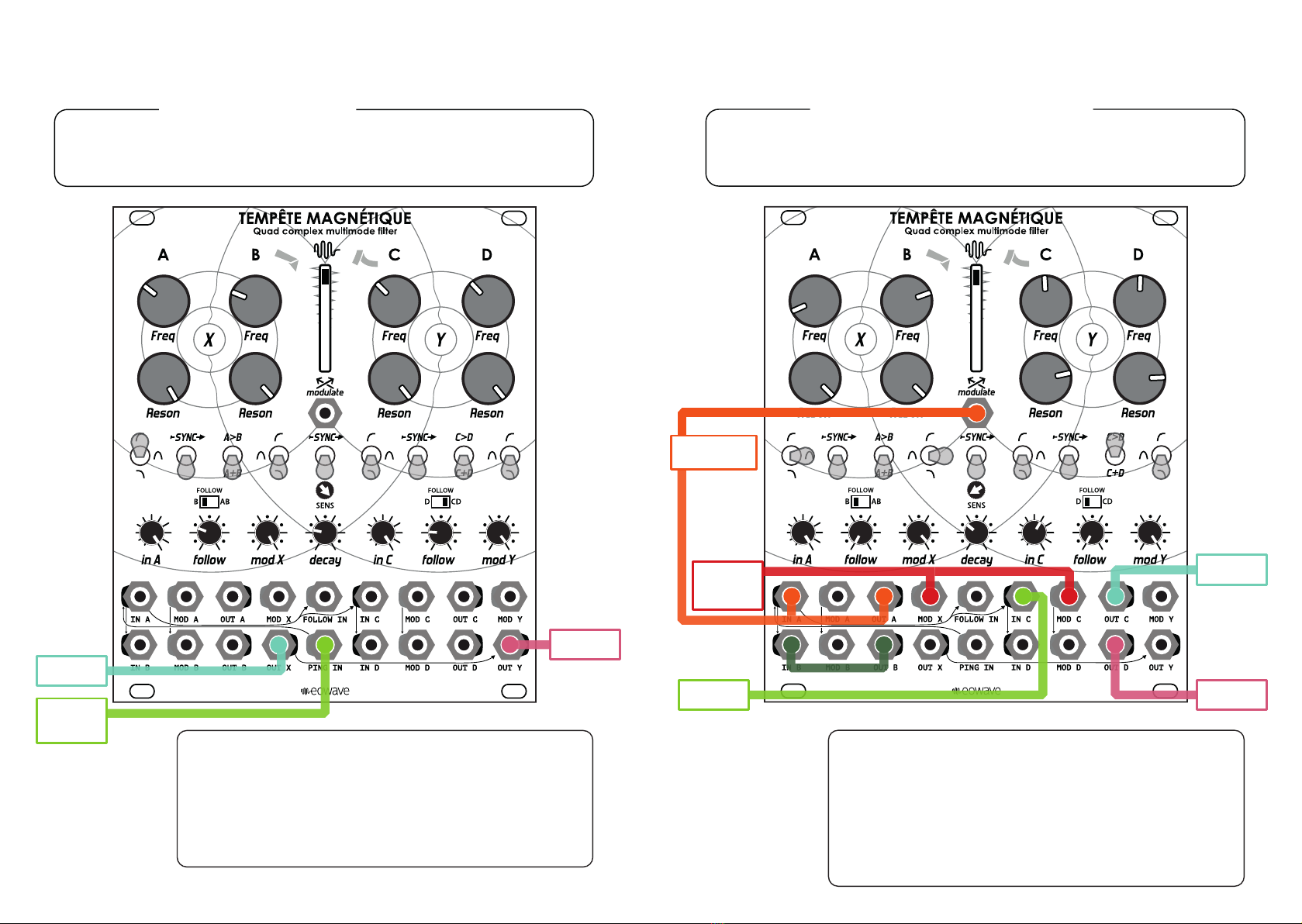
the Tempete magnetique as four 12db (2pôles) lters labeled A, B, C,
and D. Each lter has:
Of course audio inputs (1), the rst audio input of each pair(«IN A» &
«IN C») has a gain potentiometrer(2) who will add some distortion at
some point( it depend to the amplitude of your input signal).
The second input of each pair «IN B» & «IN D» has high gains to
warm it up and make possible the creation of oscillator by feeding
back the outputs to the input.
It will add some saturation to your sound (you can attenuate the
signal if you don’t want it)
«Freq» potentiometers (4) are for adjusting the cuto frequencies
«Reson» potentiometers (5) are for adjusting the resonances levels
A selector switch for each lter allow you to choose between
highpass bandpass and lowpass ltering.(8)
CV inputs for modulating the cuto frequency in approximative v/
oct (6), and individuals audio outputs (3).
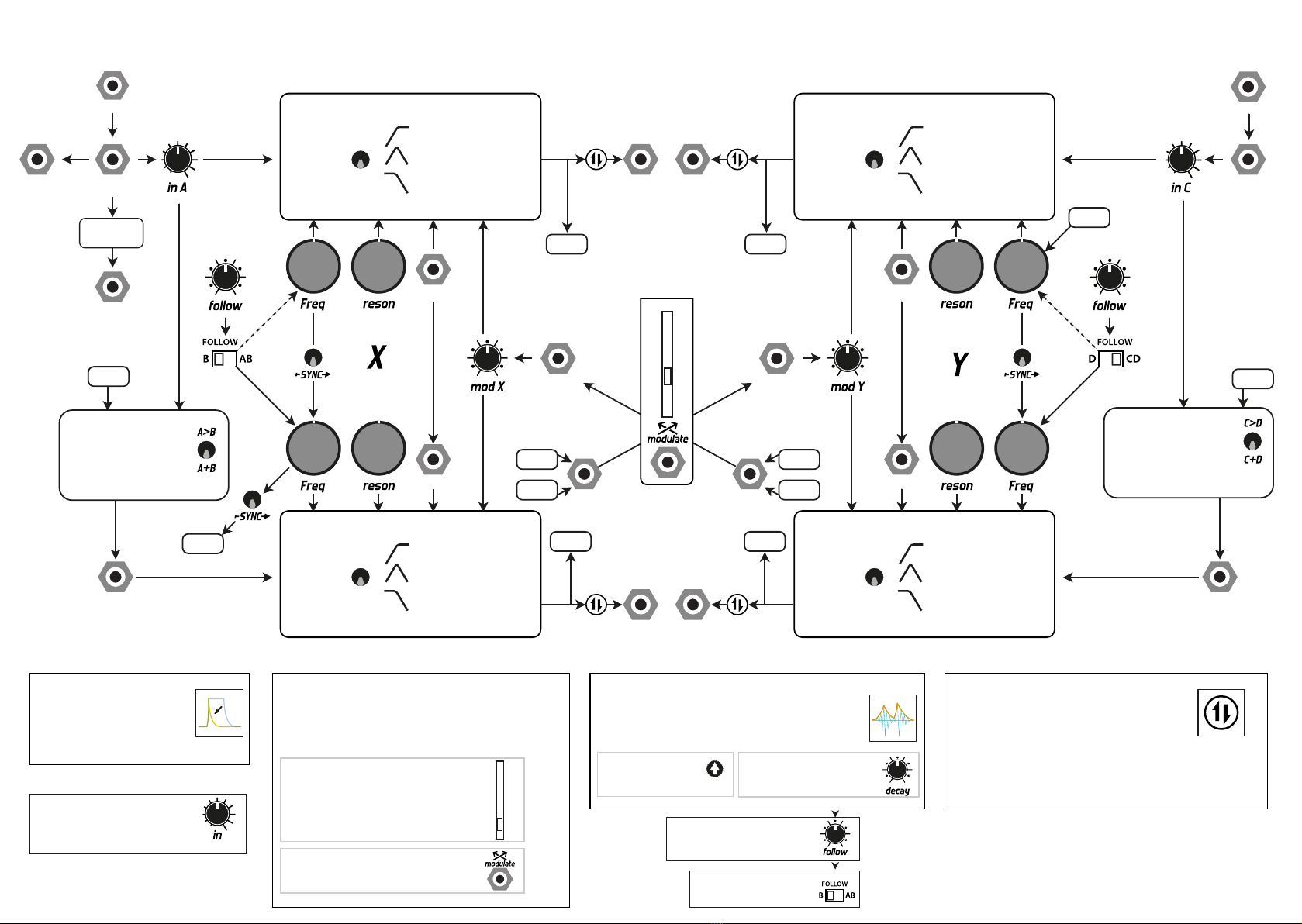
Beyond that, the lters can be control by pairs.
The «MODX» and «MODY» (9) inputs control both ot the lters of
each pairs. You can attenuate this input with the corresponding po-
tentiometers (10). When nothing is plugged to these input, They are
used for the crossmodulation engine ( see section VI).
VII. Series/Parallel & SYNC Switches
The serial/parallel switch for each pair of lters (11) allows you to
choose whether the lters are connected in series or in parallel. In
series conguration, the output of one lter is fed into the input of
the next lter, resulting in a more complex and pronounced l-
tering eect. In parallel conguration, the output of each lter is
combined, resulting in a more subtle and less pronounced ltering
eect.
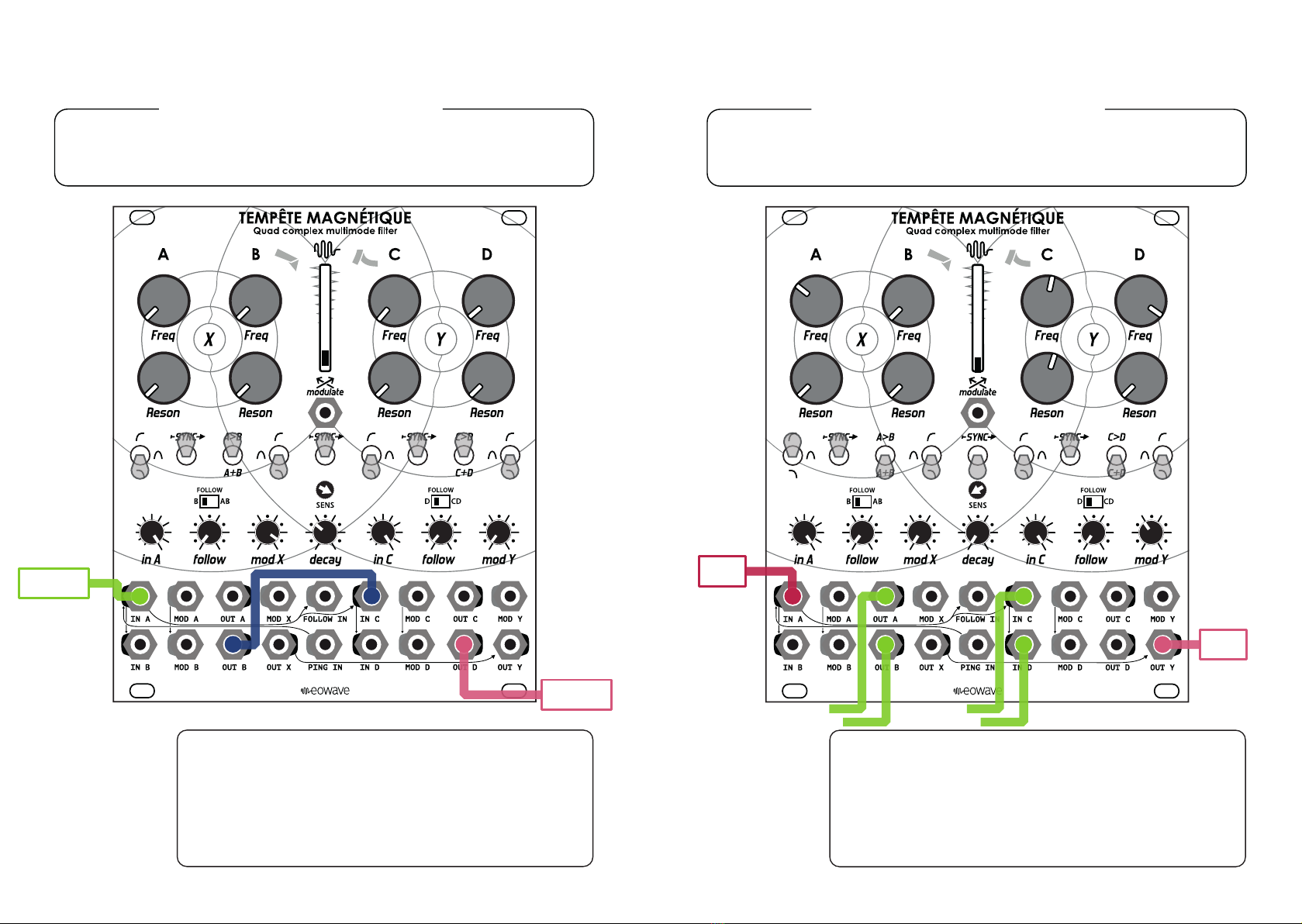
The IN A input is normalized to the IN B (if put in parallel with the
A+B switch) and IN C inputs. The IN C input is also normalized to
the IN D input ( if put in parallel mode with the C+D switch) (respec-
tively). If put in in serial (A>B) the output a is going to the input B
and if (C>D) the OUT C is going in the IN D ( meaning if you plug just
a source on input a, it goes in all the inputs).
The MOD A and MOD C inputs are respectively normalized to the
MOD B and MOD D inputs, these inputs are approximatively in v/oct
In addition to the selector switch and frequency and resonance
controls, lters A and C also have a gain potentiometer who allow
you to add some distortion.
Between each pair of lters, there is a SYNC switch (7) that allows
the right lter to track the cuto frequency of the most left lter
; For example, activating SYNC between lters A and B will cause
lter B to be controlled by lter A. Synced lters has their cuto
shifted a bit to create more warmth. If you turn a synced pot, it will
change a bit the frequency of this one.
Using the SYNC feature in conjunction with the series/parallel switch allows for
even more flexibility in shaping the sound. For example, if all four filters are in
series and in SYNC mode, with each filter being a 12dB/octave filter, you can
create a 48dB/octave filter or two 24dB/octave filters. You can also create
crossover configurations, such as a highpass and a lowpass, to create multiband
processing effects.