Proper ergonomics transform workouts
When it comes to elliptical cross trainers, the newest and
fastest growing category of fitness equipment, all definitely
are not created equal. Anyone can step onto several
different machines and quickly realize that each has its own
very distinct motion and feel, unlike other fitness equipment
such as treadmills and stationary bikes.
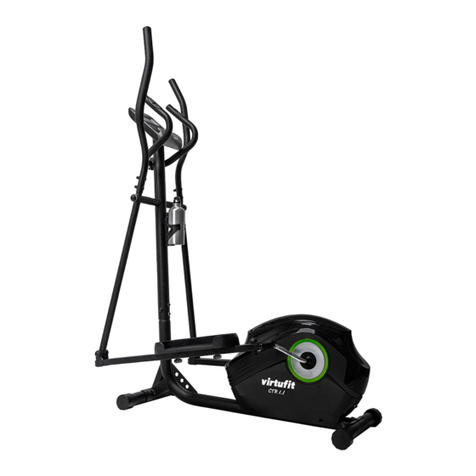
An elliptical cross trainer is a unique combination of a stair
climber and a cross-country ski machine, requiring the feet
to follow an elliptical motion that typically goes forward or
reverse. Some units also include arms that engage the upper
body as well. The advantage of these total-body machines
is that they require on upright, weight bearing position in
a natural, closed kinetic chain while training all the bodyʼs
major muscle groups - including the gluteals, hamstrings,
quadriceps, calves, lats, chest, deltoids, biceps, and triceps
- which, worked together, result in maximum calorie burn and
distinguishes ellipticals from virtually all other cardiovascular
equipment.
Quality elliptical machines foster a smooth, natural, low-
impact cardiovascular workout that challenges everyone
from beginners to elite athletes. Studies have shown that
compared to other exercises, total body elliptical cross
trainers require significant oxygen consumption and result in
high caloric expenditure for efficient, effective workouts.
Also, total body machines that disperse the exercise
throughout enable exercisers to work at higher intensities
without actually perceiving greater exertion.
It is easy to see why these machines are tremendously
popular, but before investing in an elliptical cross trainer, it is
critical to evaluate its overall feel.
The importance of biomechanics
Biomechanics, which is the study of human movement, is an
important consideration for any piece of fitness equipment,
but even more so with the elliptical cross trainer due to the
complexity and variance of its movement. For the optimum
workout, the machine must fit the exerciser; individuals
should never be required to adapt their posture, position of
movement pattern to fit a piece of equipment. Elliptical
cross trainers ideally should simulate how the body naturally
moves for people of various shapes and sizes.
The motion on an elliptical cross trainer should replicate
movements like walking or running, which involve similar
biomechanics. Engineers therefore must consider
numerous factors to make the exercise biomechanically
correct while eliminating unnatural alignment of excessive,
repetitive stress or torque.
On most elliptical cross trainers, the biomechanical analysis
is as follows: the body moves in a linear direction through
flexion and extension at numerous joints in the sagittal
plane, including the shoulder, elbow, hip, knee, and ankle.
Machines with arms may also include a minimal amount of
radial and ulnar deviation in the frontal plane at the wrist
joint. Also, in total body units, the erector spinae may en-
gage in a bit of rotation in the transverse plane throughout
the range of motion.
Critical ergonomic factors
While biomechanics are integral in developing elliptical cross
trainers, ergonomics is really where the rubber hits the road.
Ergonomics is the science of adapting external conditions to
suit individuals, or in this case, using biomechanical analysis
to build the best feeling elliptical cross trainers to satisfy
exercisers and deliver results.
The essential ergonomic factors for elliptical cross trainers
all contribute to its motion or feel, and exercisers should
evaluate the following when choosing equipment:
Stride length - Either extreme, long or short, can cause
hyperextension in the hip joint in the forward motion as
well as unnatural, forced hip flexion when going in reverse,
and both can cause discomfort. The optimal stride length
of 18.5”, should comfortably accommodate the majority of
individuals in both forward and reverse motion.
Stride angle / height - This refers to the shape of the actual
ellipse, whether it is more circular or oblong. It should not
feel too vertical like a stair climber of cycle or too flat like a
cross-country skier. The result is a natural, comfortable ride
that optimally engages all major lower body muscles.
Stride width / pedal spacing - The wider the space
between the pedals, the greater the hips shift laterally during
the movement, which can create lower back pain. In addition,
a wide stance feels distinctly unnatural, since people walk
and run with their feet and legs close together.
Pedal acceleration - Anyone who has tried several brands
of ellipticals immediately notices the difference in how
quickly and smoothly the pedals move. Some are faster
on the downstroke and drag on the upswing, others have
a “kick” on the upswing that unnaturally propels the pedals
and can throw exercisers off balance. Without steady pedal
acceleration, the result is an uncomfortable and potentially
unsafe movement.
Inertia - Inertia deals with the amount of effort it requires to
get the pedals moving. With too much inertia, it is difficult to
get the machine going, but once started, momentum kicks in
and relieves exercisers of significant effort, which takes away
from the workout.
Pedal articulation - In most elliptical machines, the ankle
joint engages in dorsi flexion on the downstroke and plantar
flexion on the upstroke. Excessive plantar flexion leads to
transient paresthesia, a “numb toe” condition due to
compression of nerves in the foot, and extreme dorsi flexion
can limit knee and hip extension, which are essential for a
complete range of motion.
Upper body pivot point and range of motion - Unlike
treadmills, stationary cycles and stair climbers, many
elliptical cross trainers engage the upper body in movements
that should be synchronized with leg motion. Arm handles
should simulate natural shoulder and arm flexion and
extension as seen in walking or running, and that excessive
radial or ulnar deviation may cause wrist discomfort.
ELLIPTICAL CROSS TRAINING
2