
Elcometer 138 Manuel utilisateur

www.elcometer.com
User Guide
Bresle Salt Kits
Elcometer 138
R

CONTENTS
R
en-1 www.elcometer.com
Section
Page
1
Overview
en-2
2
Box Contents
en-3
3
Test Procedure: ISO 8502-6 / ISO 8502-9
en-4
4
Test Procedure: US Navy PPI 63101-000
en-7
5
Technical Specification
en-10
6
Spares & Accessories
en-13
7
Legal Notices & Regulatory Information
en-14
APPENDIX A: Using the Elcometer 138 Bresle Salt Meter or Elcometer 138 Conductivity Meter
A1
Caution
en-16
A2
Fitting and Replacing the Batteries
en-1 6
A3
The Controls and Display
en-17
A4
Electrode Surface Treatment Procedure
en-19
A5
Calibration Procedure
en-19
A6
Taking a Reading
en-20
A7
After Measurement
en-21
A8
Care and Maintenance
en-21
For the avoidance of doubt, please refer to the original English language version.
A Material Safety Data Sheet for the Elcometer 138 Standard 84μS/cm Calibration Solution is available to download via our website:
http://www.elcometer.com/images/stories/MSDS/Elcometer_138_84uScm_Calibration_Solution.pdf
© Elcometer Limited 2009-2019. All rights reserved. No part of this document may be reproduced, transmitted, transcribed, stored (in a retrieval system
or otherwise) or translated into any language, in any form or by any means (electronic, mechanical, magnetic, optical, manual or otherwise) without
the prior written permission of Elcometer Limited.

1 OVERVIEW
www.elcometer.com
R
en-2
The Elcometer 138 Bresle Salt Kits provide all the materials and
equipment required to determine the surface chloride contamination
level.
Chloride salts are extracted from the surface using the Bresle Patch
method and the chloride content of the test solution is measured
a
using the Elcometer 138 Bresle Salt Meter or Elcometer 138
a
Conductivity Meter supplied.
These instructions incorporate two test methods:
Ÿ ISO 8502-6 / ISO8502-9
The Elcometer 138 Bresle Salt Kits can also be used in accordance with ISO 8502-11; AS 3894.6-A and
SSPC Guide 15.
b
For IMO PSPC , the surface salts should be measured and recorded. The Elcometer 138 Bresle Salt
Kits can be used for this.
Note: The Elcometer 138 meters measure aqueous solutions. They are NOT designed to measure solids, organic solvents,
surfactant, oil, adhesive, alcohol, strong acids (pH: 0 to 2) or strong alkalis (pH: 12 to 14). The life of the sensor will be
extremely short if these substances are measured.
Ÿ US NAVY PPI 63101-000 (Rev 27)
a Model supplied dependent on kit ordered.
b International Maritime Organisation, Performance Standard for Protective Coatings.

Kit Contents
Sales Part Number
E138-1
E138-1-CM
E138-1C
E138-1C-CM
Elcometer 138 Bresle Salt Meter & Sensor
ü
ü
Elcometer 138 Conductivity Meter & Sensor
ü
ü
Elcometer 135B Bresle Patch, Pack of 25
ü
ü
Elcometer 135C Bresle Test Patch, Pack of 25
ü
ü
Calibration Solution 84µS/cm; 250ml (8.45 fl oz)
with Certificate
ü
ü
ü
ü
Conditioning Solution; 14ml (0.47 fl oz)
ü
ü
ü
ü
Bottle of Pure Distilled Water; 250ml (8.5 fl oz)
ü
ü
ü
ü
Syringes, 5ml (0.17 fl oz); x3
ü
ü
ü
ü
Needles (Blunt); x3
ü
ü
ü
ü
Plastic Beaker; 30ml (1 fl oz)
ü
ü
ü
ü
CR2032 Lithium Batteries; x2
(supplied fitted to the Elcometer 138)
ü
ü
ü
ü
Transit Case
ü
ü
ü
ü
User Guide
ü
ü
ü
ü
R
en-3 www.elcometer.com
2 BOX CONTENTS
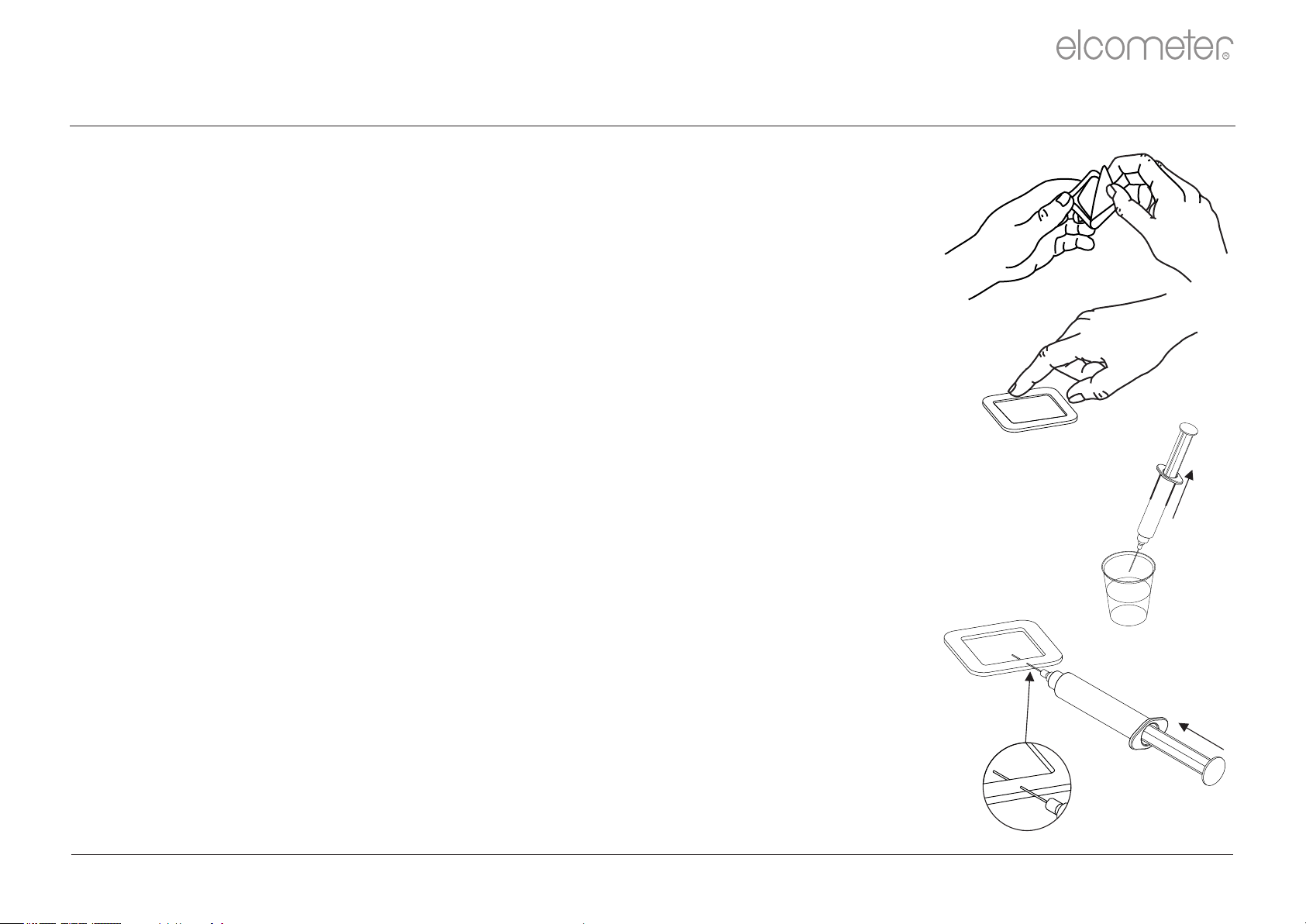
2 Apply the patch to the surface pressing firmly around the perimeter of the
patch to ensure a complete seal. If using the Elcometer 135C Bresle Test
Patch, remove the clear protective film cover using the orange tab.
3 As the test is extremely sensitive, clean latex or nitrile gloves should be
worn during the extraction of soluble salts to prevent contamination of the
surface.
4 If necessary, any air can be evacuated into the syringe and allowed to stay above the
water in the syringe. Take care not to re-insert the air during steps 6 and 7.
5 Inject the pure water into the patch. Do not remove the needle.
1 Remove the printed protective backing and foam centre from the Bresle
patch.
3 Fill a syringe with 3ml of pure water.
3.2 TEST PROCEDURE
4 Insert the syringe into the patch through the spongy foam perimeter at an
angle of approximately 30° to the test surface so that it passes through the
foam into the compartment formed by the elastomer film and the test
surface. If the patch is positioned in a difficult position bend the needle as
required.
2 Calibrate the Elcometer 138 Meter, see Appendix A Section A5 on
page en-19.
1 If using the Elcometer 138 Bresle Salt Meter, press the MEAS button to set
the measurement mode to ISO.
3.1 BEFORE YOU START
3 : 8502-6 / 8502-9TEST PROCEDURE ISO ISO
www.elcometer.com
R
en-4

c
6 During a suitable period of time , without removing the needle, suck
d
and re-inject the solution at least four times .
8 Analyse the solution using the Elcometer 138 Meter, see Section 3.4
on page en- . Inject the sample directly into the sensor cell. Rinse the 6
sensor cell several times with the solution to be measured before
taking the reading.
7 At the end of the period, extract as much solution as possible and
d
remove the syringe from the patch .
4 See Appendix A on page en-15 for further instructions on using the Elcometer 138
Meters.
1 Record the temperature of the solution.
2 Remove the patch from the surface and clean the surface. If
required, any adhesive residue from the patch left on the test surface
can be removed by wiping with a cloth moistened with a suitable
solvent. Ensure that the solvent will not damage the surface before
use.
3.3 AFTER TEST
3 Rinse all components of the test kit, other than the patch, in fresh,
pure water. The components can then be used again.
3 : 8502-6 / 8502-9 (continued)TEST PROCEDURE ISO ISO
d During steps 6 and 7, it is essential that no solution is lost. If any solution is lost, the test shall be rejected.
c On un-pitted blast-cleaned areas, a period of 10 minutes has been found to be satisfactory, though this time should be agreed by the interested parties.
1
2
3
4
5
R
en-5 www.elcometer.com

3 : 8502-6 / 8502-9 (continued)TEST PROCEDURE ISO ISO
e 2
Based on an area of 12.5cm and a volume of 3ml.
e
Surface Density of Salts: Factors
ISO Salt Mix
IMO PSPC equivalent NaCI
Reading
2
mg/m
µg/cm2
2
mg/m
µg/cm2
µS/cm
x1.2
x0.12
x1.1
x0.11
The Elcometer 138 Bresle Salt Meter measures the conductivity of the sample but displays the surface
density of salts. The measured conductivity is converted to surface density of salts using the ISO Salt
Mix or IMO PSPC equivalent NaCI conversion factors shown in the table below, dependent on the
measurement mode selected.
Multiply the reading displayed by one of the ISO Salt Mix or IMO PSPC equivalent NaCI conversion
factors shown in the table below.
3.4 CALCULATING THE SURFACE DENSITY OF SALTS
USING THE ELCOMETER 138 BRESLE SALT METER
USING THE ELCOMETER 138 CONDUCTIVITY METER
Note: ISO 8502-9 allows for the measurement of the pure water before testing and then the subtraction of that value from that
obtained in section 3.2 step 8.
www.elcometer.com
R
en-6

4 : 63101-000TEST PROCEDURE US NAVY PPI
4.2 TEST PROCEDURE
1 If using the Elcometer 138 Bresle Salt Meter, press the MEAS button to set the measurement mode
to ISO.
1 Remove the printed protective backing and foam centre from the Bresle patch.
3 Fill a syringe with 3ml of pure water.
4.1 BEFORE YOU START
Measurements are to be made randomly over the prepared surface. Five measurements should be taken
2 2 2 2
every 90m (1000ft ). Five measurements should be taken for areas less than 90m (1000ft ).
2 Apply the patch to the surface pressing firmly around the perimeter of the patch to ensure a
complete seal. If using the Elcometer 135C Bresle Test Patch, remove the clear protective film cover
using the orange tab.
2 Calibrate the Elcometer 138 Meter, see Appendix A Section A5 on page en-19.
4 The US Navy PPI 63101-000 pass / fail criteria is based on the conductivity of the test sample. The Elcometer 138
Bresle Salt Meter measures the conductivity of the sample but displays the surface density of salts. The measured
conductivity is converted to surface density of salts using the ISO Salt Mix or IMO PSPC equivalent NaCI conversion
factors, dependent on the measurement mode selected. See Section 4.4 on page en-9 for an explanation of how to use
the displayed surface density of salts reading to calculate the conductivity of the test sample.
3 As the test is extremely sensitive, clean latex or nitrile gloves should be worn during the extraction of
soluble salts to prevent contamination of the surface.
R
en-7 www.elcometer.com
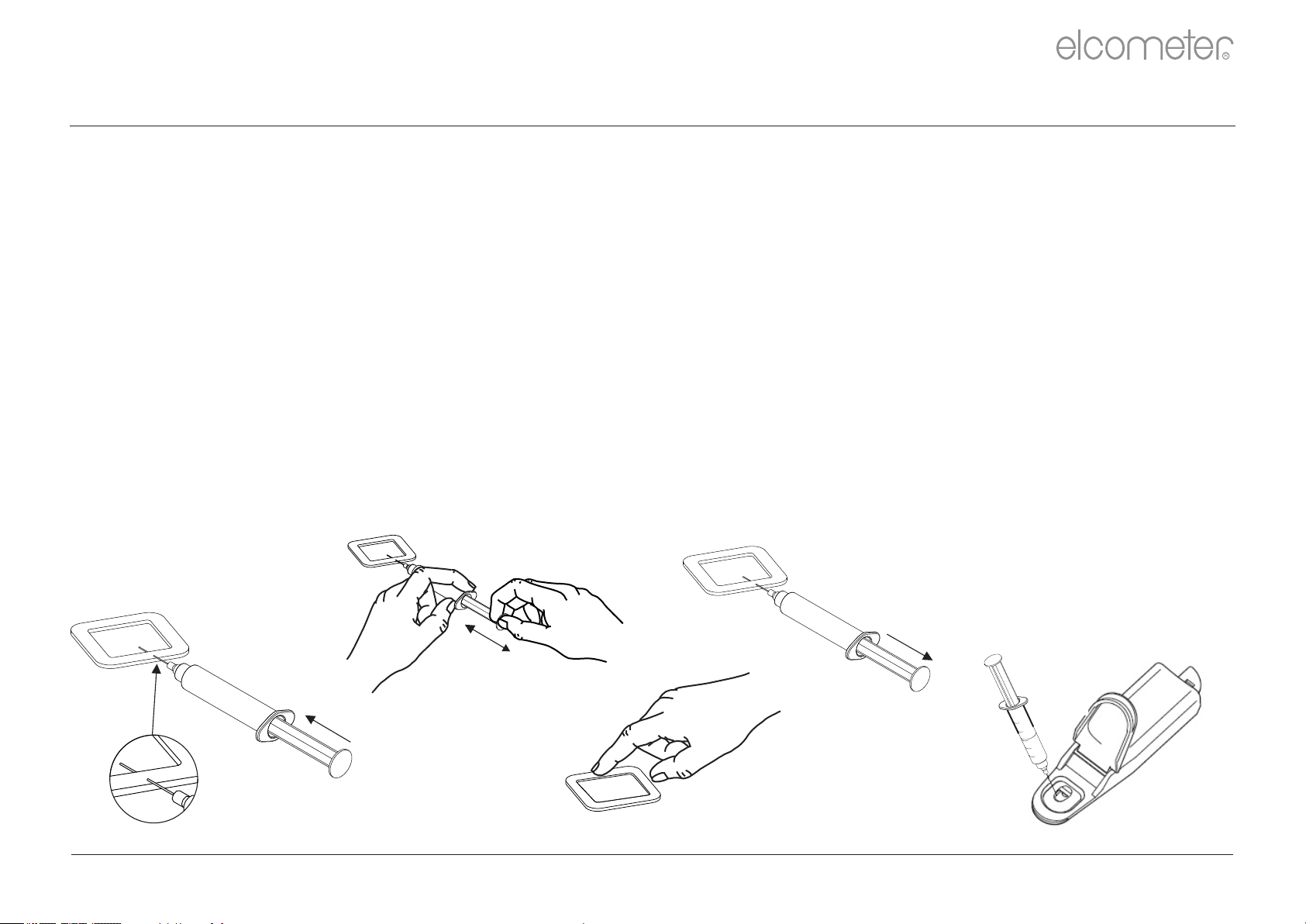
4 Insert the syringe into the patch through the spongy foam perimeter and inject 1.5ml of pure water
into the patch. Do not remove the syringe.
5 With the syringe still in the patch, reposition the needle and evacuate any air in the patch.
7 Remove the syringe from the patch.
9 Insert the syringe into the patch through the spongy foam perimeter and extract the solution from the
patch.
8 Rub the surface of the patch gently for 10 to 15 seconds to allow the water to dissolve surface
contaminants.
10 Analyse the solution using the Elcometer 138 Meter, see Section 4 on page en- . Inject the 4. 9
sample directly into the sensor cell. Rinse the sensor cell several times with the solution to be
measured before taking the reading.
4 See Appendix A on page en-15 for further instructions on using the Elcometer 138 Meters.
6 Once the air has been removed, inject the remaining 1.5ml of pure water.
4 : 63101-000 (continued)TEST PROCEDURE US NAVY PPI
1
2
3
4
5
www.elcometer.com
R
en-8

4 : 63101-000 (continued)TEST PROCEDURE US NAVY PPI
Note: The charts produced by the US Navy for the calculation of chloride levels are not required for this test method. Please
contact Elcometer or your local Elcometer supplier if you require a copy of these charts.
Simply record the displayed value.
The Elcometer 138 Bresle Salt Meter measures the conductivity of the sample but displays the surface
density of salts. The measured conductivity is converted to surface density of salts using the ISO Salt
Mix or IMO PSPC equivalent NaCI conversion factors, dependent on the measurement mode selected.
USING THE ELCOMETER 138 BRESLE SALT METER
USING THE ELCOMETER 138 CONDUCTIVITY METER
2 Remove the patch from the surface and clean the surface. If required, any adhesive residue from
the patch left on the test surface can be removed by wiping with a cloth moistened with a suitable
solvent. Ensure that the solvent will not damage the surface before use.
3 Rinse all components of the test kit, other than the patch, in fresh, pure water. The components can
then be used again.
For non-immersed applications, conductivity due to soluble salts shall not exceed 70µS/cm.
4.4 PASS / FAIL CRITERIA
When working in accordance with US Navy PPI 63101-000, the pass / fail criteria is based on the
conductivity of the test sample.
4.3 AFTER TEST
1 Record the temperature of the solution.
For immersed applications, conductivity due to soluble salts (total ionic) shall not exceed 30µS/cm.
R
en-9 www.elcometer.com
Autres manuels pour 138
4
Ce manuel convient aux modèles suivants
4
Table des matières


