Dino Rainer Manuel utilisateur

Instruction
Manual
US English Version
Please read carefully
Store manual behind cover
Convertible+Booster

2
Page
4Warnings
5Seating Position Information
6Child Restraint Safety Information
8Seat Belt Information
9Carrying Restraint
10 Unfolding and Folding Restraint
13 Installing and Removing Detachable Base
14 Rear-facing LATCH Installation
16 Rear-facing Lap-Shoulder Belt Installation
18 Rear-facing Lap Belt Installation
20 Forward-facing LATCH Installation
22 Forward-facing Lap-Shoulder Belt Installation
24 Forward-facing Lap Belt Installation
25 Checking Restraint Stability
26 Booster
28 Aircraft Installation
28 SafeStopTM Instructions
29 Forward-facing Recline Adjustment
30 Top Tether
31 Tether Connecting Strap
32 Infant Support Cushion
32 Side Impact Head Support
33 Using Harness Clip
33 Restraint Harness Buckle
34 Properly Securing Child
35 Proper Harness Height and Child Height
36 Adjusting Harness Height
37 Harness Buckle Location
37 Harness Buckle Removal and Installation
39 Locking Vehicle Belt with Locking Clip
40 Restraint Cover
41 Expandable Sides
41 Cup Holder
42 Operating SuperLATCH® Connector
43 Replacing Harness Straps
44 Cleaning and Maintenance
47 Warranty Information
Table of Contents

3
Rainier Features
1Child information tag
2LATCH strap
3LATCH strap guide
4Release lever
5 Locking clip
6 Top tether
7 Lap belt guide
8 Harness adjuster
9 Shoulder belt guide
10 Rear-facing base
11 Backpack strap anchor
12 SafeStopTM
13 Shoulder carry strap
anchor
14 Locking bolts
15 Rear-facing tether
connector strap
16 Infant Support Cusions
2
11
6
5
13
12
3
1111
44
10
14
4
18
7
16
9
15

4
• Follow all instructions labeled on this child restraint and
in the written instruction manual on the lanyard located
on back of restraint. For infants under 10 lbs, consult
pediatrician for recommended seat back angle before
installation.
• Failure to follow all instructions and product labels can
result in death or serious injury in a crash. Carefully read
and understand this instruction manual prior to using
restraint. If you have any questions, visit us.diono.com or
contact Diono at 855-463-4666.
• Use only with children weighing between 5 lbs to 120 lbs
(2.3 to 54 kg).
• With any infant weighing less than 20 lbs (9.1 kg), use
only rear-facing
• Maximum child weights:
Rear-facing 50 lbs (22.7 kg),
Forward-facing with 5-point harness 90 lbs (41 kg),
Booster mode 120 lbs (54 kg).
• Maximum heights:
Rear-facing 44" / 112cm,
Front-facing 57"/ 144 cm
• Secure the top anchorage strap provided with this child
restraint.
• Always use the SafeStop device according to manufac-
turer’s instructions.
• Always use a locking clip if it is required for proper
restraint installation. Consult vehicle owner’s manual.
• WARNING: Before installing restraint in a vehicle
equipped with front passenger airbags, carefully read
the vehicle owner’s manual for proper restraint installa-
tion instructions.
WARNING
DEATH OR SERIOUS INJURY CAN OCCUR

5
• Some vehicles have passenger seating in which the
passenger faces the side or rear of the vehicle. Do not
install this restraint in such passenger seating. Only use
this restraint in a vehicle seat which faces an adult
passenger toward the front of the vehicle.
• Always adjust restraint harness for a comfortable and
snug t around child. A snug harness strap should not
allow any slack. It lies in a relatively straight line without
sagging. It does not press on the child’s esh or push the
child’s body into an unnatural position.
• This restraint is not for use in homes, boats, on a motor-
cycle or in any other non-specied applications or
environments.
• Always keep this child restraint secured in the vehicle
even when it is unoccupied. In a crash, an unsecured
child restraint system may injure other occupants.
• In the event of an accident, the vehicle body itself
provides the most signicant passenger protection.
While a properly installed restraint will improve chances
for survival in most accidents, some crashes are unsur-
vivable regardless of what restraint is used.
• Based on accident statistics, the National Highway Trac
Safety Administration recommends the vehicle’s rear
seat as the safest location for all children under age 13.
• Register this restraint with the manufacturer using the
attached registration card.
Seating Position Information
WARNING:
• Use restraint ONLY with forward-facing vehicle seats.
• DO NOT use restraint with side-facing or rear-facing
vehicle seats in vans, trucks or station wagons.
WARNING
DEATH OR SERIOUS INJURY CAN OCCUR

6
Child Restraint Safety Information
• This restraint meets all applicable U.S. Federal Motor
Motor Vehicle Safety Standards.
• This restraint is certied for use in motor vehicles and
aircraft.
• Register this restraint with the manufacturer.
Child restraints can be recalled for various reasons. To be
reached directly in the event of a recall, you must register
your restraint with the manufacturer. Fill out the included
product registration card and mail it. You can register
online at us.diono.com. You can also register by sending
your name, address, the restraint’s model and serial
numbers to:
Diono LLC
PO BOX 77129
Seattle, WA 98177
For recall information, call the U.S. Government’s Vehicle
Safety Hotline at 1-888-327-4236 (TTY 1-800-424-9153), or
go to http://www.nhtsa.gov
WARNING: DO NOT place a child
restraint in the front seat of a
vehicle with a passenger air bag
unless the air bag is turned o.
DEATH or SERIOUS INJURY can
occur. The back seat is the safest.
IMPORTANT:
• Before each use, always conrm restraint is securely
installed and harness is properly adjusted around the child.
Remember: The addition or removal of clothing (such as a
sweater or coat) will change the t of the harness.
• Always conrm before each use that restraint is securely
locked in its unfolded position.
• If the vehicle seat has an adjustable seat back angle, make
sure seat back is securely locked and in its most upright
position. An incorrect seat back angle or unsecured seat
back will impair the restraint installation and its ability to
protect the child occupant.

7
• Cover restraint when vehicle is parked in direct sunlight.
Parts of the restraint can become hot and cause injury to a
child.
• Do not leave any child in a vehicle alone or unattended by
an adult.
• Secure all personal objects inside the vehicle. In an
accident loose objects can become ying hazards with the
potential for causing serious injury.
• Except per the instructions in this manual, do not
disassemble, attempt to disassemble or tamper with
any part of this restraint or change the way the restraint
harness or the vehicle restraint system is used.
• Do not use restraint if there is any appearance of rust on
any of the metal surfaces.
• Do not oil or lubricate any part of the restraint.
• Release levers and locking bolts should operate smoothly
and freely. When release levers are lifted, the release levers
and locking bolts should spring back immediately and
completely. Do not use restraint if release levers and/or
locking bolts wither bind or do not move freely.
• When not in use, store restraint properly and avoid placing
heavy objects on top of it.
To prevent injury to child:
• Do not use restraint in harness mode if it is older than
eight years from the date of original purchase or date
of manufacture. Do not use this restraint in booster
mode if it is older than 12 years from the date of origi-
nal purchase or date of manufacture. Manufacture
date is on side of restraint.
• Do not use restraint after is has been involved in any
accident. Damage to the restraint may have occurred
which could impair its ability to adequately protect a
child.
• This restraint is not a toy. Do not allow children to play
with it.
• Using any non-Diono product with this restraint, or any
product not specically approved by Diono for use with
this restraint, is not allowed. Use of such products voids
manufacturer’s warranty and may seriously impact this
product’s ability to perform properly in an accident.
• Fill out Emergency Child Information form stored in front
ap of restraint.

8
Seat Belt Information
The information below applies only to installations using
vehicle seat belts.
IMPORTANT:
• This restraint can be installed securely in most vehicles
using the seat belt. However, some seat belts have an
anchoring position for the lap belt that may not allow a
secure restraint installation.
• Some vehicles do not have any seating positions that
are compatible with a child restraint. Read owner’s
manual to determine child-specic seating. Contact
the vehicle manufacturer if you have any doubts or
questions.
Some vehicle seat belts that are NOT compatible with this
restraint are:
• Seat belts with top or bottom anchorage points
attached to the front door.
• Motor driven automatic seat belts.
• Non-locking, (ELR) two-point vehicle seat belts.
If your seat belt is of a type listed above, choose another
seat within the vehicle or use LATCH connectors and
anchorage points. Information on the types of seat belts in
your vehicle are in the vehicle owner’s manual.

9
1 2 3
4
Carrying Restraint
WARNING:
• Do not carry restraint by harness adjuster strap (see
diagram, page 3). This can damage the mechanism and
the webbing.
• Only the shoulder strap made by Diono is approved for
use with this restraint.
There are four ways to carry restraint:
1. Red carry strap (Fig. 1)
2. Plastic side (Fig. 2)
3. Shoulder strap: Connect shoulder strap* to webbing
anchors on side of restraint (Fig. 3)
4. Backpack:
Connect shoulder straps*to
lower webbing anchors on both
sides and upper webbing
anchors on back of restraint.
(Fig. 4)
* Padded shoulder strap(s) avail-
able as a separate accessory, not
included.
10
WARNING:
• Do NOT use restraint if release levers or locking bolts
bind or do not move freely. When release levers are
lifted, release levers and locking bolts should spring back
immediately.
• Do NOT oil or lubricate any part of restraint.
• ALWAYS conrm restraint is locked securely in its unfold-
ed position before each use.
• To avoid risk of injury, keep others at a safe distance
during folding and unfolding.
• Familiarize yourself with restraint unfolding and folding
operations prior to use.
• Foreign objects and debris can interfere with proper
operation of locking mechanism. Before installation,
conrm both locking bolt and release lever areas are free
of any debris (see page 44 for cleaning of mechanisms).
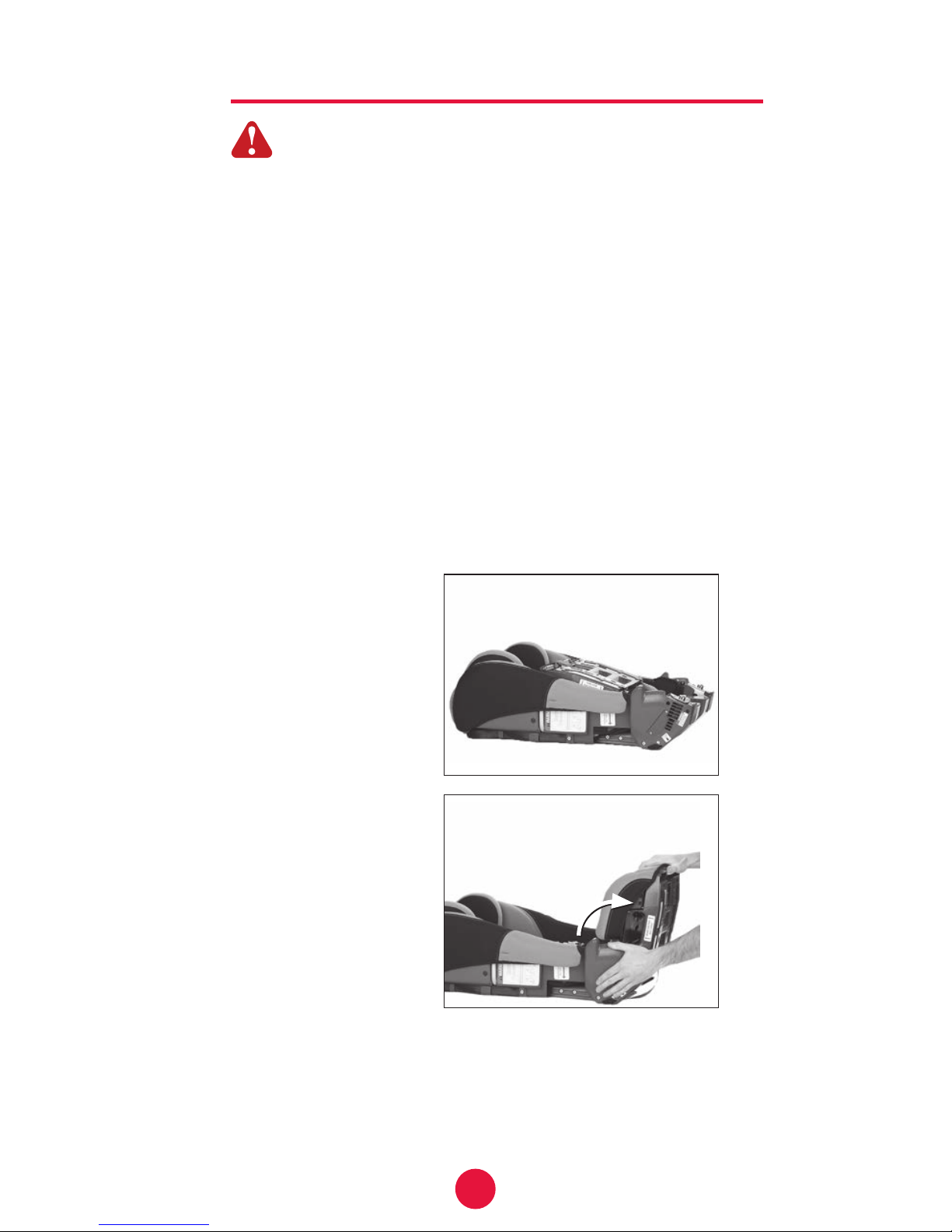
1
2
Unfolding and Folding Restraint
Unfolding Restraint
1. Place restraint on its
back on a at surface
and unfasten red
carry strap from
restraint bottom.
(Fig. 1)
2. Firmly rotate
restraint bottom
until a ‘click’ conrms
restraint is locked in
open position.
(Fig. 2)
IMPORTANT:
Conrm release levers are completely recessed inside their
housings. (See page 3 diagram.) Conrm restraint is locked
in the open position. If not, repeat step 2.
Table des matières