In season pool maintenance and water care
• WARNING!: The lter pump included with your pool is designed to remove dirt and other small particles from your pool water. However, to
maintain pool water that is perfectly clear, algae free, and safe from harmful bacteria, it is VERY IMPORTANT TO ENGAGE IN A CONSISTENT
REGIMEN OF CHEMICAL TREATMENT. Contact your local pool retailer for guidance on the safe and effective use of chlorine, shock, algaecide
and other such chemicals.
• WARNING! To avoid skin and eye irritation or even injury to bathers, never add chemicals to the pool while it is occupied. Never add any
chemicals or substances to your pool if you cannot verify the exact quantity or type to add to the water. Consult a pool supply retailer for specic
instructions and guidelines concerning the use of chemicals in your pool.
• WARNING! It is highly recommended that pool owners frequently test their pool water to ensure that the pH and chlorine concentration in
the water is optimal for safe and enjoyable bathing throughout the season. Please consult your pool retailer to nd a suitable testing kit and
instructions on its use.
• WARNING!: Non-respect of the maintenance rules may result in serious hazards for health and especially for children.
• This product is designed to be a storable, seasonal pool. If you live in a temperate area in which the pool will not be in use year-round, it is
STRONGLY RECOMMENDED that you drain your pool, clean and dry it thoroughly, and store it in a protected area for the off-season. This will help
extend the life of your pool and prevent a health or safety hazard from developing while the pool is not in use. During the season of use of the
pool kit, the ltration system must be put into service each day, long enough to ensure at least a complete renewal of the volume of water.
• In order to keep your pool water clean and hygienic all season long please closely adhere to the following guidelines:
• A: The proper and consistent use of basic pool chemicals are required to maintain the proper pH balance in your pool water.
• Furthermore, the application of chemicals will help prevent the growth of harmful bacteria or algae in your pool, and assist your lter-pump in
keeping your water crystal clear. Chemicals that your pool may require include but are not limited to:
• 1) Tabular, Granular, or Liquid Chlorine: Disinfects pool water and inhibits algae growth.
• 2) PH Adjusting Chemicals: These are used to correct PH level and make water more or less acidic.
• 3) Algaecides: These chemicals are formulated to remove algae.
• 4) “Shock” (Super chlorinator): Eliminates certain organic and other combination compounds that can affect water clarity.
• In order to obtain specic details on the use of chemicals, please consult a local pool retailer and provide them with the volume of water in your
specic pool, and if desired, a sample of your pool water. This will enable them to properly instruct you on: 1) which chemicals to purchase, 2)
what quantities of chemicals to purchase, and 3) how to use specic chemicals safely and effectively.
• B: Never let chlorine come into direct contact with the pool liner until it has completely dissolved. This means that granular or tabulated chlorine
is rst dissolved in a bucket of water before applying to pool water, and likewise, liquid chlorine is slowly and evenly poured into pool water from
various locations around perimeter of pool.
• DANGER: NEVER add water to chemicals. INSTEAD, always add chemicals to water. Also, never mix separate chemicals together, rather, add
chemicals to the pool separately and allow them to circulate throughout the pool before adding additional types of chemicals.
• C: We recommend that you purchase a Dellonda test kit (pool Starter Kit: Model no. DL63 and Test Strips: Model no. DL32 test kit) and frequently
test your pool water to make sure that your PH balance and chlorine levels are optimal.
NOTE: Excessive chlorine levels or low (acidic) pH levels can damage your pool liner, so please take corrective action as soon as possible if
testing reveals either condition.
• The tasks of removing larger debris from your pool and keeping the inside of the pool liner clean are simplied by using a leaf skimmer and
garden hose powered vacuum. Please contact your local after sales service centre.
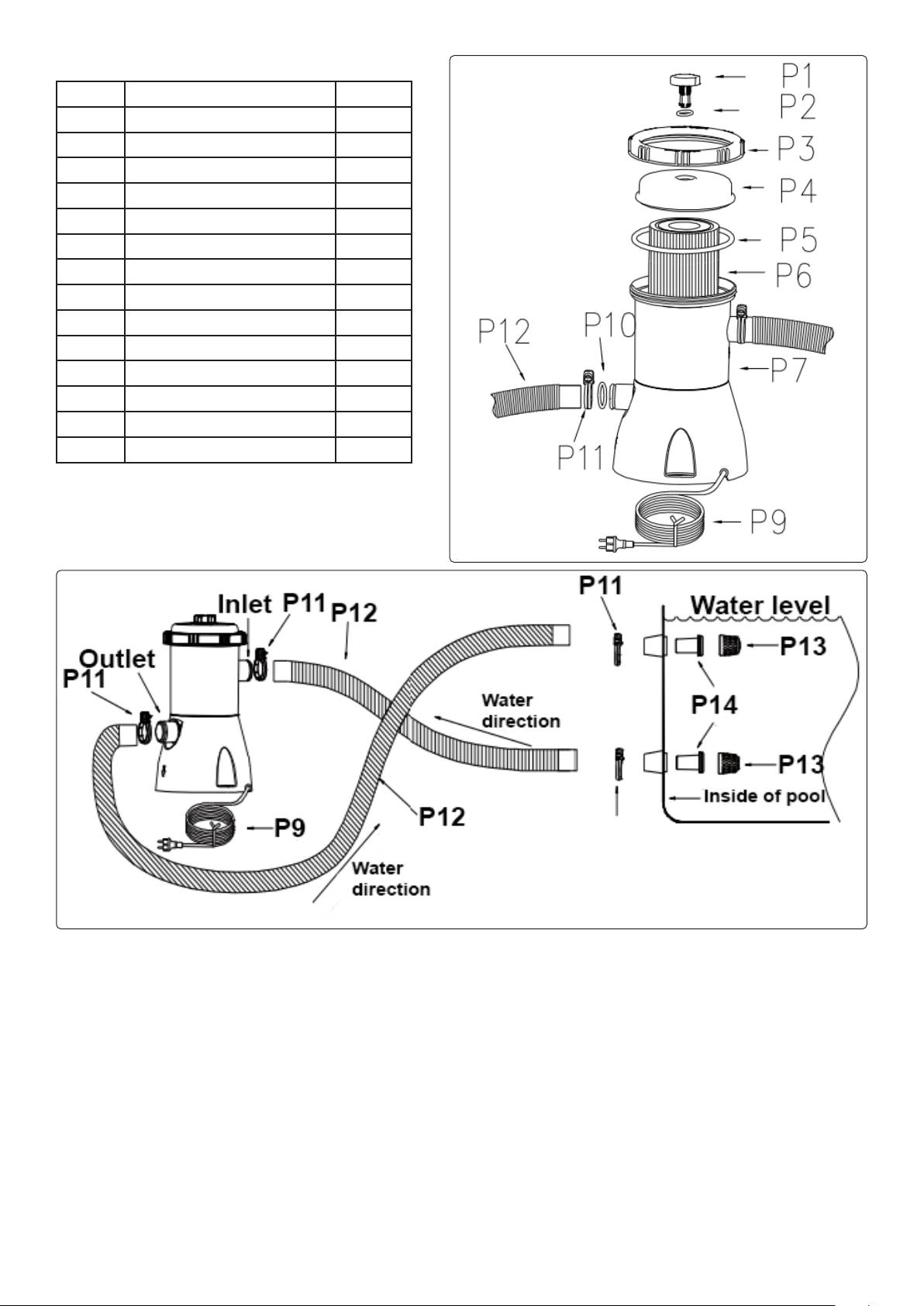
• D: Check your lter-pump cartridge every two weeks (or more frequently during periods of heavy usage) to verify whether it needs to be cleaned
or replaced. If your cartridge is no longer white in color, attempt to spray it clean with a strong blast of water from your garden hose. If your
cartridge cannot be cleaned in this manner, the cartridge must be replaced, refer to lter pump manual.
• Failure to frequently clean and/or replace your cartridges will affect the effectiveness of your lter pump and could shorten its useful life.
• E: If your pool system included a cover, try to keep your pool covered at all times when not in use. This will help keep the wind and other elements
from depositing dirt and debris in your pool, and will also prevent excess rainwater from overlling your pool.
• F: Remind your family and friends to always hose or rinse off any dirt or tanning oil from their hands, feet, and body prior to entering the pool.
• G: It’s necessary to monitor the bolts and hardware of the pool (eg. rust stain) when possible (if applicable).
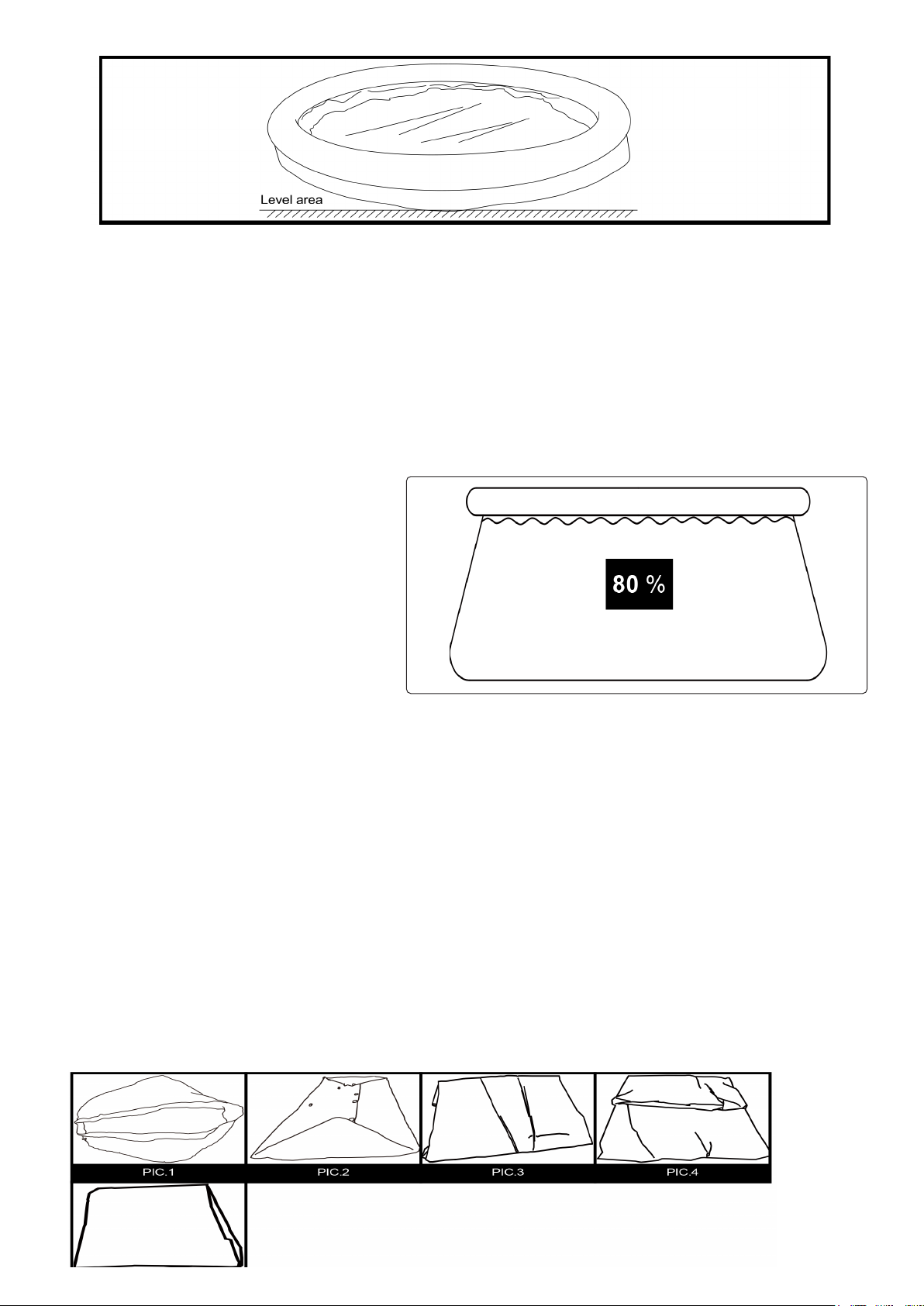
• H: Once your pool has been lled with water for the season, take note if your pool becomes overlled due to rainwater or accidental overll. If this
should occur, it is important to drain or bale out the excess water as soon as possible. The water level should never be higher than the bottom
edge of the inatable ring.
• I: Irrespective of materials used for swimming pool construction, accessible surfaces have to be checked regularly to avoid injuries.
• Troubleshooting
• Repair Patch Instructions
• Small pinhole and small puncture leaks can be repaired with the included repair patch
• a) Locate the leak.
• b) Deate.
• c) Clean the area surrounding the leakage and wipe up all water from the surface.
• d) Take out the repair patch, cut it into required shape and size, which should be larger than the leaking area, put the patch on leaking area and
press tightly.
• e) Wait 30 minutes for open-air drying of the repaired position.
• If the damage is too big, we recommend using a Silicone or rubber based glue for repair.
• Repair Glue Instructions
• a) Locate the leak.
• b) Deate and drain thoroughly
• c) Clean the area surrounding the leakage and wipe up all water from the surface.
• d) Thoroughly clean the area surrounding the leak . Cut a piece of repair material in round shape, which should be larger than the damaged area.
• e) Gluing (need to purchase adhesive separately) one side of the material patch to the repair area. Apply glue evenly to the repair patch.
• f) Put the patch on the damaged area and press tightly. Wait 12 hours for drying. After patch has dried, apply glue around the edges for a
complete seal (dry for 4 hours).