
DDC POLYLASE MX Manuel utilisateur

POLYLASE MX PULSED DUAL OUTPUT
LASER
Operator’s Manual
Caution: In the United States, federal law restricts this device to sale to or on the order of a physician or
any practitioner licensed by state law to use or order the use of this device.
Document Number 4000-002M
See Revision History page for revision of this manual.
Manufactured by
311 Woods Avenue, Oceanside, NY 11572
Tel.: (516) 594-1533
2020 by DDC Technologies, Inc.

- 1 -
Contacting DDC Technologies, Inc.
In the United States:
DDC Technologies, Inc.
311 Woods Avenue,
Oceanside, NY 11572
USA
Tel.: (516) 594-1533
(516) 770-0441 Customer Service
email: sales@ddctech.com

- 2 -
Revision History
Document Number 4000-002M Rev. 1-12
Document Number 4000-002M Rev. 1-17
Document Number 4000-002M Rev. 2-19
Document Number 4000-002M Rev. 1-20
Document Number 4000-002M Rev. 2-20
Prepared by:
Joseph Buscarello
Document No.:
UM 4000-002M
Reviewed by:
Dmitry Donskoy
Current Revision:
2-20
Approved by:
Dmitry Donskoy
Effective Date:
9/10/19

Chapter 1: Introduction
General Description 1-1
Operator Training 1-3
Indications for Use 1-3
Patient Exclusion Criteria 1-4
Warnings 1-4
Precautions 1-5
Complications/Adverse Effects 1-5
Operator Guidelines 1-6
Symbols Used in this Manual 1-7

- 1 -
General Description
The POLYLASE MX Pulsed Dual Output Alexandrite and Nd:YAG Laser is designed to
deliver precise fluences of long pulses of laser energy at 755 nm and 1064 nm
wavelength to a predetermined target site to effect the elimination of unwanted hair.
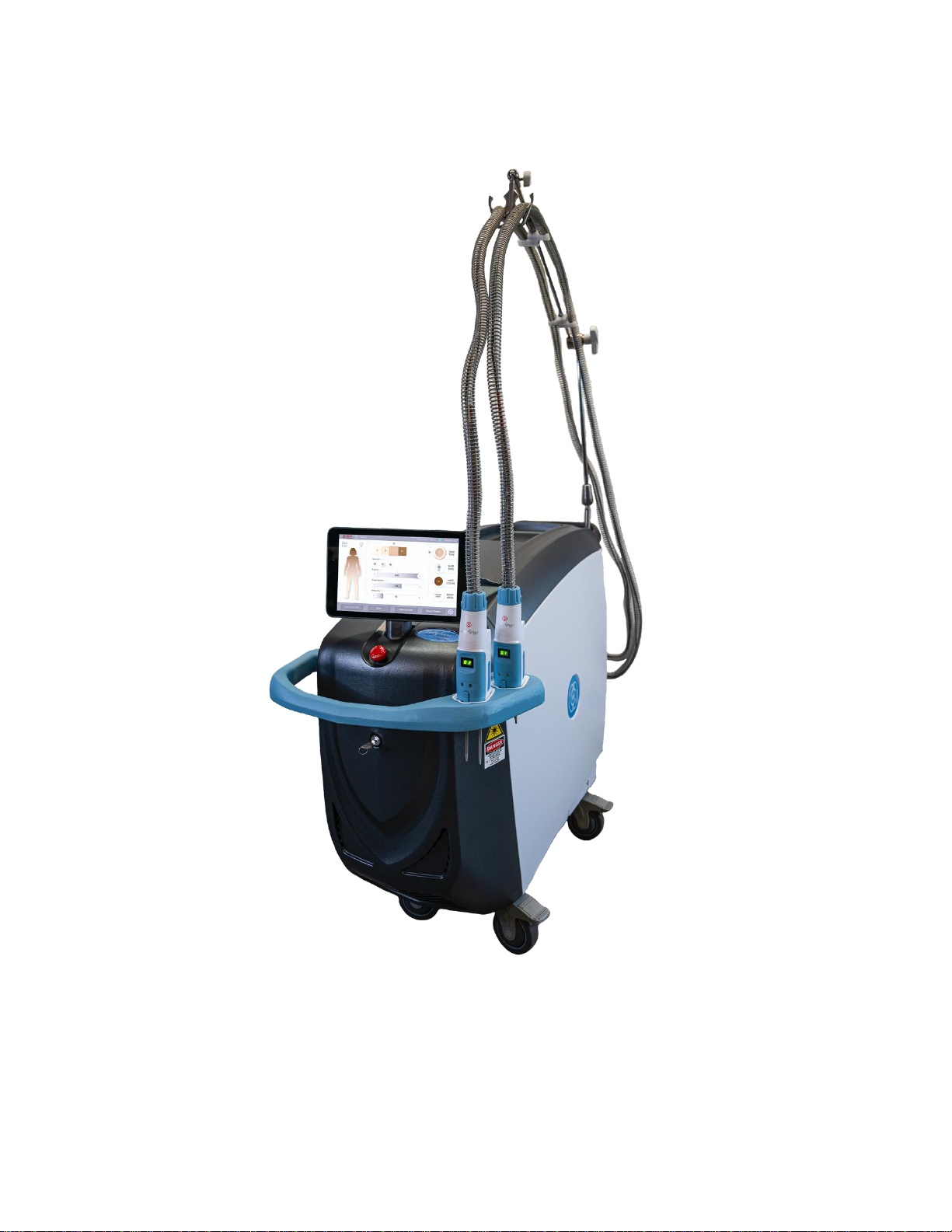
The laser system (see Figure 1-1) is housed in a single protective cabinet. Delivery of
laser energy to the treatment site is through a fiber optic cable fitted with a handpiece,
designed to provide pre-determined laser beam spot sizes on the patient’s skin during
treatment. Once a foot switch is depressed, light is administered to the treatment area by
placing the distal end of the handpiece in contact with tissue.
The POLYLASE MX Pulsed Dual Output Laser is microprocessor-based to ensure
optimal flexibility and “user-friendly” control of the laser system. A touch-screen control
panel with color LCD display controls all laser system user functions. This display
provides visual feedback of system settings and operating parameters. Memory function
allows to store up to 5 five laser parameters’ settings, which provides the operator with
fast and repeatable laser setup.
- 2 -
Figure 1-1. POLYLASE MX Dual Output Laser

- 3 -
Operator Training
The POLYLASE MX Pulsed Dual Output Laser:
Caution: In the United States, federal law restricts this device to sale by or on the order of
a physician or any practitioner by state law to use or order the use of this device.
It is to be used by those trained in the safe handling and operation of this system. It is
recommended that, in addition to laser safety training of all operation room or clinic
personnel, the user/institution adopt a training and safety program as outlined in the latest
revision of the ANSI Standard Z-136.3, the American National Standard for the Safe Use
of Lasers in Health Care Facilities.
It is further suggested that practitioners desiring privileges for laser use should obtain
approval from the appropriate credential issuing body within their respective institutions.
Practitioners should consider the following training avenues:
1. An accredited training course within the practitioner’s specialty,
2. “Hands-on training under the preceptorship of a qualified used,
3. Attendance at specialty-specific courses presented during academy or college
meetings.
All practitioners handling lasers, including physicians, nurses and other allied
professionals, should also complete a training program which may include subjects such
as basic laser physics, laser safety, tissue interaction, laser operating procedures, laser set-
up procedures, potential hazards, and hands-on experience.
In-service training in the use of the POLYLASE MX Pulsed Dual Output Laser will be
provided near the time of the initial system installation. Clinical techniques described
here are presented only as a reference based on clinical experience with the device and
other laser devices reported in the published literature.
Indications for Use
The POLYLASE MX Pulsed Dual Output Alexandrite and Nd:YAG Laser indication for
use is based upon the selective absorption of natural chromophores, particularly melanin.
The Alexandrite Laser wavelength of 755 nanometers and Nd:YAG Laser wavelength of
1064 nanometers is well absorbed by this chromophore.
Indication for use:
The POLYLASE MX Pulsed Dual Output Laser is designed to effect hair removal of
patients with skin types I-VI through selective targeting of melanin in hair follicles.

- 4 -
Patient Exclusion Criteria
There are no known absolute contraindications to laser treatment with the POLYLASE
MX Pulsed Dual Output Alexandrite and Nd:YAG Laser System. Patients who have had
prior problems with laser therapy, however, should be carefully screened prior to
treatment.
Persons known to form skin keloids may be more prone to scarring after any skin trauma,
including Alexandrite and/or Nd:YAG Laser treatment.
Relative patient exclusion criteria to Alexandrite and/or Nd:YAG Laser therapy include:
History of keloid scarring;
Active infections;
Herpes simplex within the treatment area;
Resent sun tanning;
Use of chemical or mechanical epilation 6 weeks prior to laser treatment;
Hypersensitivity to hydroquinone, if applicable.
Warnings
Patients should be cautioned in any of these situations apply.
The POLYLASE MX Pulsed Dual Output Laser is designed for treatment to
intact skin only;
Do not treat around the outer cantus of the eye;
Closing the eye is not sufficient protection from Alexandrite and Nd:YAG laser
light, therefore appropriate eye protection measures should be taken when treating
near the eye;
Should bleeding result at any time during the use of the POLYLASE MX Pulsed
Dual Output Laser contact cooling handpiece, discontinue use immediately and
quarantine the handpiece. Contact you DDC Technologies Customer Service
Representative for further instructions.
Be sure to observe all precautions described in Chapter 2: Safety, of this manual.

- 5 -
Precautions
Clinical studies have shown that both treatment effectiveness and inflammatory response
to injury of the skin is exposure dose (FLUENCE) related; higher fluence level result in
greater effectiveness and also higher inflammatory response.
Begin treatment with a conservative exposure dose. If more tissue reaction is desired,
increase the energy level in 2-5 J/cm² increments until the desired tissue effect is
observed.
Treatment exposure dose should be based on test sites applicable to both the treatment
site and skin type of the patient to be treated.
Complications/Adverse Effects
In clinical studies involving the long pulse Alexandrite and Nd:YAG laser treatments, the
following minor complication were observed in some patients:
Hypopigmentation or hyperpigmentations may occur (Note: There complications
have been rated as both transient and minor and appear to resolve spontaneously
within several weeks or month after laser treatment.)
Pain during treatment sometimes occurs, but local anesthesia is generally not
required for these procedures.
Erythema and edema may occur immediately following treatment, but resolves
after several hours or days.
Blisters may occur during or sometimes after treatment, but since they are intra-
epidermal in nature, usually heal without scarring.

- 6 -
Operator Guidelines
The following operator guidelines are provided as an outline of the general concepts for
properly using the POLYLASE MX Pulsed Dual Output Laser, and improve the care of
patients who choose this method of hair removal. For more information regarding
training on the use of the POLYLASE MX Pulsed Dual Output Laser, please refer to
page 1-2 of this Operator’s Manual.
Possible side effects or complications that may arise from use of the POLYLASE
MX Pulsed Dual Output Laser may include, but are not limited to:
hypopigmentation, hyperpigmentation, depigmentation, vesiculation (blister
formation), prolonged erythema and edema, scarring and poor clinical response.
These side effects are rare and can be minimized by following established
preoperative and postoperative instructions and using proper surgical technique.
Any hair that lies on the skin surface during treatment will absorb laser energy
and cause unnecessary discomfort or present other complications to the epidermis.
Therefore, all treatment areas should be shaved and cleared of all hair prior to
exposure to POLYLASE Alexandrite or Nd:YAG Laser pulses.
Performing tests at different energy fluences and properly evaluating the tissue’s
response prior to initiating treatment will help determine the proper energy
fluence for each site, reducing the risk of complications and side effects.
Vesicles (blisters) may sometimes occur at areas where the energy fluence used
was excessive. If a vesicle should form, it is important to recognize that it is
generally intra-epidermal and will usually heal without scarring. Vesicles should
be treated conservatively with gentle cleansing and application of a topical
antibiotic ointment until they have completely healed. If vesiculation or
nikolsky’s sign is encountered, the energy fluence should be reduced until these
reactions are no longer produced. If vesiculation occurs at even the lowest
fluence, then that person should be excluded from treatment.
Residue from hair shafts that have been destroyed by exposure to POLYLASE
MX Laser energy may accumulate on the surface of the handpiece protective
window during treatment. This debris may interfere with the effectiveness of the
treatment if it is not wiped off frequently using lint-free lens cloths or Q-tips.
It is recommended that the pulses be overlapped slightly to ensure that effective
energy is delivered to disable all hair follicles in the treatment site. The risk of
injury to the skin from overlapping pulses is very low. Overlapping using the
aiming beam as a guide is sufficient.
Since hair follicles typically grow at angles within the skin, it is possible to affect
follicles that are not directly in the beam’s apparent path at the skin surface. For
this reason, it is not advisable to use the POLYLASE MX Laser for shaping or
sculpting precise hair-bearing areas such as eyebrows.
Treatment of large areas may be somewhat time consuming and tedious. For that
reason, it is strongly recommended that POLYLASE MX Laser users take
frequent breaks or limit the length of each scheduled treatment session in order to
minimize eye strain of fatigue that could otherwise adversely affect the clinical
response.
Table des matières
Autres manuels DDC Système d'épilation


