
CTM HS-2800 Manuel utilisateur
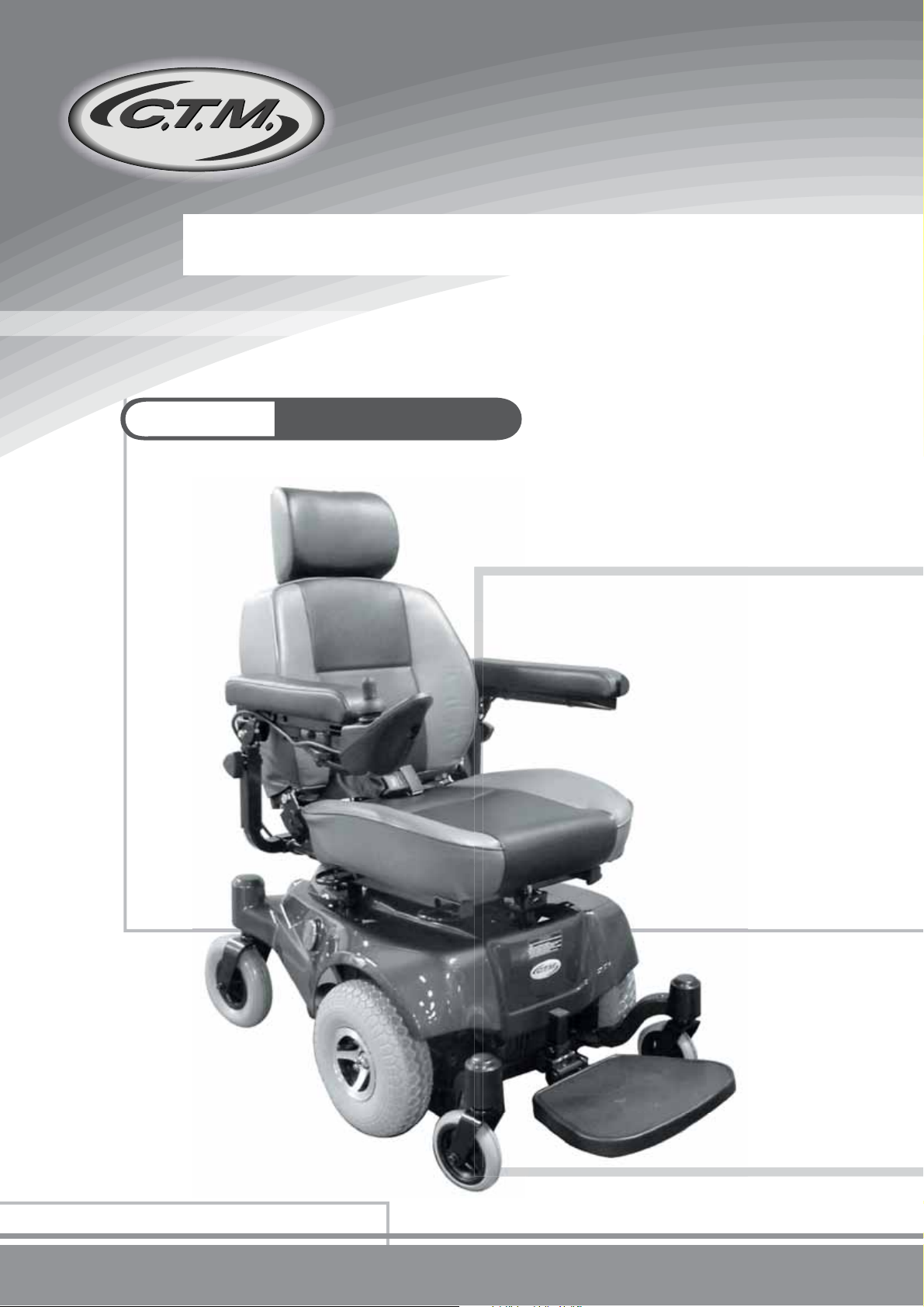
C.T.M. Mini Power Chair
C.T.M. Mini Power Chair
C.T.M. Mini Power Chair
HS-2800 User's Manual

User's ManualHS-2800
TABLE OF CONTENTS
INTRODUCTION
IMPORTANT PRECAUTIONS
ELECTROMAGNETIC INTERFERENCE AND WARNINGS
IDENTIFICATION OF PARTS
OPERATING YOUR POWER CHAIR
DISASSEMBLING / RE-ASSEMBLING YOUR POWER CHAIR
INSTALLATION OF BATTERIES
CHARGING THE BATTERIES
CARE AND MAINTENANCE
TROUBLESHOOTING
TECHNICAL SPECIFICATIONS
---------------------------------------------------------1
------------------------------------------2
-------3
------------------------------------------5
---------------------------------8
-11
-------------------------------------12
----------------------------------------14
------------------------------------------16
-------------------------------------------------18
--------------------------------------20
User's ManualHS-2800
C.T.M.HOMECARE PRODUCT, INC.
6191 Schaefer Ave Suite B Chino CA 91710
Tel : +909-590-1388 Fax : +909-590-3365
If you have any question, please contact your local dealer or:
or your local dealer:
INTRODUCTION
1
Thank you and congratulation on purchasing your new C.T.M. Power Chair. It is
designed to provide you with transportation ability indoors and outdoors.
We pride ourselves on providing safe and comfortable products. Our goal is to ensure
your complete satisfaction with our product. We are certain that you will enjoy your
C.T.M. power chair.
Please read and observe all warning and instruction provided in owner's manual before
operating with this power chair. Also, retain this booklet for future reference.

User's ManualHS-2800
IMPORTANT PRECAUTIONS
2
•Only one person at a time can ride a C.T.M. Power Chair.
•Maximum load is 135 kg/300 lbs.
•Turn off power before getting on or off your power chair.
•
Always drive carefully with your feet on the footplate and be aware of others in your area.
•Always use pedestrian crossings wherever possible. Take extreme when care crossing
roads.
•Do not drive on slopes exceeding 8 degrees, and take extreme care when turning on
slopes.
•Do not use full power when turning to sharp corners.
•Take great care and drive in low speeds when backing up, riding downhill, or on uneven
surfaces and climbing curb.
•The power chair may not operate well in high humidity.
•Never put your power chair in neutral when staying on slopes.
•Follow all traffic laws when riding in the vicinity of public roads.
•It is NOT recommended to use your power chair in wet environments as it may cause
damage.

User's ManualHS-2800
ELECTROMAGNETIC INTERFERENCE
AND WARNINGS
3
CAUTION: It is very important that you read this information regarding the possible
effects of Electromagnetic Interference on your power chair.
Powered wheelchairs and motorized scooters may be susceptible to electromagnetic
interference (EMI), which is interfering electromagnetic energy (EM) emitted from sources
such a radio stations, TV stations, amateur radio (HAM) transmitters, two-way radios, and
cellular phones. The interference (from radio wave sources) can cause the motorized
scooter to release its brakes, move by itself, or move in unintended directions. It can also
permanently damage the motorized scooter control system. The intensity of the interfering
EM energy can be measured in volts per meter (V/m). Each motorized scooter can resist
EMI up to a certain intensity. This is called its "immunity level." The higher the immunity
level, the greater the protection will be. At this time, current technology is capable of
achieving at least a 20 V/m immunity level, which would provide useful protection from
the more common sources of radiated EMI. The immunity level of this motorized scooter
model is 20 V/m.
There are a number of sources of relatively intense electromagnetic fields in the everyday
environment. Some of these sources are obvious and easy to avoid. Others are not
apparent and exposure is unavoidable. However, we believe that by following the warnings
listed below, your risk to EMI will be minimized.
Some cellular telephones and similar devices transmit signals while
they are ON, even when not being used.
The sources of radiated EMI can be broadly classified into three types:
1.Hand-held portable transceivers (transmitters-receivers) with the antenna mounted
directly on the transmitting unit. Examples include: citizens band (CB) radios, "walkie
talkie," security, fire, and police transceivers, cellular telephones, and other personal
communication devices.
2.Medium-range mobile transceivers, such as those used in police cars, fire trucks,
ambulances, and taxis. These usually have the antenna mounted on the outside of
the vehicle.
User's ManualHS-2800
4
3.Long-range transmitters and transceivers such as commercial broadcast transmitters
(radio and TV broadcast antenna towers) and amateur (HAM) radios.
Because EM energy rapidly becomes more intense as one moves closer to the transmitting
antenna (source), the EM fields from hand-held radio wave sources (transceivers) are of
special concern. It is possible to unintentionally bring high levels of EM energy very close
to the power chair control system while using these devices. This can affect power chair
movement and braking. Therefore, the warnings listed below are recommended to prevent
possible interference with the control system of the power chair.
Other types of hand-held devices, such as cordless phones, laptop computers,
AM/FM radios, TV sets, CD players, and cassette players, and small appliances,
such as electric shavers and hair dryers, so far as we know, are not likely to
cause EMI problems to your motorized scooter.
Power Chair Electromagnetic Interference:
Electromagnetic interference (EMI) from sources such as radio and TV stations, amateur
radio (HAM) transmitters, two-way radios, and cellular phones can affect the power chair.
Following the warnings listed below should reduce the chance of unintended brake release
or power chair movement, which could result in serious injury.
1.Do not operate hand-held transceivers (transmitters-receivers), such as citizens band
(CB) radios, or turn ON personal communication devices, such as cellular phones,
while the power chair is turned ON;
2.Be aware of nearby transmitters, such as radio or TV stations, and try to avoid coming
close to them;
3.If unintended movement or brake release occurs, turn the power chair OFF as soon
as it is safe;
4.Be aware that adding accessories or components, or modifying the power chair, may
make it more susceptible to EMI; and
5.Report all incidents of unintended movement or brake release to the distributor listed
on the inside front cover of this manual. Note whether there is a source of EMI nearby.
Warnings:
Important Information
1.20 volts per meter (V/m) is a generally achievable and useful immunity level against EMI
(as of May 1994). The higher the level, the greater the protection.
2.The immunity level of this product is 20 V/m.
User's ManualHS-2800
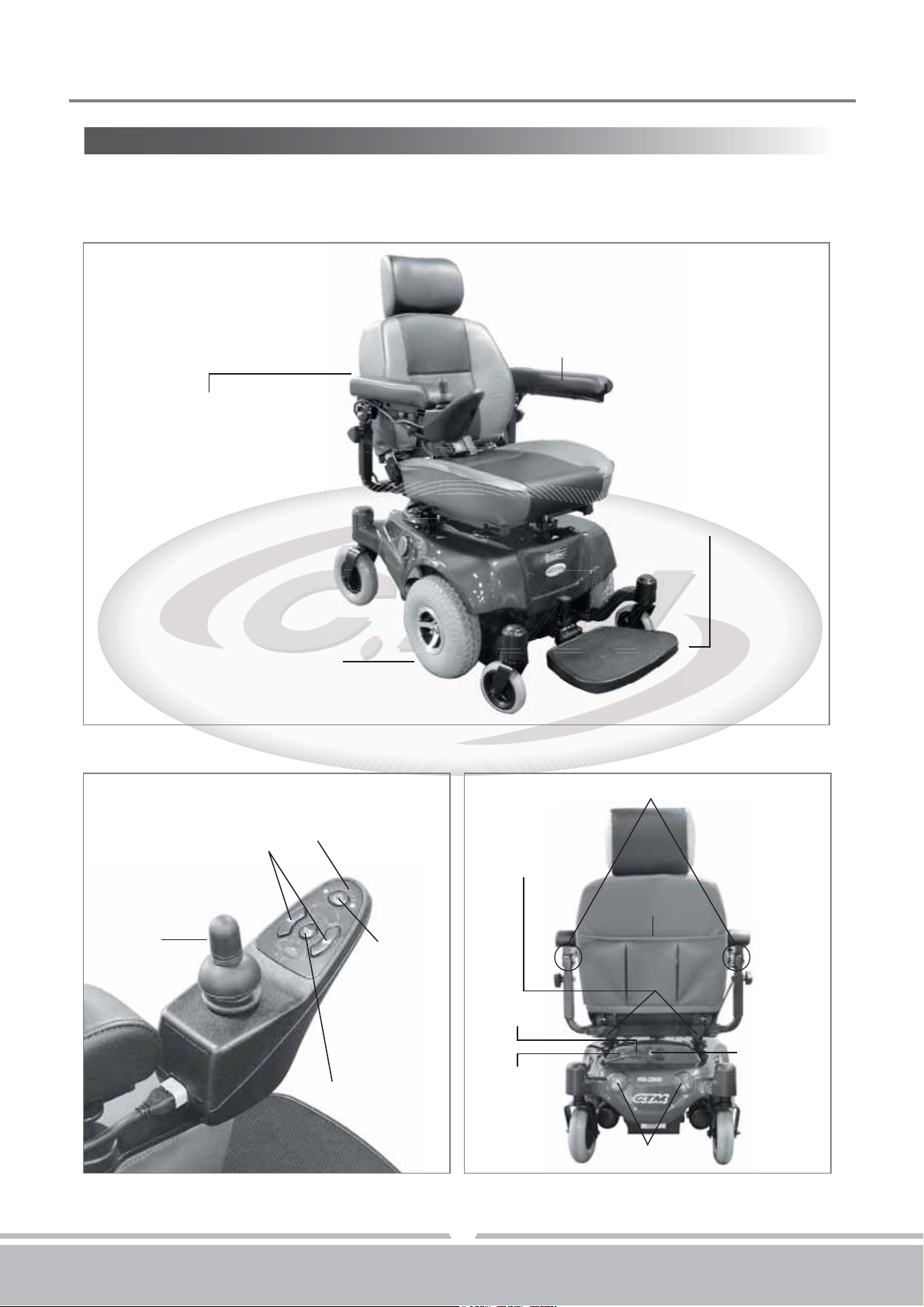
On/Off
Button
Horn
Joystick
Speed Control Button
Self Diagnostic
Warning Lights &
Battery Gauge
Rear Bag
Armrest width
Adjustment
Thumbscrews
Armrest height Adjustment Thumbscrews
Charging
Port
Rear Reflectors
Ciricuit
Breaker
Charging
Indicator
/Ammeter
Figure 1 - HS-2800 Power Chair Front View
Figure 2 - HS-2800 Joystick
Figure 3 - HS-2800 Power Chair Rear View
IDENTIFICATION OF PARTS
5
Before attempting to drive this power chair on your own, it is important that you familiarize
yourself with the controls and how they operate.
19" Mid-Back Seat
w/ Adj. Headrest & Seat Belt
Width & Height
Adjustable Armrests
Extended Footplate
with 3-Angle Adjustment
10"
Drive Wheels
User's ManualHS-2800
6
JOYSTICK:
•Self Diagnostic Warning Lights
Flashing of lights indicates there is a problem within power chair. See page 18 for more
information.
•Battery Gauge
There are eleven LED lights on joystick. When all LED lights are on, batteries are fully
charged; The Battery Gauge is used to indicate power on and provides an estimate of
the remaining battery capacity.
Any green LEDs lit indicate well charged batteries.
If only amber and red LEDs are lit, the batteries are moderately charged. Recharge
before undertaking a long trip.
If only red LEDs are lit, the batteries are running out of charge. Recharge as soon as
possible.
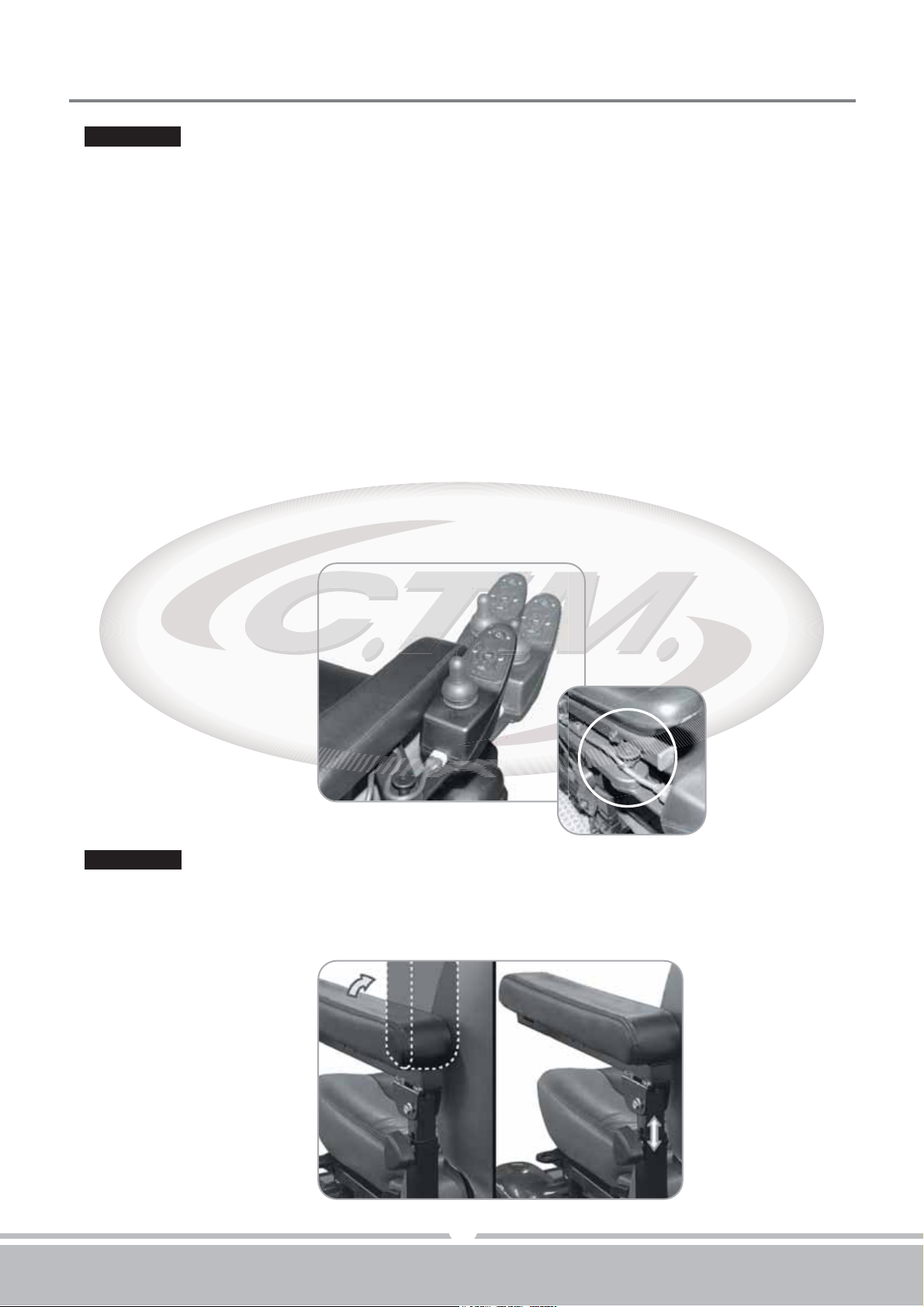
•Swing Away Bracket
The joystick is able to extend and retract. With joystick retracted, this enables you to
pull up to any table.
ARMREST:
•Armrest width & height Adjustment Thumbscrews
Loosen two thumbscrews to adjust armrest width & height tighten again to lock in
desired position.
Figure 4
Figure 4
Figure 5
Figure 5
User's ManualHS-2800
7
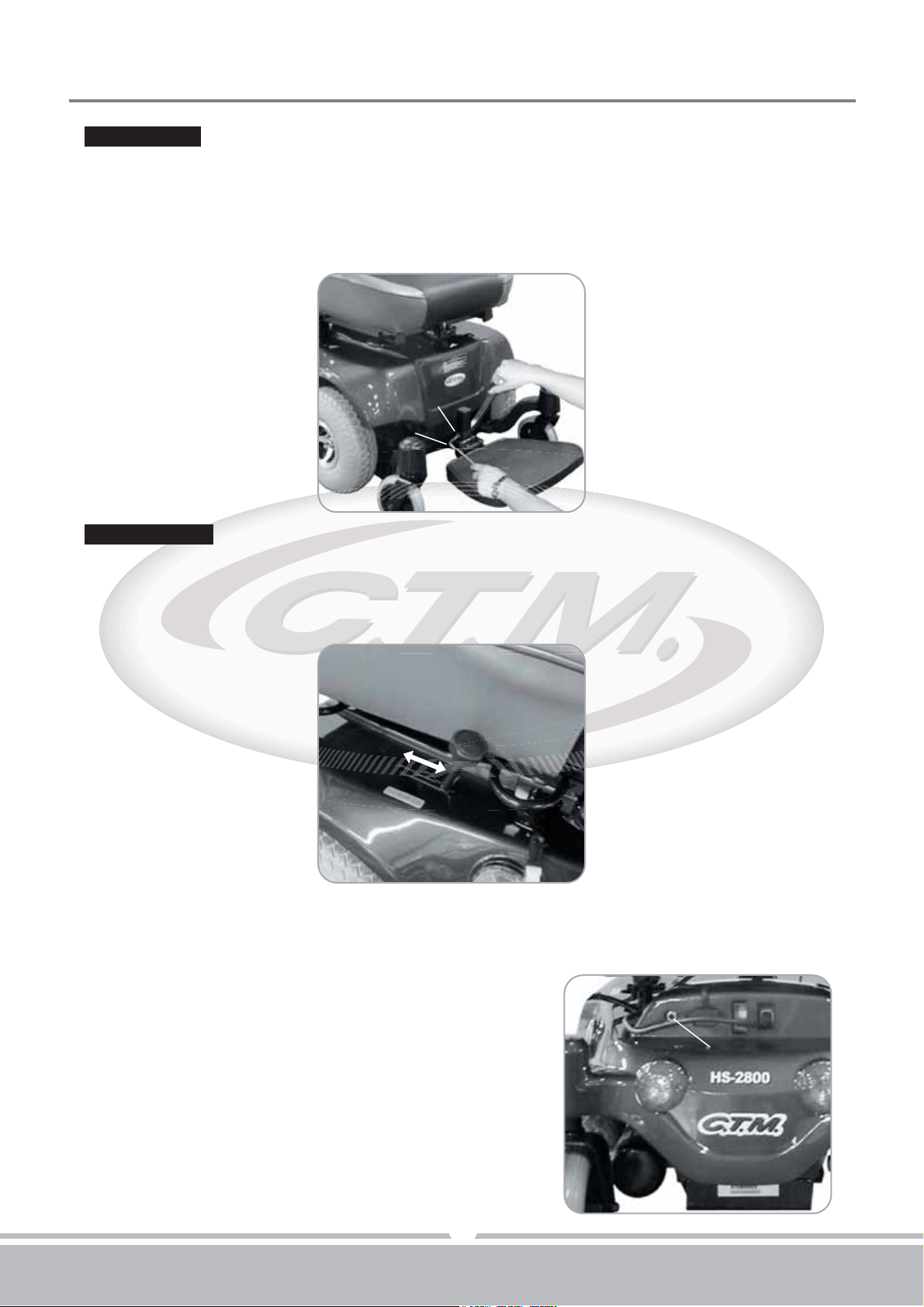
FOOTPLATE:
•Footplate
The footplate can be adjusted according to your specific needs. It can be width &
adjusted vertically or horizontally. To adjust footplate, loosen screw and arrange height
to desired position, then, tightened screw to secure plate in place. (A & B)
Figure 6
Figure 6
POWER BASE:
•Free-Wheeling Lever
When lever is in N (Neutral) position, power chair can be moved manually.
When lever is in D (Drive) position, power chair can be driven. Normal position is D.
•Circuit Breaker
This is to protect your power chair from overloaded current within the electrical parts.
If power chair suddenly stops, push circuit breaker (C) back in will help resolve this
problem.
•Charging port
When charging your power chair, use power cord
provided. To correctly charge your power chair, connect
one end to power chair and the
other end to a
wall
outlet. See Charging the Batteries, page 14 for further
instructions.
Figure 7
Figure 7
Figure 8
Figure 8
(C)
(A)
(B)
User's ManualHS-2800
Figure 9
Figure 9
Figure 10
Figure 10
OPERATING YOUR SCOOTER
8
Before beginning your journey with your new power chair, make sure power chair is on
alevel surface and clear of any obstacle. Although your power chair is able to climb slopes,
it is safer to practice on a leveled surface.
1.Before operating with your power chair, check the following:
•free-wheeling lever is on D.
•speed dial is at the lowest speed (fully turned counterclockwise).
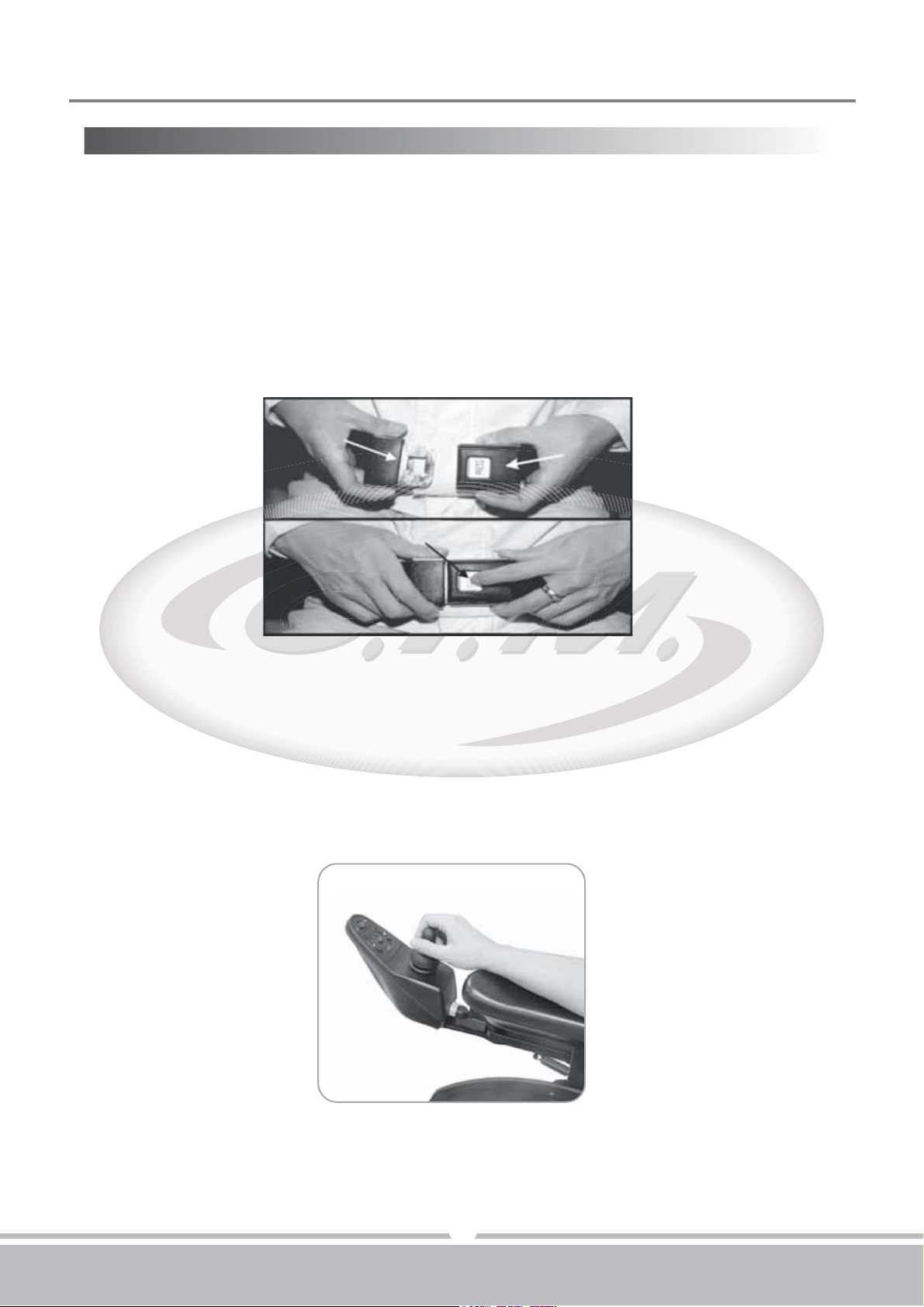
2.Sit on chair and fasten seatbelt.
3.When power is turned on, all battery gauge LED lights should be lit lighting. The self-
diagnostic warning lights should not be blinking.
4.While resting your arm on armrests, joystick should be within reach. By pushing joystick
slightly forward, power chair will move forward slowly, and pushing joystick fully forward,
chair will move at normal speed. And adjusting speed dial will also decrease or increase
speed. Also, with joystick, you are able to turn chair in 360
o
. When joystick is let go and
back in center position, chair will stop.
5.Practice driving where there is no obstacle. Start at slowest speed and move forward
and backward; make some turns. As you get more comfortable, you can increase the
speed by turning speed dial knob clockwise.
(D) (E)
(F)
Table des matières
Autres manuels CTM Fauteuil roulant


