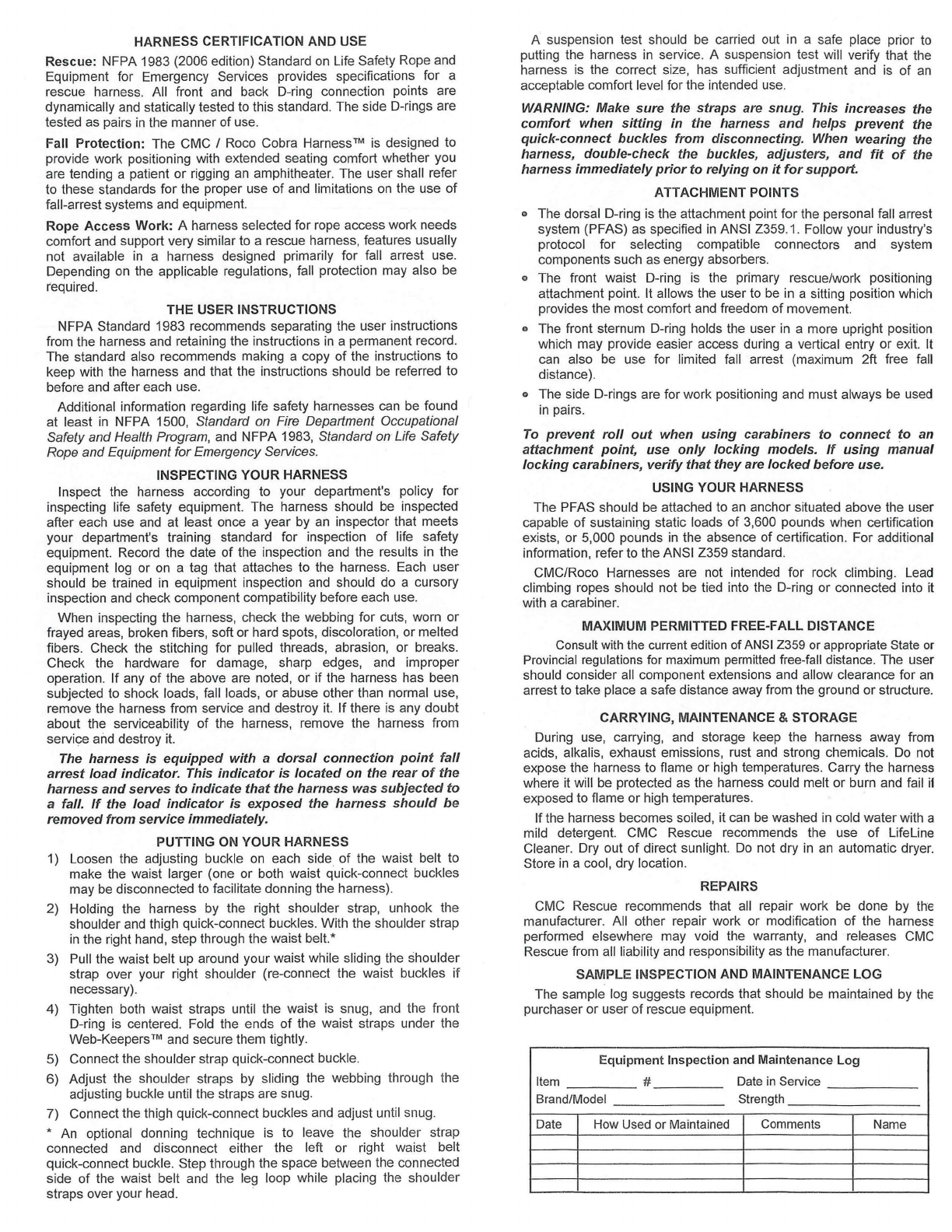
HARNESS CERTIFICATION AND USE
Rescue:
NFPA 1983 (2006 edition) Standard
on
Life Safety Rope and
Equipment for Emergency Services provides specifications for a
rescue harness. All front and back D-ring connection points are
dynamically and statically tested to this standard. The side D-rings are
tested as pairs
in
the manner of use.
Fall
Protection:
The CMC I Roco Cobra Harness™ is designed to
provide work positioning with extended seating comfort whether you
are tending a patient
or
rigging an amphitheater. The user shall refer
to these standards for the proper use of and limitations
on
the use
of
fall-arrest systems and equipment.
Rope
Access
Work:
A harness selected for rope access work needs
comfort and support very similar to a rescue harness, features usually
not available
in
a harness designed primarily for fall arrest use.
Depending
on
the applicable regulations, fall protection may also be
required.
THE USER INSTRUCTIONS
NFPA Standard 1983 recommends separating the user instructions
from the harness and retaining the instructions
in
a permanent record.
The standard also recommends making a copy of the instructions to
keep with the harness and that the instructions should be referred to
before and after each use.
Additional information regarding life safety harnesses can be found
at least
in
NFPA 1500, Standard on Fire Department Occupational
Safety and Health Program, and NFPA 1983, Standard
on
Life Safety
Rope and Equipment for Emergency Services.
INSPECTING YOUR HARNESS
Inspect the harness according to your department's policy for
inspecting life safety equipment. The harness should be inspected
after each use and at least once a year by
an
inspector that meets
your department's training standard for inspection of life safety
equipment. Record the date of the inspection and the results in the
equipment log or on a tag that attaches to the harness. Each user
should
be
trained
in
equipment inspection and should do a cursory
inspection and check component compatibility before each use.
When inspecting the harness, check the webbing for cuts, worn
or
frayed areas, broken fibers, soft or hard spots, discoloration,
or
melted
fibers. Check the stitching for pulled threads, abrasion, or breaks.
Check the hardware for damage, sharp edges, and improper
operation. If any
of
the above are noted,
or
if
the harness has been
subjected to shock loads, fall loads,
or
abuse other than normal use,
remove the harness from service and destroy
it.
If
there is any doubt
about the serviceability of the harness, remove the harness from
service and destroy it.
The
harness
is
equipped
with
a
dorsal
connection
point
fall
arrest
load
indicator. This
indicator
is
located
on
the
rear
of
the
harness
and
serves
to
indicate
that
the
harness
was
subjected
to
a fall.
If
the
load
indicator
is
exposed
the
harness
should
be
removed
from
service
immediately.
PUTTING ON YOUR HARNESS
1) Loosen the adjusting buckle
on
each side of the waist belt to
make the waist larger (one or both waist quick-connect buckles
may be disconnected to facilitate donning the harness).
2) Holding the harness by the right shoulder strap, unhook the
shoulder and thigh quick-connect buckles. With the shoulder strap
in
the right hand, step through the waist belt.*
3) Pull the waist belt up around your waist while sliding the shoulder
strap over your right shoulder (re-connect the waist buckles if
necessary).
4) Tighten both waist straps until the waist is snug, and the front
D-ring is centered. Fold the ends
of
the waist straps under the
Web-Keepers
™ and secure them tightly.
5) Connect the shoulder strap quick-connect buckle.
6)
Adjust the shoulder straps by sliding the webbing through the
adjusting buckle until the straps are snug.
7) Connect the thigh quick-connect buckles and adjust until snug.
* An optional donning technique is to leave the shoulder strap
connected and disconnect either the left or right waist belt
quick-connect buckle. Step through the space between the connected
side
of
the waist belt and the leg loop while placing the shoulder
straps over your head.
A suspension test should be carried out in a safe place prior to
putting the harness
in
service. A suspension test will verify that the
harness is the correct size, has sufficient adjustment and is of
an
acceptable comfort level for the intended use.
WARNING: Make
sure
the
straps
are
snug.
This
increases
the
comfort
when
sitting
in
the harness
and
helps
prevent
the
quick-connect
buckles
from
disconnecting.
When
wearing
the
harness,
double-check
the buckles,
adjusters
,
and
fit
of
the
harness
immediately
prior
to
relying
on
it
for
support.
ATTACHMENT POINTS
o The dorsal D-ring is the attachment point
for
the personal fall arrest
system (PFAS) as specified
in
ANSI Z359.1 . Follow your industry's
protocol for selecting compatible connectors and system
components such as energy absorbers.
o The front waist D-ring is the primary rescue/work positioning
attachment point. It allows the user to
be
in a sitting position which
provides the most comfort and freedom
of
movement.
o The front sternum D-ring holds the user in a more upright position
which may provide easier access during a vertical entry or exit. It
can also be use for limited fall arrest (maximum 2ft free fall
distance).
" The side D-rings are for work positioning and must always be used
in
pairs.
To
prevent
roll
out
when
using
carabiners
to
connect
to
an
attachment
point,
use
only
locking
models.
If
using
manual
locking
carabiners,
verify
that
they
are
locked
before
use.
USING YOUR HARNESS
The PFAS should be attached to an anchor situated above the user
capable
of
sustaining static loads
of
3,600 pounds when certification
exists, or 5,000 pounds
in
the absence of certification. For additional
information, refer to the ANSI Z359 standard.
CMC/Roco Harnesses are not intended for rock climbing. Lead
climbing ropes should not be tied into the D-ring or connected into
it
with a carabiner.
MAXIMUM PERMITTED FREE-FALL DISTANCE
Consult with the current edition of
ANSI
Z359 or appropriate State
or
Provincial regulations for maximum permitted free-fall distance. The user
should consider all component extensions and allow clearance for
an
arrest to take place a safe distance away from the ground
or
structure.
CARRYING, MAINTENANCE & STORAGE
During use, carrying, and storage keep the harness away from
acids, alkalis, exhaust emissions, rust and strong chemicals. Do not
expose the harness to flame or high temperatures. Carry the harness
where it will be protected as the harness could melt
or
burn and fail il
exposed to flame
or
high temperatures.
Ifthe harness becomes soiled, it can
be
washed
in
cold water with a
mild detergent. CMC Rescue recommends the use
of
Lifeline
Cleaner. Dry out
of
direct sunlight.
Do
not dry
in
an
automatic dryer.
Store
in
a cool, dry location.
REPAIRS
CMC Rescue recommends that all repair work be done by
the
manufacturer. All other repair work or modification
of
the
harnes~
performed elsewhere may void the warranty, and releases CMC
Rescue from all liability and responsibility as the manufacturer.
SAMPLE
INSPECTION AND MAINTENANCE LOG
The sample log suggests records that should be maintained by
the
purchaser
or
user
of
rescue equipment.
Equipment Inspection and Maintenance Log
Item
#
Date
in
Service
Brand/Model Strength
Date How Used
or
Maintained Comments Name