
CIBIN KUMA Manuel utilisateur

1
č
�

2

55
GB
CONTENTS
1. INSTALLATION
1.0 GENERAL STANDARDS AND WARNINGS
1.0.1 Inspection test and guarantee
1.0.2 Foreword
1.0.3 Machine description
1.0.4 General safety standards
1.0.5 Preparations to be made by the customer
1.0.6 Instructions for service intervention requests and replacement parts orders
1.0.7 Glossary of terms
1.1 MACHINE TRANSPORT AND HANDLING
1.2 PACKING REMOVAL AND MACHINE POSITIONING OPERATIONS
1.2.1 Packing Removal
1.2.2 Machine Positioning
1.2.3 Cold room Light Installation
1.3 ELECTRICAL CONNECTIONS
1.3.1 Remote keyboard installation and deinstallation
1.3.2 Door switch connection
1.4 WATER SUPPLY CONNECTIONS
1.5 INITIAL OPERATION
1.5.1 Start Conditions
1.5.2 Pre-heating Instructions
1.6 DEINSTALLATION
1.7 PACKING DISPOSAL
2. TECHNICAL DATA
2.1 FLUIDS AND MATERIALS USED
2.2 POWER, WEIGHTS, NOISE LEVELS AND DIMENSIONS
3. OPERATION
3.1 DESTINED USE, INTENDED AND UNINTENDED USES
3.2 POSSIBLE DANGER AREAS, RESIDUAL DANGER AND RISKS, DEVICES USED
3.3 OPERATION LIMIT CHARACTERISTICS
4. INSTRUCTIONS FOR THE END USER
4.1 INITIAL OPERATION
4.1.1 Description of the Electronic Control Panel
4.1.2 Starting the Machine
4.1.3 Temperature Setting
4.1.4 Defrosting
4.1.5 Switching on the Cold Room Light
4.1.6 Stopping the Machine
4.1.7 Keyboard lock
4.2 ALARMS AND SIGNALS
4.3 SAFETY PRESSOSTATS
5. ROUTINE AND PERIODIC MAINTENANCE
5.1 BASIC SAFETY STANDARDS
5.1.1 Principal Guidelines
5.1.2 Warnings
5.1.3 Emergency Operations in the Event of Fire
5.2 APPLIANCE CLEANING
5.2.1 Cleaning the Surfaces
5.2.2 Cleaning the Condenser
5.3 PERIODIC CHECKS
5.4 LONG PERIODS OUT OF SERVICE
6. SPECIAL MAINTENANCE
6.1 PROGRAMMING THE PARAMETERS
6.1.1 Parameters Description
7. REFUSE DISPOSAL AND DEMOLITION
7.1 REFUSE STORAGE
7.2 DEMOLITION PROCEDURES
8. TECHNICAL DOCUMENTATION
(See Manual )

56
1. INSTALLATION
1.0 GENERAL STANDARDS AND WARNINGS
1.0.1 INSPECTION TEST AND GUARANTEE
1.0.1.1 Inspection Test
All equipment must pass inspections and tests before it is dispatched. Inspection test types are :
- visual.
- leakage control.
- optimal vacuum attainment.
- electrica.
-operation.
Equipment is dispatched ready for use. Passing of inspection tests is certified in the specific annexes.
1.0.1.2 Guarantee
Our equipment and the component parts manufactured by us are guaranteed for 1 year from the date of manufacture, against
any defect in workmanship.
Materials found to have defects must be returned carriage free to the factory of dispatch, where they will be checked and
repaired or replaced in the event that, in our final judgement, they are found to be defective.
It will be the specific task of the manufacturer to repair any defects on condition that the equipment has been correctly used in
full respect of the guidelines given in the manuals.
This guarantee does not cover chance defects such as those caused during transport, handling or interventions carried out by
personnel not authorised by us, improper use, or the incorrect installation of the equipment. Materials replaced under guarantee
will remain our property.
1.0.2 FOREWORD
This manual contains all information necessary for the correct installation, use and maintenance of the equipment. The manual is
for technical personnel who are qualified to install and service the equipment. It is also for the end user in order to ensure that he
or she will use the equipment correctly. The manual is to be considered as an integral part of the machine. It is obligatory for the
user to read it carefully and to refer always to the manual before carrying out any installation or start operations. The manual,
or in any case a copy thereof, should always be kept in close proximity to the machine in order for consultation by the end user
whenever necessary.
Tampering with this manual, even partially, is strictly forbidden (copyright © )
THE MANUFACTURER DECLINES ALL RESPONSIBILITY FOR IMPROPER USE OF THE MACHINE.
1.0.3 MACHINE DESCRIPTION
The machines described in this manual are refrigerator units with water-cooled or air condensers. The machine includes :
- a condenser on the cold room exterior.
- an evaporator on the cold room interior.
- a remote control panel
- supplied fittings.
The machine is a machine that is ready for operation when installed and it has been manufactured exclusively for use as follows:
TO MAINTAIN A DETERMINED TEMPERATURE IN A COLD ROOM SUITED FOR THIS USE
This machines are destined for installation in cold rooms.
The cyclic defrosting system is fully automatic.
The machine operates using a refrigerator compressor with reciprocating motion and which operates using the power supply
mains (mono- or three-phase) and refrigerant. The refrigerant flows into the evaporator and cools its surrounding atmosphere
(by absorbing the heat). The “hot” fluid is sucked in/compressed by the compressor and sent to the exchange battery “conden-
ser” to regain its cooling capacity. The cycle is then repeated.
1.0.4 GENERAL SAFETY STANDARDS
The machine must only be used by those personnel who are aware of its specific characteristics and of the main safety procedu-
res. Accident prevention rules and other health and safety requirements must always be respected. Any unauthorised alteration
made to the machine will absolve the Manufacturer from any responsibility regarding possible resulting damages.

57
GB
WE RECOMMEND, THEREFORE, THE READING OF THE MANUAL AND THE OBSERVATION OF ALL THE INSTRUCTIONS IT
CONTAINS.
CAUTION!! Before connecting to the power supply mains, make sure that the voltage and frequency correspond
to those given on the data plate fixed to the side of the machine.
CAUTION!! Do not approach electrical parts with either wet hands or bare feet.
CAUTION!! Always connect the equipment to a suitable, differential and high-sensitivity thermomagnetic switch (30 mA).
CAUTION!! Always connect the equipment to an efficient earthing system installed according to the relative standards .
CAUTION!! Always connect the equipment to the power supply mains following the colours of the supply cable wires
(phase conductor, neutral and earth).
CAUTION!! Before carrying out any maintenance operations, disconnect the equipment from the mains power
supply :
-Press the O/I KEY to switch off the DISPLAY
-Remove the plug (if fitted)
-Remove voltage using the thermomagnetic switch
CAUTION!! Use gloves when carrying out maintenance operations in proximity to “Extreme Temperatures“.
CAUTION!! Do not insert tools or other objects into the fan protection grids.
CAUTION!! To ensure correct operation of the machine, do not block the air vents when it is operating.
CAUTION!! Installation and special maintenance operations must be carried out by authorised, qualified tech-
nical personnel with good knowledge of refrigerating and electrical systems.
1.0.5 PREPARATIONS TO MADE BY THE CUSTOMER
The preparations to be made by the Customer are as follows:
-Installation of the equipment in the place of use
-Fitting a differential thermomagnetic switch
-Fitting a power socket with earthing
-Fitting a power plug
-Perforation of the cold room (See Manual 2)
-Fitting ducts, if necessary, for the outlet of condensate fluid
1.0.6 INSTRUCTIONS FOR SERVICE INTERVENTION REQUESTS AND SPARE PARTS
ORDERS
When requesting any information or technical intervention for the machine, it is obligatory to state the name and serial
number of the model as well as the nature of the fault. The plate is fixed to the side of the machine and it’s shown in the
DECLARATION OF CONFORMITY.
Often operating malfunctions are due to trivial causes and therefore, before requesting the intervention of a technician, please
consult the “Troubleshooting” section in the Manual 2. When identifying replacement parts, always refer to the machine model.
CAUTION!! We recommend the use of original replacement parts. The Manufacturer declines all liability for the use of repla-
cement parts that are not original.
1.0.7 GLOSSARY OF TERMS
- Compressor. An organ of the refrigerating system that is able to intake the refrigerant in its gas state and compress it as it is
released at a higher pressure.
- Condenser and Evaporator. Heat exchangers where the “exchange of heat” occurs between the refrigerant and the
surounding air.
- Grid. A protective element for mechanical moving parts, which also consents the passage of air.
- Fan. A mechanical organ which moves air through the heat exchangers.
- Refrigerating Circuit. A body composed of parts that contain refrigerant and which are joined together to form a closed
refrigerating circuit in which the refrigerant circulates to absorb or release heat.
- Defrosting. A process in which the ice formed between the evaporator fins is melted by raising the temperature by hot gas
of the compressor or by electric heating resistors or by air.
- Control Panel. An electronic device for the control of all machine functions.
- Cold Room. A room insulated against heat for the storage and conservation of perishable goods at a temperature that is
different to that of the ambient temperature level.

58
1.1 MACHINE TRANSPORT AND HANDLING
The machines are protected during transport by particularly sturdy packing which is resistant to various stresses.
In spite of its low dimensions the packaged machine cannot be transported manually.
The correct lifting system to use is a fork lift or pallet conveyor/mover, making sure that the weight of the machine is evenly
distributed. For highest safety during transport and handling, the equipment contained inside the packing has been screwed
down to the pallet.
The packing has printed warning symbols that represent the instructions to follow during transport and storage in order to assure
that no damage is caused to the equipment during loading and unloading operations
The symbols printed on our packing are as follows (UNI ISO 780):
1.2 PACKING REMOVAL AND MACHINE POSITIONING OPERATIONS
We recommend unpacking the equipment as soon as it arrives in order to verify that it is complete and that it has not been dama-
ged during transport. Damage, if any, must be communicated immediately to the carrier, even in the event that such damage is
only found during installation. Damaged equipment may not, under any circumstances, be returned to the manufacturer without
prior to written warning and without the manufacturer’s written consent.
1.2.1 PACKING REMOVAL
For correct removal of packing, follow the sequence of steps (A....C), using the following tools: crowbar and screwdriver.
Delivered equipment includes supplied fittings.
A) Use the screwdriver to REMOVE the screws from along the base and lift the outer edge.
B) Use the screwdriver to REMOVE the screws which fix the machine to the base.
C) DO NOT place the machine directly on the ground in order not to damage it.
1.2.2 MACHINE POSITIONING
For a correct operation of the machine, we recommend, when positioning the machine, that you:
- PositioN the cold room in an area that is well ventilated continuously and well away from all sources of heat.
- Do not install the machine on outside cold rooms.
- Check that the panels of the cold room are perfectly level.
- Position the machine in an easily accessible place, in order to facilitate inspections and maintenance operations.
- Position the machine in this part, where the most uniform cold distribution is possible.
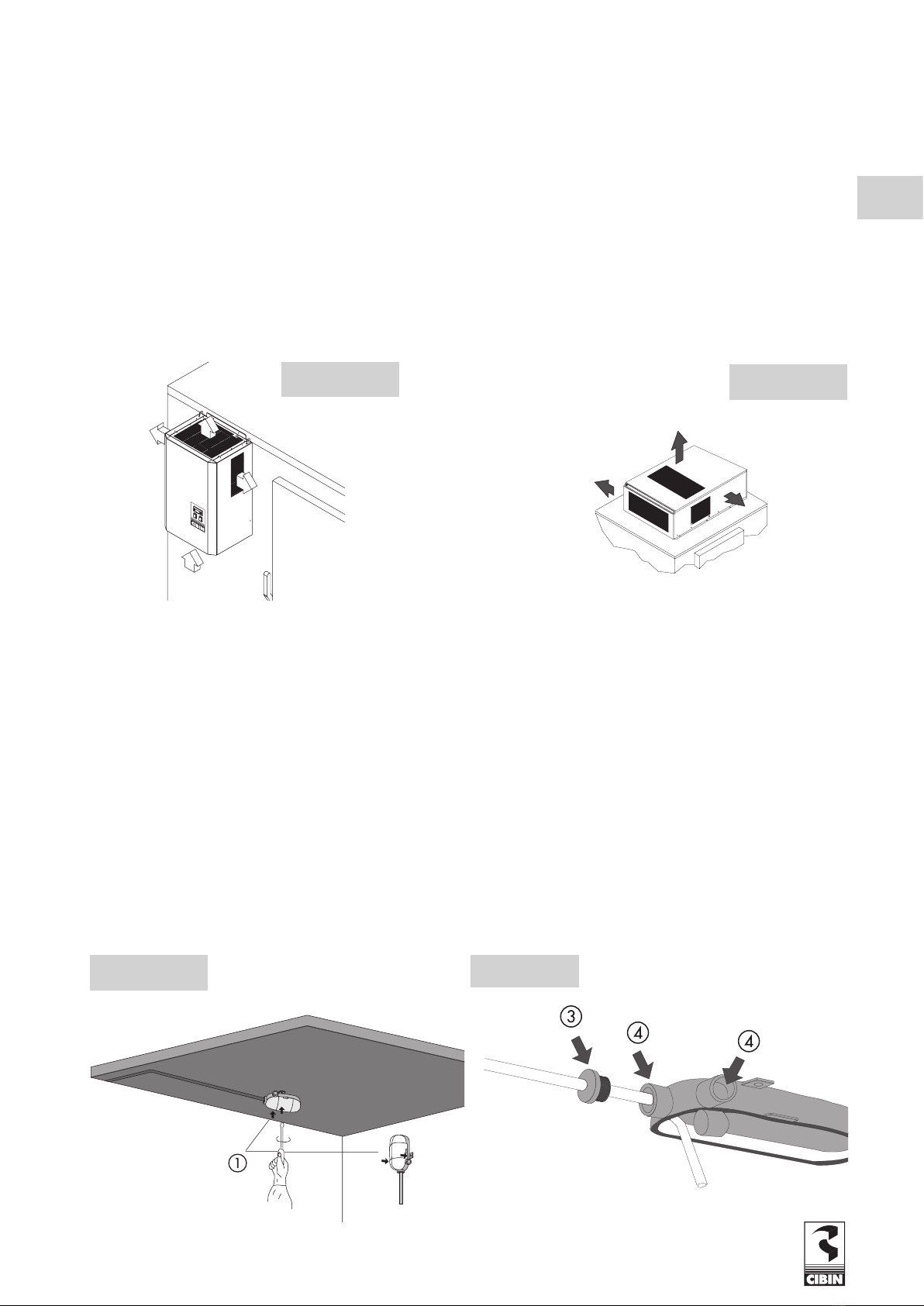
- Ensure that the spaces around the air suction and exhaust grids of the machine are not blocked or reduced in size in any way
(fig. 1.2.2).
CAUTION: care must be taken when using the machine unit at altitudes of over 1000 m above sea level.
We recommend, during the installation phase, that you don't tilt the machine too far, in order to avoid the spilling of oil from the
compressor into the refrigerating circuit what damages the compressor. As a precaution, we recommend that you leave the unit
switched off for several hours, in order to avoid any possible problems.
HANDLE WITH
CARE THIS WAY UP PROTECT FROM
MOISTURE
FORK
HERE
FORK HERE
59
GB
The machine should be positioned in the cold room by a qualified technician and following the steps (A....E) given below. Tools
required are as follows: -hand saw; -screwdriver; drill.
A) ASSEMBLE the cold room flooring, outer walls and ceiling elements which are not in the vicinity of the area where the
machine is to be installed.
B) MAKE the necessary cuts and holes in the cold room panel, by respecting the formats given in the template (see Manual 2).
C) POSITION the machine at the prepared place. Take care to balance of the machine.
D) INSULATE the cuts using filler or silicone and assemble the supplied frames (if they are provided).
E) INSTALL the possible accessories (cold room light, door resistor, door microswitch, compensation valve, strip doors)
in the best position for use.
If it’s provided, we advise you to connect the overflow pipe of the condensation tray to a flexible hose for water drainage.
WARNING!! This machine has not been designed for installation in environments with a potentially explosive atmosphere.
1.2.3 COLD ROOM LIGHT INSTALLATION (pre-set machines only)
Install the cold room interior light (supplied) in a position that will guarantee the best visibility inside the cold room. The tools
required for installation are as follows: -screwdriver; scissors; -drill.
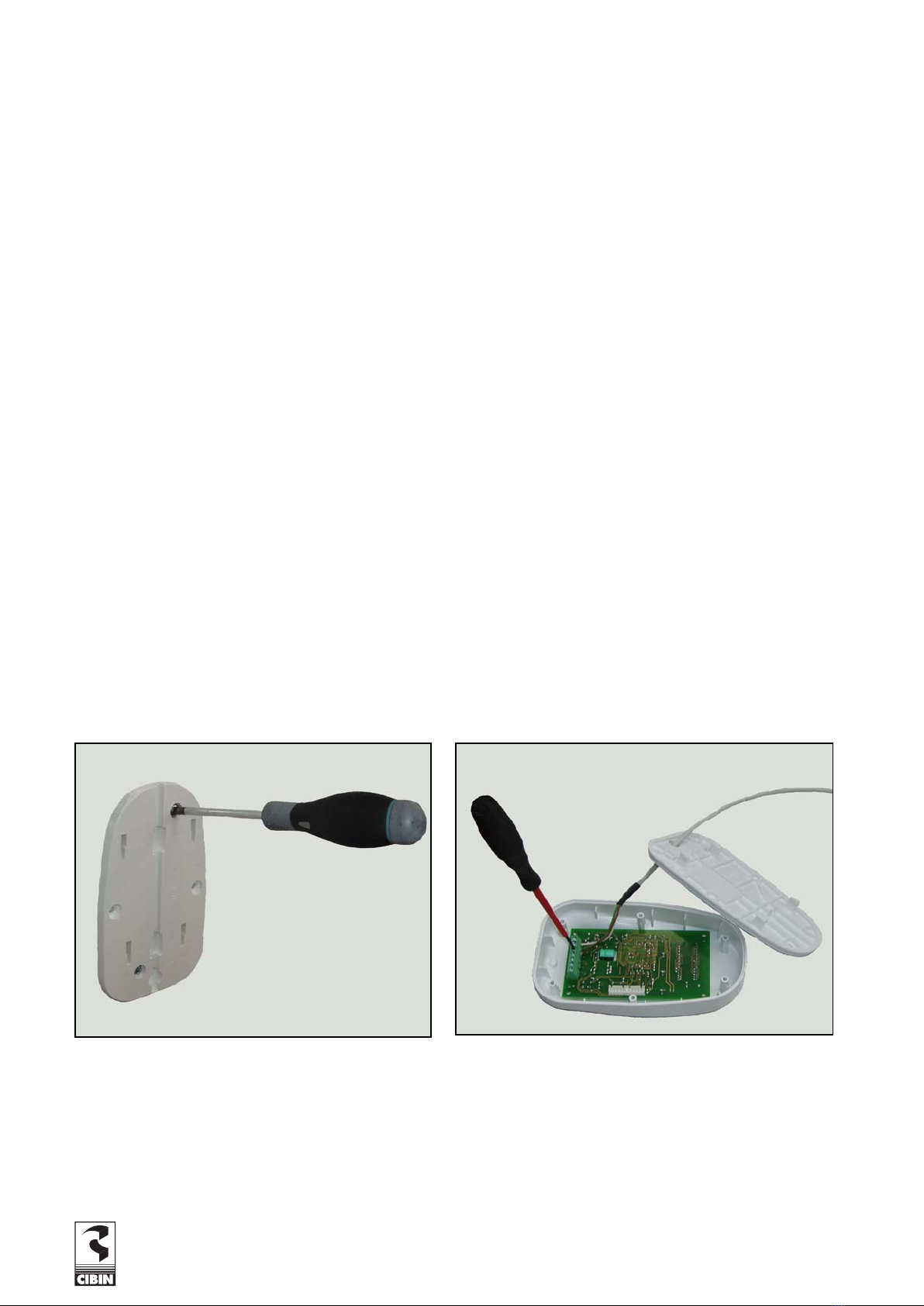
A) FIX the light fitting on the ceiling or wall of the cold room using the self-tapping screws provided (fig 1.2.3.a). If the light
fitting is being fitted to the cold room wall, ensure that the cable leads downwards, as shown.
B) REMOVE the glass and protective grid from the light fitting by loosening the locking screw. Make a hole for the cable throu-
gh the stopper .
C) MAKE a hole through the membrane of the cable gland most suited to the installation type. Feed the cable marked “LC” (if
it’s provided) from the machine through the stopper and the cable gland . Pull out any excess cable (fig.1.2.3.b).
D) CUT the cable down to size, remove the sheathing from the conductors and connect them to the relative terminals of the light
fitting. Screw the stopper to the cable gland and the light bulb (supplied) into the light fitting. Replace the light fitting glass
and protection grid.
Fig. 1.2.3.a Fig. 1.2.3.b
500mm
500mm
200mm
200mm
500mm
1000mm
1000mm
Fig. 1.2.2.a Fig. 1.2.2.b
60
1.3 ELECTRICAL CONNECTION
WARNING!! The electrical connections for the machine should only be carried out by a qualified technician who will be in
charge of the preparation of the installation and who should follow the indications below before connecting to the power supply.
- ENSURE that the power voltage and frequency correspond to that given on the data plate fixed on the side of the machine
Permitted Tolerances: +/- 10% of rated voltage +/-1% of continuous rated frequency.
- IT IS IMPORTANT to connect the equipment to an efficient earthing system, fitted according to the standards in force
WARNING!! Do not use sockets or plugs that are not been earthed.
- IN ORDER to protect the equipment from possible overloads or short circuits, connection to the power supply must be made by
means of a thermomagnetic circuit breaker or a switch with adequate dimensioned fuses.
- WE RECOMMEND, furthermore, that a differential switch (earth fault interrupter), with a high-sensitivity of at least 30 mA and
manual reset, be fitted upstream of the system.
CAUTION!! If the power supply is made by means of a generator make sure that the produced electrical energy is sufficient for
a sure start-up of the compressor.
For the size of safety device, the following should be taken into calculation:
-In (rated current), indicated on the CE label, intervention curve “C”
-PROCEED to the electrical connection of the machine by following the colours of the wiring in the power supply cable:
green/yellow = PROTECTIVE CONDUCTING WIRE
blue = NEUTRAL
-POSITION the door microswitch on the upper corner of the door (hinged side).
-CONNECT the resistor (if foreseen) to the relative power supply cables of the machine.
WARNING!! In the event that it is necessary to extend the power supply cable and/or auxiliaries,
first contact our Technical Department.
1.3.1 REMOTE KEYBOARD INSTALLATION AND DEINSTALLATION
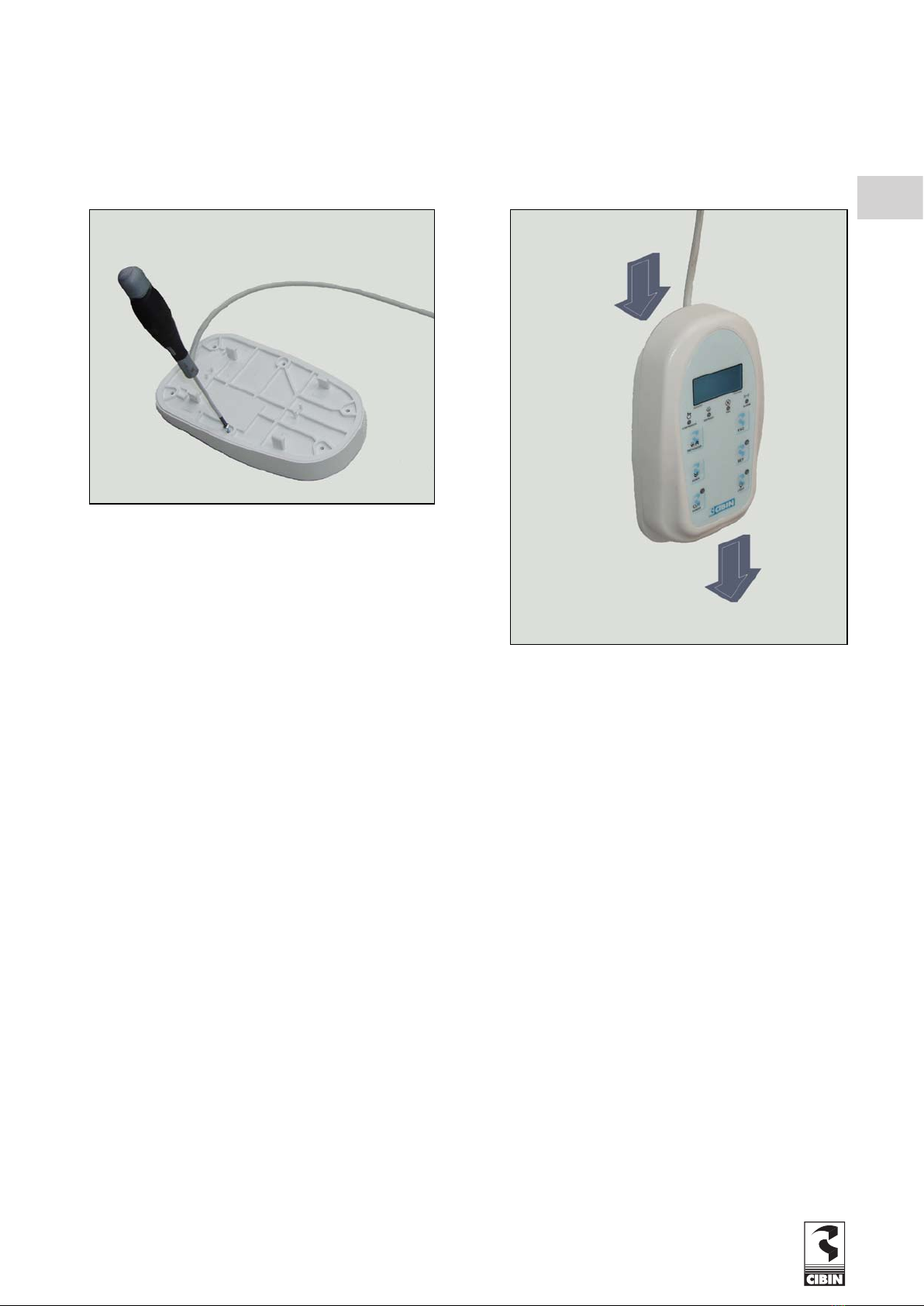
Fig. 1.3.1.a Fig. 1.3.1.b
61
- FIX the support of the remote keyboard on the cold room wall using screws (Fig. 1.3.1.a).
- CONNECT the cable to the relative terminals (Fig. 1.3.1.b).
- CLOSE the coverage of the remote keyboard using the provided screws (Fig. 1.3.1.c).
- INSTALL the remote keyboard on the support (Fig. 1.3.1.d).
1.3.2 DOOR SWITCH CONNECTION (pre-set machines only)
Where required, connect the door switch as indicated in the electrical diagram. Some machines are supplied with a cable bridge
on the door switch terminals, this must be removed when a door switch is installed.
Use only shielded cables to connect the door switch (see wiring diagram).
1.4 WATER SUPPLY CONNECTION (pre-set machines only)
When connecting to the water supply, follow the inlet (blue) and outlet (red) directions of the water supply.
Connect to the respective couplings on the unit.
Remember that the diameters of the connection pipes must never be less than those of the pipes of the equipment.
The minimum working pressure for good water circulation must never be less than 1 bar or more than 5 bar.
Fig. 1.3.1.c
Fig. 1.3.1.d
GB

62
1.5 INITIAL OPERATION
1.5.1 START CONDITIONS
Before switching on the machine CHECK THAT:
- the machine has been correctly positioned;
- all locking screws have been tightened;
- all electrical and/or water supply connections have been made correctly;
- in the event that the machine was opened, no tools have been left inside;
- there are no refrigerant gas leaks;
- all fittings have been correctly installed according to their use.
1.5.2 PRE-HEATING INSTRUCTIONS (pre-set machines only)
Heating the housing
This function heats up the compressor unit housing prior to its being started.
Pre-heating is carried out as follows:
- APPLY voltage to the machine by inserting the plug or using the thermomagnetic switch.
- ENSURE that the machine is switched off by the POWER button.
- LEAVE the machine in this condition for at least 24 hours.
- ONLY after this period of time is it possible to start the machine.
1.6 DEINSTALLATION
FOR deinstallation, if any, follow steps A-F as given below.
- DISCONNECT the power supply switch
- REMOVE the plug or power supply cable from the main power supply.
- REMOVE all machine fittings from the cold room (lamp, door microswitch, frames, control panels, connection pipes,.......etc.)
- REMOVE the equipment from its place, handling it with caution!
- REPACK the equipment in its original packing if possible, taking care to replace all protective materials necessary to avoid
damage during transport.
- FOR a new positioning and connection operations of the machine, proceed as previously described.
1.7 PACKING DISPOSAL
The packing can be used again for reinstallation, if any, or it can be disposed of. Packing must be disposed of according to the
standards in force in the Country of use.
Most of the materials we use for packing are recyclable. These are:
- “Fir” wood;
- Plywood;
- Polyethylene ( PE ) protective film for packing;
- Polyethylene ( PE )straps and adhesive tape;
- Recycled and recyclable cardboard packing;
- CFC-free Polystyrene ( PS ) and/or soft Polyurethane compound ( PUR ) spacers;
- Metal nails, hinges and other fixing devices.
For highest protection of the environment, we recommend that you contact a specialised centre for the collection and recycling of
packing in your Country.
2. TECHNICAL DATA
2.1 FLUIDS AND MATERIALS USED
Machine areas that may come into contact with food products are made of non-toxic materials for use with food.
The refrigerants used in our equipment are those permitted by current directives for the protection of the environment.
2.2 POWER, CONSUMPTION, WEIGHTS, NOISE LEVELS AND DIMENSIONS
See Manual 2 (pre-set machines only)
Table des matières
Manuels Pompe à chaleur populaires d'autres marques


Mitsubishi Electric
Mitsubishi Electric PUZ-SWM60VAA Manuel utilisateur

Dimplex
Dimplex LI 16I-TUR Guide de l'utilisateur

Carrier
Carrier WSHP Open v3 Guide de configuration rapide

TGM
TGM CTV14CN018A Manuel utilisateur

Carrier
Carrier 38MGQ Series Manuel utilisateur

Kokido
Kokido K2O K880BX/EU Guide de dépannage


