and a CT connected around all three phases to
measure residual current leakage to earth
[ground]. It will usually also contain the MV
Load Terminals, though these could be
supplied in a separate section. The Converter
switches the supply voltage in such a way as to
control (reduce) the amount of voltage that
reaches the heater to provide the heating
needed.
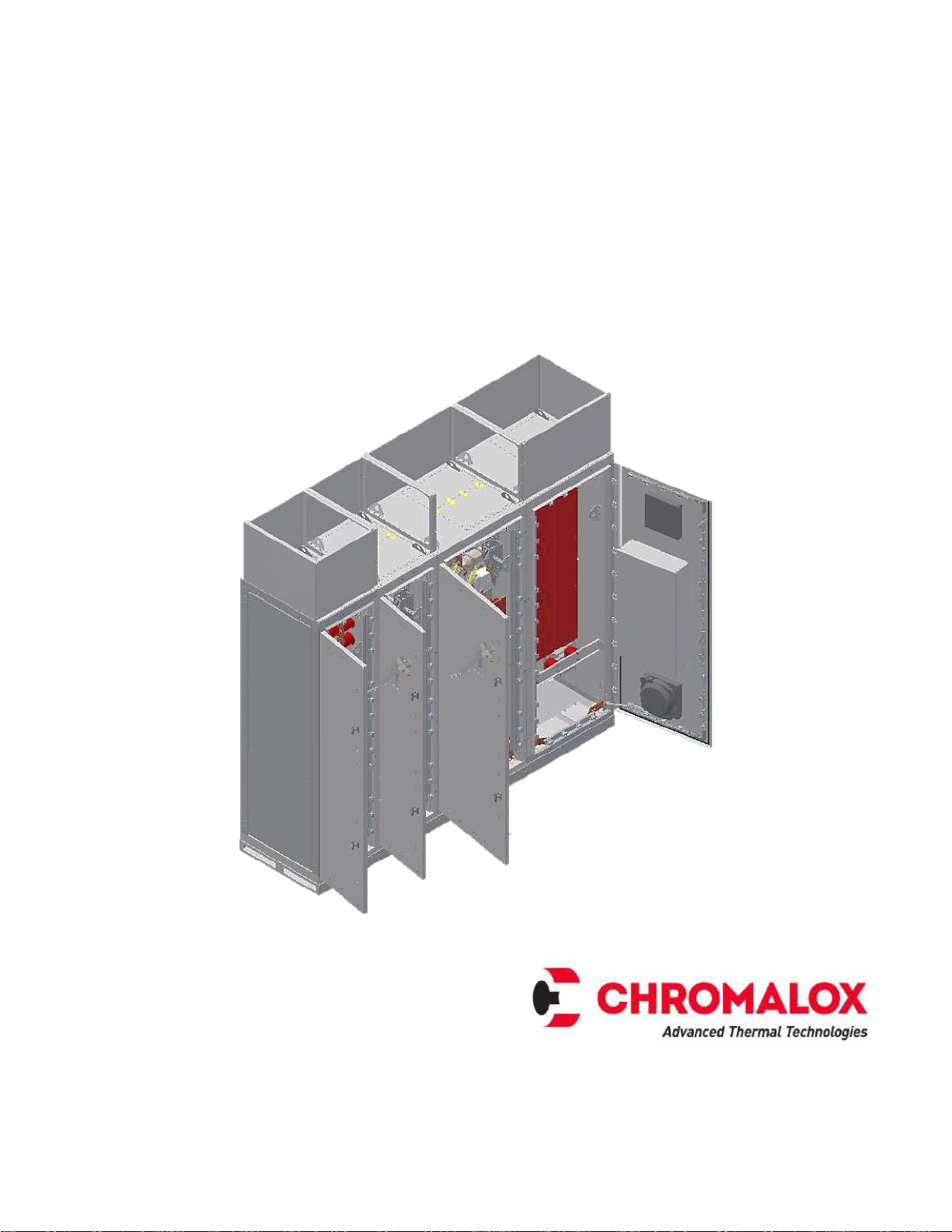
Power for the Converter is fed from the
‘Controller’ section. This contains an MV
Disconnector Switch, fully rated Type E MV
fuses, an MV Contactor, Inductors, and an input
voltage monitoring VT. It can also contain a
power supply Control Power Transformer
(CPT), and the MV Supply Line terminals.
Cooling for the Converter stacks is provided by
a door mounted fan (for NEMA 1), or a side
mounted Heat Exchanger (for NEMA 4). The
Inductors, which are connected in circuit
between the Contactor and the SCR stacks,
limit the rate of rise (di/dt) of current flowing into
the SCRs.
If the incoming MV supply line terminals are not
mounted in the Controller section, a separate
‘Direct-on-Line’ (‘DOL’) section will be provided
for these terminals.
If multiple Heaters are to be fed from a
Converter, and separate switching control is
required for each Heater, ‘Load Switching’
section(s) will be provided, each with up to two
Contactors, and associated load terminals.
If the total Heater load exceeds the maximum
that can be supplied by the Converter, the
Converter System will be equipped with
additional ‘Stepper’ sections that work in
sequence with the Converter to ramp the
Heater load up to the level required. ‘Stepper’
sections each have a Disconnector Switch, MV
fuses, and output Power and Dry-out
Contactors.
LV control is mounted in a separate ‘LV
Compartment’ that is mounted on the front door
of the Converter.
The doors for the various sections, and for the
Low Voltage compartment can be locked closed
using key locks provided in the door handle.
The Disconnector Switches mentioned above
each provide an isolation gap between the
Supply/Line power and the associated
Heater(s). They can be padlocked open. A
window is provided for each Disconnector so
that its status can be verified visually.
The Disconnector and the Heater junction
box(s) can be equipped with a key inter-locking
system intended to prevent opening of certain
compartments until specific conditions are met.
For example, the Heater junction box lock may
be equipped with a key that is captured in the
Disconnector Switch mechanism and is not
released until the Disconnect Switch is open.
Secondary compartmentalization may be
provided, in which the Disconnector(s) is
segregated in its own compartment within the
Controller or Stepper section. This
compartment has its own door, and with this
door closed, in some regions / applications, if
the Disconnector is open access to the
associated MV fuses mounted in that section, is
possible for replacement with MV power still
connected to the primary side of Disconnector.
Appropriate PPE must be worn. However, it is
strongly recommended that, if at all possible,
the main incoming supply be switched off and
locked off upstream of the Converter System
before such work is carried out.