B) Metal-walled or roofed buildings can affect antenna operation. If you have no choice, your GAP should be
located at a corner of the building, rather than along a flat wall. In this case, the antenna should be tested
first away from the building. Section 4.2E on Elevated Mounting provides instructions for temporary
installation and test.
C) Stucco buildings often have metal mesh in their walls, and should be treated as metal structures, until
proven otherwise.
D) Mobile homes or RVs are a special case, which will involve some individual experimentation. It is
suggested that the antenna be tested first, following the instructions in section 2.2, before attempting
installation near or on the RV.
1.4 Guying
When ground mounted, the GAP vertical is designed to withstand substantial winds without guys. Guys are
a form of insurance, however, which we recommend. Non-conductive guy rope should be fastened above
the GAP center insulator, using a stainless steel hose clamp.
Three guys should be used. Do not pull them taut; leave some slack to accommodate temperature changes.
In areas where high winds are uncommon, the guys may be dressed alongside the antenna, and tied to guy
anchors only when needed.
Guys must be used for roof mounting. Do not rely on a chimney mount to support the GAP vertical; even
moderate winds can produce enough force to damage the mount or the chimney.
1.5 Radials
In choosing the site, remember that three 25' radials will be required for operation. Ideally, these would
extend straight out from the base, and be installed at 120 degree increments around the antenna. In limited
space situations, the radials may be bent or curved to fit into the available space.
1.6 Feed line
We recommend a minimum of 65' of coax cable, in order for the feed line not to look like a radial. If the site
is closer to the transmitter, make provision for coiling the coaxial cable outside the home.
CHAPTER 2: BASE INSTALLATION
2.1 Ground Mount
A) A carpenter's level, and post-hole digger or small shovel are required for this step.
B) Referring to the parts diagram, select the 3' Mount Section.
C) At the desired installation site, dig a 3' deep hole, using the post-hole digger or small shovel. This should
be no larger than 8" in diameter.
D) Place the Mount Section in the hole, and refill with dirt to about 2' below ground level. Tamp the dirt well.
The top of the Mount Section should be 2" above ground.
E) Select the Base Section. Temporarily slide it into the Mount Section. Using the carpenter's level, make
sure that the Base Section is vertical. 'Check at least at four positions, dispersed 90 degrees around the
Base.
F) For permanent installations, a 40# bag of concrete gravel mix should be mixed according to directions
and poured in the 2' deep hole. Level the mix with the ground. Clean any residue from the Base Section,
above ground.
Be sure that the Base Section is vertical. Let set for 24 hours. After 24 hours, the Base Section may be
removed, for assembly in the Challenger DX-VIII antenna.
H) For temporary installations, in non-sandy soils, rocks and dirt may be packed in the hole, in lieu of
concrete. Tamp well. Soak well, and tamp again. In this case, use of guy ropes is strongly recommended.
CHAPTER 3: ASSEMBLY
3.0 General
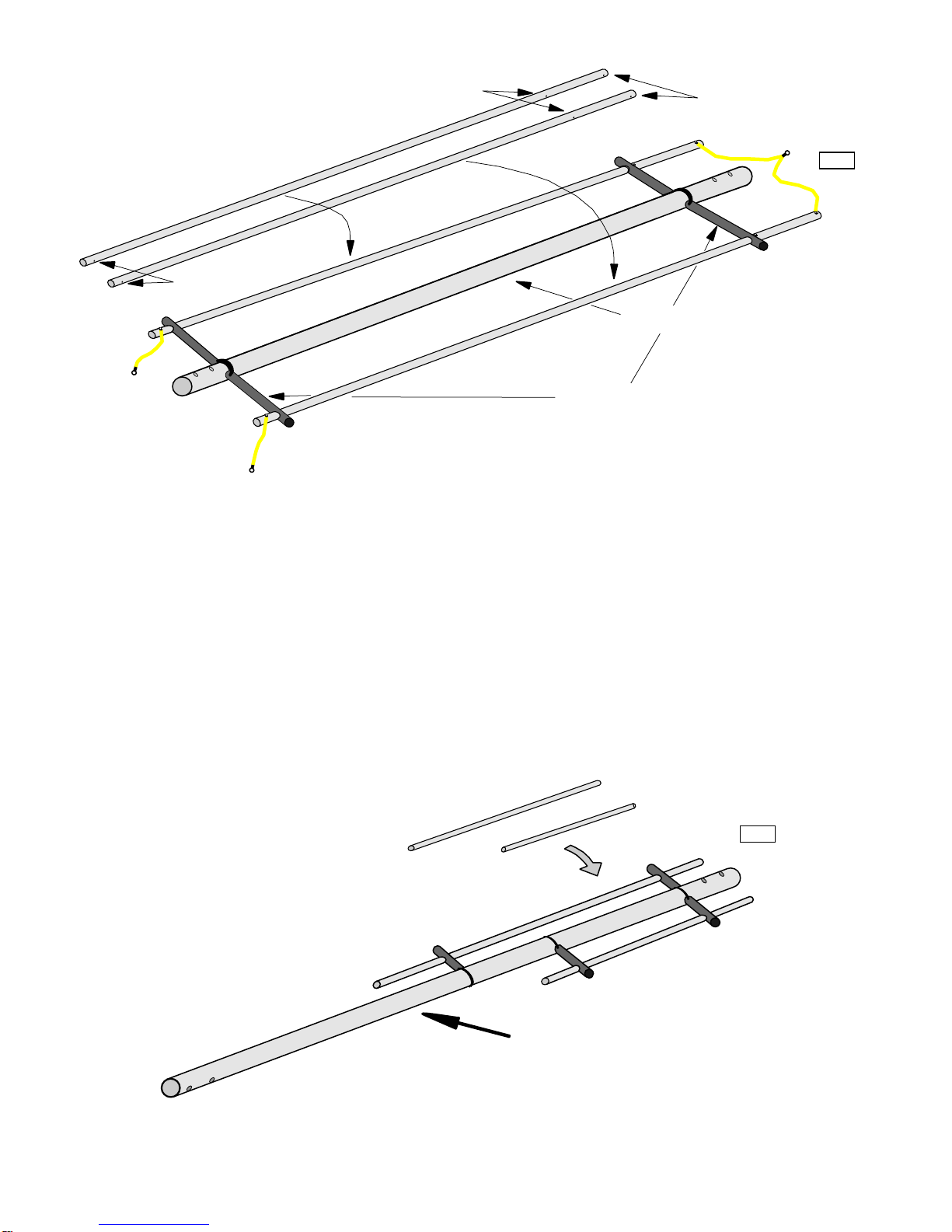
Assembly of the Challenger DX-VIII antenna is done in stages. Sub-assemblies are completed first, then
joined in the final assembly stage. The process should take about 60 minutes, based on user experience.
Within the manual is an assembly drawing of the DX-VIII, on the back of which is a parts drawing. This
drawing is removable for use in assembly and parts identification. Partial sketches are embedded in the text
to help you visualize the assembly step referenced.