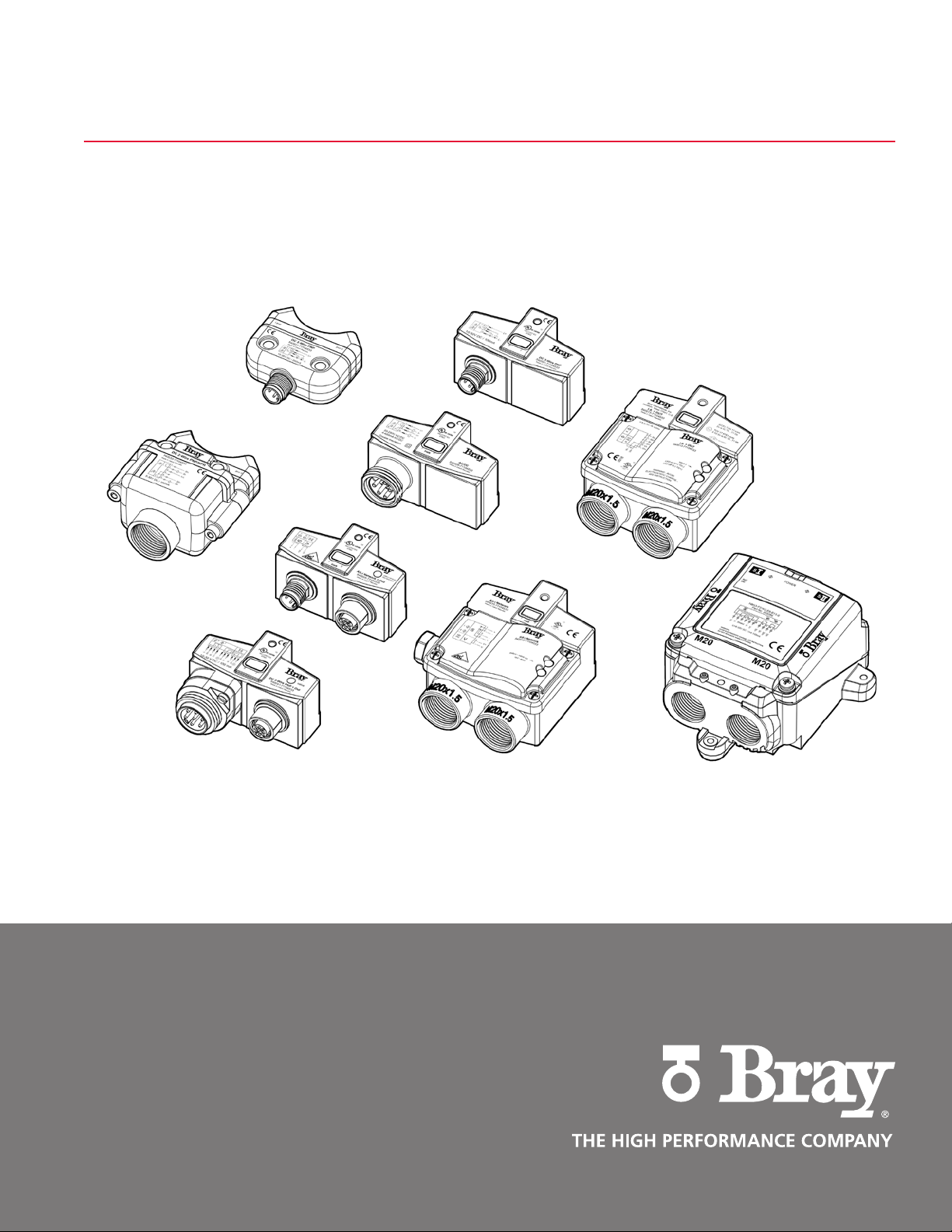
Series 54 Proximity Sensors
Installation, Operation and Maintenance Manual
SERIES 54 PROXIMITY SENSORS | 3
2.0 - Introduction
Note: The following information is intended to assist
individuals with the use and support of the Bray Series 54
Proximity Sensors.
The Series 54 Proximity Sensor has been designed to provide
valve position indication utilizing various signal types. Each
of these configurations will be covered in more detail on the
pages that follow.
All Bray S54 Proximity Sensors utilize solid state switches.
Although the solid state switch performs the same function
as a conventional mechanical switch, there are differences in
the way solid state switches operate.
NOTICE
It is very important for the user to pay close attention
to the exact specifications of their sensor in order to
avoid damaging the unit.
Solid state switches have current restrictions imposed by the
semi conducting materials used to form the sensor. These
current limitations have to be accounted for during setup.
Unlike mechanical switches, which can normally handle several
amperes of current flowing through them, solid state switches
are generally rated for half an ampere or less.
NOTICE
The electrical characteristics of the S54 must be
compatible with the application
When working with the S54, several parameters must be
considered. A few of which (with significant importance) are
listed here:
• operating voltage
• maximum switching current
• output voltage drop
• residual current.
Using an S54 outside of these parameter limits can cause
damage to the unit and void factory warranty.
Operating voltage is the amount of voltage necessary for the
sensor to operate. The maximum switching current is the largest
amount of current that the sensor’s solid state electronics can
have flowing through them in the on-state (when the target is
in proximity of the sensor). During commissioning, it is up to
the user to correctly apply the sensor to their control system in
order to limit the current flowing through the device. All the
necessary information can be found in the technical manual.
Output voltage drop is defined as the amount of voltage that will
drop across the solid state switch. This voltage drop will often
vary with the amount of current flowing through the sensor
and the load. This drop in voltage becomes paramount when
connecting several proximity sensors in series, each unit will have
a voltage drop across it – adding each subsequent drop and
subtracting from the supply voltage yields the resulting voltage
at the end of the series connection. The user needs to ensure
that the supply voltage is large enough so that the resulting
voltage after all the drops is above the minimum operating
voltage of the last S54 in the series connection. Sensors located
a great distance from the load require consideration as well, as
a general rule, every 1000 ft. of wire will have a resistance of
10Ω (see electrical code references for the resistance value of
specific wire sizes). It is important for the customer to ensure
that the distance between the S54 and the control panel is
not long enough to cause the voltage drop to fall below the
minimum operating voltage of the sensor.
Residual current is often referred to as leakage current. In the
“off” state (target is NOT in proximity of the sensor) the sensor
draws a small amount of current in order to power the device’s
electronics. This is necessary for the device to sense the target
at any point in time when the supply voltage is applied. It is
important that this residual current is below the maximum
off-state current rating of the control system.
2.1 - Pre-installed Storage
Bray Series 54 Proximity Sensors are not weatherproof until
the unit is properly installed, or all conduits and applicable
port connections are sealed off and prepared for storage. The
units may be shipped with temporary covers to prevent foreign
matter from entering through the conduit openings; however,
the user is responsible for replacing with the proper sealing
plugs to support its NEMA/IP ratings.
To prevent condensation from forming inside the unit, maintain
a near constant external temperature and store indoors in a
well ventilated, clean, dry room. The temperature shall be
between 40°F (4°C) and 85°F (29°C), with a relative humidity
less than 70%. Store units away from vibration and direct
sunlight exposure, and place units on a shelf or wooden pallet
in order to protect against dampness. Keep units covered to
protect against dust and dirt; if storing for long term, placing
the unit inside a plastic sealed bag may be preferred.
Bray cannot accept responsibility for deterioration caused on-
site once the cover is removed or due to improper storage.
2.2 - S54 Sensor Part Numbering
ersion
00: Plastic Base
01: Aluminum Base
Housing
0: Large Housing with Connector
1: Large Housing with Conduit Entry
2: Small Housing with Connector
3: Small Housing with Conduit Entry
4: Large Housing with Rd24 Connection
Electrical Output
1: DC 3 wire PNP
2: DC 2 wir
3: Intrinsically Safe
4: AC/DC
5: AS-i