General information
Hardly any other "mechanical" musical instrument comes in so many different variations as
the accordion. This is shown by the many different terms for instruments of this genre,
whereby one and the same instrument is sometimes given different names depending on the
country and region. Even the attempt to classify the various designs into categories is only
incomplete.
A distinction is made, for example, between alternating tones and equal-tone instruments.
The alternating tone instruments produce different tones on one and the same key during pull
and push. Equal-tone instruments, on the other hand, always produce the same tone
regardless of the direction of the bellows movement on a key. Diatonic instruments are always
alternating tones, but also have keys that are partly of the same tone. Chromatic instruments
are usually of the same tone, but there are exceptions.
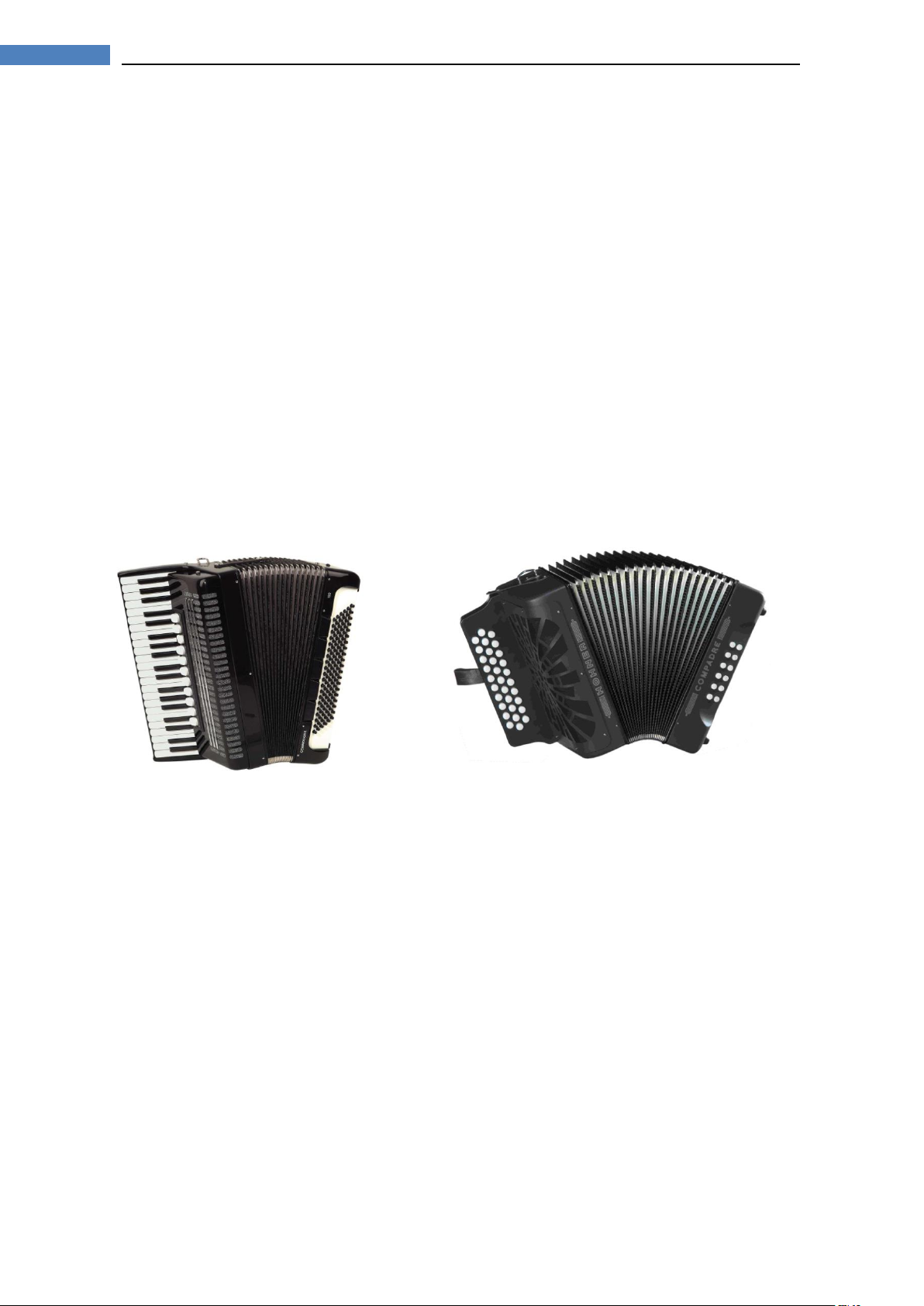
The differentiation between the knob handle and the piano keyboard is the most obvious
outwardly, but (at least for the button accordions) says nothing about the type of tone
assignment.
Figure 1: large, multi-choir piano accordion
Each design probably has its own special advantages, but is not always equally suitable for
every type of music (or even every key). Furthermore, a variety of different playing techniques
and notations have developed for these instruments.
Popular "big" accordions are usually built in 4 to 5 choirs. Analogous to the organs, we also
speak of foot positions, namely 16', 8' and 4' as "even" (i.e. purely tuned) stops. In addition,
there are up to two tremolo registers, which are also in the 8' pitch, but are tuned a little
higher or lower in comparison.
Other accordions have instead of the detuned 8' stops the 16' and/or 8' stops in their own
resonance chamber (Cassotto), which gives a rather dull and soft sound, and maybe
additionally an open 8' stop in the same tuning. Still others even have a high fifth register (2
2/3'), but then usually do not have a detuned 8' register.
Although the keyboards of our instruments (here the organ is meant) differ only slightly from
those of a (piano) accordion, it is often the way of playing that provides a "real" accordion
sound. Just think of the bass (and chord) side of the accordion.