WHAT YOU NEED
TO DO THE JOB
SPEAKER SYSTEM
PARTS INVENTORY
Before you get involved in the actual
installation process, it’s a good idea to
check for possible shipping damage and
identify parts and hardware.
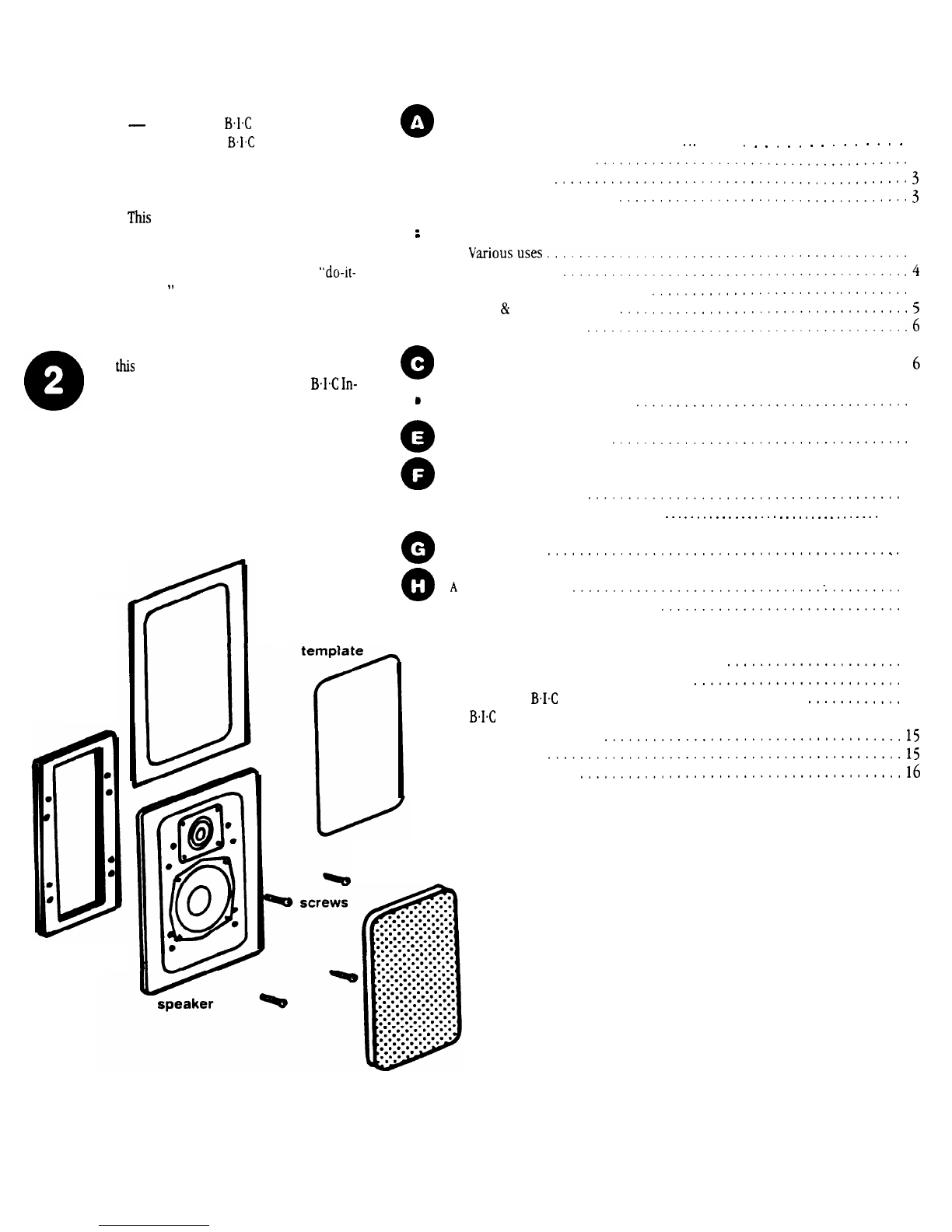
You should have the parts shown in
Drawing 1:
0
‘ho (2)
B+IC
In-wall loudspeaker
systems with attached grilles
0
Iho
(2) metal brackets
0
Eight (8) black metal screws (in
their own little zip-top bag)
0
Another clear plastic bag with little
rectangles of a black substance
wrapped in white paper (we’ll
explain this one later!)
0
l’wo
(2) white cardboard mounting
templates
0
‘Iwo
(2) white cardboard masking
templates for painting
If anything is missing after a thorough
search of the box and packing materials,
contact the dealer where you bought your
speakers.
Although BIG In-Wall Systems are
extremely well packed to withstand the
rigors of shipping, you should still
inspect them closely, especially if there
is any damage to the outside cartons. If
you find anything wrong, contact your
dealer or the shipper who delivered
the speakers.
TOOLS FOR INSTALLATION
IN EXISTING WALLS
It doesn’t take a whole workshop to
install your new speakers, just a few
simple tools:
0
A pencil
0
A
drill with a l-inch flat bit
0
A retractable utility knife or
keyhole saw
0
A length of stiff wire about 3 feet
long (a straightened wire coat
hanger works fine)
0
A
Phillips-head screw driver which
will fit the black screws included
with your speakers
0
A pair of diagonal pliers or wire
strippers
Some of the following may also be
needed, depending on the application.
0 A stud finder
0
Drill bit just slightly larger than
the diameter of one speaker wire
0
Plumb bob or small weight on a
string
0
Insulated staples for securing
speaker wire
0
Masking tape or foam
“double-
stick” tape
0
Paint and applicator for changing
grille
#and
outer frame finish
0 A bubble level
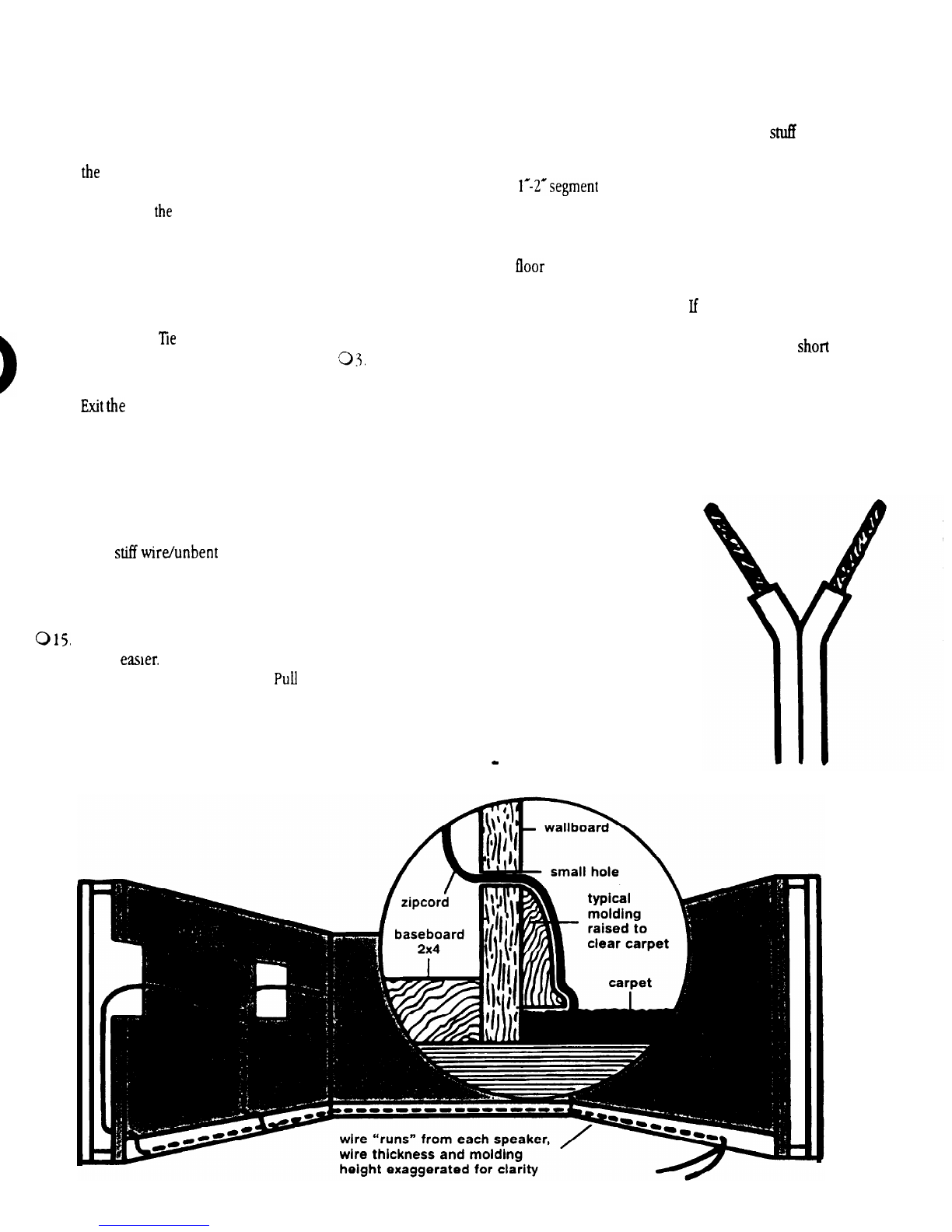
SPEAKER WIRE
The amount of wire you’re going to
need will of course vary with speaker
placement (which we cover next). But
we’re covering the subject of wire now
because it’s something you may have to
go out and obtain along with whatever
tools you don’t already have.
What
kind to use
We recommend using inexpensive,
multi-stranded “zip-cord” for
amplifier-
to-speaker connections. Also called lamp
cord, it’s sold in pre-packed rolls and in
bulk displays at hardware, lighting and
home improvement stores. Zip-cord’s
outside covering (insulation) can be
transparent, black, brown, white, etc.
Color doesn’t matter. Thickness does.
Selecting the proper gauge
Wire is measured in “gauges.” For no
particularly good reason, the bigger the
number, the smaller the wire. For exam-
ple,
18-gauge
is thinner than
14-gauge.
The gauge of wire you need is deter-
mined by the distance between your
amplifier/receiver and the speakers. Use
the following chart as a guide:
Length
Minimum Gauge
Less than 10 ft.
18
10 to 50 ft.
16
Over 50 ft.
14
If in doubt, be safe and get a smaller
gauge (i.e. thicker wire). Using too thin
a gauge over a long distance can compro-
mise sound quality. And besides, there
isn’t a vast cost difference between
gauges, anyway.
How much to buy
Basically, more than you think you
need. As we noted earlier, a discussion of
lengths is sort of premature until you’ve
decided on exact placement, so you may
want to skip to page 4 and read the sec-
tion on “‘Where to
put your speakers.”
But if you have a rough idea of the dis-
tance from your
ampfier
to the speak-
ers, here are a few tips:
Because of the complicated paths
which are often required to route
wires, you’ll definitely need more
than the amount derived from
simple measurements.
Even if one speaker is a lot closer
to the amp than the other speaker,
you should use the same length of
wire for both paths. This insures
that both speakers will play at
equal volume.
Professional installers often use
the following rule of thumb:
“As
the crow flies” amp to speaker
distance TIMES FIVE. That allows
enough for both speaker paths plus
a very healthy margin for unplanned
detours. Remember the electrician’s
favorite
adage: “You
can
always
cut
off extra wire, but
they
don’t stretch
worth a ah.
”
AMPLIFIER
CONSIDERATIONS
Virtually any receiver, power amplifier
or integrated amplifier can be used with
your
BIG
Ceiling Speakers. Although
Muro
M-50’s
are rated at 100 watts maxi-
mum input power, M-60’s at 110 watts,
M-80’s
at 120 watts,
M-8.3’s
at 120 watts,
and
V&38’s
at 125 watts, it’s OK to use a
more powerful amplifier if you take some
simple precautions, which we cover on
page 13 (‘Taking care
of your new
B-1-C
In-wall speakers”).
A more serious consideration is
whether or not you intend to power more
than one set of speakers with the same
amplifier or receiver. If you intend to
hook speakers to both “A” and
“B”
receiver outputs and then play both sets
of speakers at the same time, you should
read the section starting on page 14 of
this manual
(“More on amplifiers
and impedances”),
to avoid potential
problems.