Bellhowell BHNV10 Manuel utilisateur

BHNV10 User’s Manual

1. About Your Monocular
1
About this Manual
Congratulations on purchasing the Bell+Howell BHNV10 Digital Night Vision
Monocular!
The contents of this manual are subject to change without notice. Note that the
example screens and product illustrations shown in this User’s Guide may differ
somewhat from the screens and configuration of the actual monocular.
Copyright
This manual contains proprietary information protected by copyright. All rights
are reserved. No part of this manual may be reproduced by any mechanical,
electronic or other means, in any form, without prior written permission of Elite
Brands Inc. © 2022.
FEDERAL COMMUNICATIONS COMMISSION INTERFERENCE
STATEMENT
This equipment has been tested and found to comply with the limits for a Class
B digital device, pursuant to Part 15 of the FCC Rules. These limits are
designed to provide reasonable protection against harmful interference in a
residential installation. This equipment generates, uses and can radiate radio
frequency energy and, if not installed and used in accordance with the
instructions, may cause harmful interference to radio communications. However,
there is no guarantee that interference will not occur in a particular installation. If
this equipment does cause harmful interference to radio or television reception,
which can be determined by turning the equipment off and on, the user is
encouraged to try to correct the interference by one or more of the following
measures:
•
Reorient or relocate the receiving antenna.
•
Increase the separation between the equipment and receiver.
•
Connect the equipment into an outlet on a circuit different from that to which the
receiver is connected.
•
Consult the dealer or an experienced radio/TV technician for help.
CAUTION:
Any changes or modifications not expressly approved by the party responsible
for compliance could void the user's authority to operate the equipment.
This device complies with Part 15 of the FCC Rules. Operation is subject to the
following two conditions:
(1)
This device may not cause harmful interference and
(2)
This device must accept any interference received, including interference
that may cause undesired operation.
RF Exposure Warning
This equipment complies with FCC RF radiation exposure limits set forth for an
uncontrolled environment. This equipment must be installed and operated in

2
accordance with provided instructions and must not be co-located or operating in
conjunction with any other antenna or transmitter. End-users and installers must
be provided with antenna installation instructions and transmitter operating
conditions for satisfying RF exposure compliance.
FCC: SAR standard Value: 1.6 W/Kg, Maximal Measure: 0.4 W/kg
CE Mark Warning
This is a Class B product, in a domestic environment, this product may cause
radio interference, in which case the user may be required to take adequate
measures.
Safety and Handling Precautions
Monocular Information
•
Do not disassemble or attempt to service the monocular yourself.
•
Do not expose the monocular to moisture, or extreme temperatures.
•
Allow the monocular to warm up when moving from cold to warm
temperatures.
•
Do not touch and put pressure on the monocular lens.
•
Do not expose the lens to direct sunlight for extended periods.
•
Do not use abrasive chemicals, cleaning solvents or strong detergents to
clean the product. Wipe the product with a slightly damp soft cloth.
•
Do not use the flash, IR LED or LED Light near a person's eyes to prevent
possible eye injury.
•
To prevent you from falling over or resulting in traffic accident, please do not
use the monocular while you are walking, driving or riding a vehicle.
•
Please handle the monocular strap with care, and never place the strap
around the neck of an infant or child. Wrapping the strap around a neck may
cause suffocation.
•
Do not subject the LCD screen to impact.
•
To prevent the risk of fire or electric shock, do not expose this appliance to rain
or moisture.
Battery Information
•
Turn off the monocular before installing or removing the battery.
•
Use only the provided batteries or type of battery and charger that came with
your monocular. Using other types of battery or charger may damage the
device and invalidate the warranty.
•
Inserting the battery upside down can cause damage to the product and
possibly cause an explosion.
•
When the monocular is used for an extended period of time, it is normal for
the monocular body to feel warm.
•
Download all pictures and remove the battery from the monocular if you are
going to store the monocular for a long period of time.
1. About Your Monocular

3
•
The type of battery and the battery power level may cause the lens to be
stuck up. Ensure you use the correct battery type and use a fully charged
battery.
•
Risk of explosion if battery is replaced by an incorrect type. Dispose of used
batteries according to the instructions.
•
Please keep the batteries out of the reach of children to prevent from
swallowing batteries, which might cause poisoning.
•
Once the battery's color changes or its shape is twisted, please stop using it.
USB adapter Information
•
Do not expose the adapter to high temperatures or moisture places.
Otherwise, it may cause fire or electric shock.
•
Do not attempt to repair, disassemble, change or transform the adapter.
•
Avoid sudden changes in temperature, which may cause condensation on the
adapter’s internal surfaces. Please do not use it immediately in this situation.
•
Do not touch the plug with wet hands. Otherwise, it may cause electric shock.
•
Do not use the travel voltage converter or AC/DC power inverter. Otherwise,
it may cause damage, overheating, malfunction or fire to the monocular.
1. About Your Monocular

4
1.1
Monocular Interface
1. Lens Cap
8. Zoom In / Out –Up / Down
2. Focus Ring
9. Night Vision
3. Battery Compartment
10. Eyepiece
4. IR LED Light
11. Eye-Cup
5. Power | Mode
12. USB Port
6. Ok | Shutter | Record | Menu
13. Reset
7. Status LED
14. Memory Card Slot
12 13 14
10
11
5
6
7
8
9
1
2
3
4
1. About Your Monocular

5
1.2
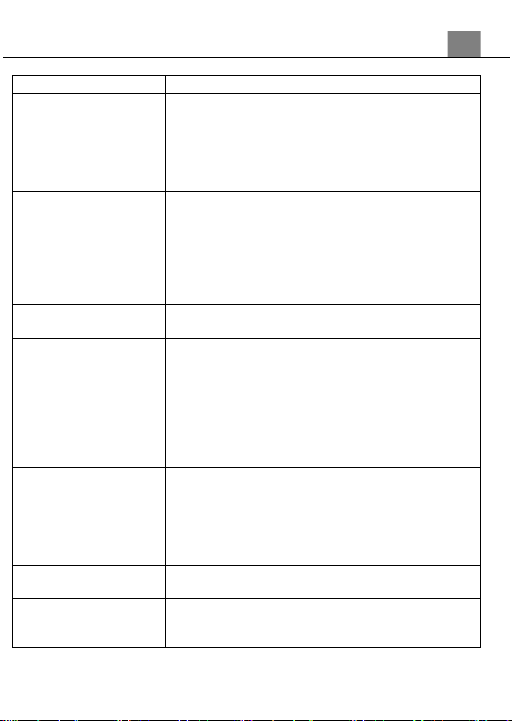
Button Function Description
Function
Description
Power | Mode
Press once to power on and press and hold for
3 seconds to power off.
Press to cycle between Video, Photo and
Playback modes.
In Video Playback: Press to stop a playing
video.
Ok | Shutter |
Record | Menu
Press and hold to access the Menu. OK button
in menus. Tap to confirm a setting.
In Photo: Press to capture a photo.
In Video: Tap to start recording, tap again to
stop recording.
In Playback: Tap to start playing a recorded
video. Press and hold to access delete menu.
Menu
Tap to access and exit all menus and
submenus.
Zoom | Up | Down
In Video and Photo: Press and hold the right
side to zoom-in. Press and hold the left side to
zoom-out.
Tap to change the screen brightness.
In Menu: Press to go to the previous or next
setting option.
In Playback: Press to go to the previous or
next video or image.
Photo | OK
In Photo: Press hard to capture a photo.
In Video: Tap to pause a recording, tap again
to resume recording.
In Playback: While playing a recorded video,
tap to pause and tap again to resume.
OK button in menus. Tap to confirm a setting.
Night Vision
In Video and Photo: Press to enter starlight
mode, press again to activate the IR LEDs.
Sun-shield
Used to protect the lens when using the
monocular in daylight. Open the sun-shield
when used at night or in dark settings.
1. About Your Monocular

6
IR LED Light
LED light to aid with vision and recording in
darkness.
Tripod Mount
Mount port for attaching to a tripod nut located
on the bottom of the
Focus Ring
Rotate left or right to focus the image on the
screen.
Reset
Button for power cycling your monocular if it
freezes or becomes unresponsive.
1. About Your Monocular

7
2.
First Use
2.1
Inserting the Memory Card
Insert the included MicroSD memory card to record and store your videos
and photos. When the battery is low, media stored on the memory card will
not be erased. Please insert the MicroSD memory card by following the
steps below:
1.
Open the rubber jack door to access the memory card slot.
2.
Insert the memory card. Ensure that the metal contacts are inserted first.
Push the memory card down until you hear an audible click.
The memory card can only be inserted in one way. Do not force the
card in if it will not go in smoothly.
3.
Close the rubber jack door.
4.
To remove the memory card, simply push in and the card will eject out.
2.2
Installing the Battery
Insert the lithium-ion battery into the battery compartment with the negative
side first.
NOTE:
•Please format the memory card before using the monocular
(Caution, this will erase all data on the card).
•Do not remove or insert the memory card when recording. It may
damage the card or cause data loss.
•Memory card rating must be Class 10 or above.
2. First Use

8
1.
Open the battery door by rotating the battery door counter clockwise until
it comes off the monocular.
1.
Insert the battery. Ensure that the negative side of the battery is inserted
first.
2.
Close the battery door by rotating it clockwise until it is tight.
Note: Do not overtighten the battery door, this may cause the battery
door to get stuck and make it difficult to open again.
2.3
Charging the Battery
Connect your monocular to the included AC adaptor with the USB cable
provided for charging. Open the rubber jack door on the side of the
monocular to access the charging port. Insert the small end of the USB plug
into the monocular’sport, and the larger end into the included AC adaptor.
The LED indicator light will light up red while charging and will light up green
when charging is complete.
2.4
Powering the Monocular On/Off
Press and hold the POWER/MODE button for three seconds to power the
monocular on. To power the monocular off, press and hold the
POWER/MODE button for three seconds. If the monocular’s battery is low, a
“Low Power” message will display on the screen and it will automatically shut
down within a few seconds to prevent memory corruption or loss.
2.5
Switching Modes
Press the POWER/MODE button to cycle between Photo, Video and
Playback modes.
2. First Use

2. First Use
9
2.6
Connecting to a Computer
Your monocular can connect to a computer to transfer photo and video files
for viewing and editing. To connect the monocular to your computer, open
the rubber jack door on the side of the monocular to access the USB port.
Insert the small end of the USB plug into the monocular’s port, and the larger
end into the USB port on your computer. Once connected and powered on,
the monocular will automatically enter mass storage mode and screen will
show an image of a USB stick.
2.7
Focusing
When viewing objects or scenes at varying distances, the image may be out
of focus and appear blurry. To focus the monocular, hold the monocular to
your eye and while viewing the subject or scene, slowly rotate the focus ring
left or right until the image is in focus.
2.8
Lens Cap
The monocular’s night starlight image sensor is designed to be used in low-
to-no light environments. While using the monocular in sunlight or bright
environments, the lens cap should be in the closed position. If the lens cap is
open, the captured images and videos will be overexposed.
2.9
Exposure
The monocular’s frame brightness can be adjusted to your liking. The
recommended exposure value setting is A, for auto exposure. The auto
exposure setting will automatically adjust the exposure based on the external
environment. To decrease the exposure value manually, press the ZOOM-
OUT button. The available exposure levels range from 1-9 with 1 being the
highest and 9 being the lowest. If you decreased the exposure manually,
press the ZOOM-IN button to increase the exposure and to enter auto
exposure.
Table des matières
Autres manuels Bellhowell Monoculaire
Manuels Monoculaire populaires d'autres marques

Night Vision
Night Vision NOXM50 Manuel utilisateur

ATN
ATN Night Vision Spotting Scope Night Storm-HPT Manuel utilisateur

ATN
ATN Night vision Monocular MO-4 Manuel utilisateur

Leica
Leica Monovid 8x20 Manuel utilisateur

StellaX
StellaX ZoomX X-003 Manuel utilisateur

AGM
AGM ASP-MICRO TM160i Manuel utilisateur