
Avalon Instruments M-Uno Manuel utilisateur

USER MANUAL
Version 2.0.1 July 2020
All the pictures and contents included here are propriety of AVALON INSTRUMENTS.
They cannot be reproduced, published, copied or transmitted in any way, including the internet, without the
written permission of AVALON INSTRUMENTS.

SAFETY RECOMMENDATIONS AND WARNINGS
•Read carefully the manual before nstall ng and us ng the mount.
•Use the power cable suppl ed w th the mount or a 12V- 3A stab l zed power supply
as suggested n the manual.
•Connect the power cable correctly and securely to the power socket.
•Do not bend, pull or press the cable as th s may damage t.
•For any ass stance or repa r, please contact only the manufacturer.
•Be sure to remove the power supply at the end of ts use or before any clean ng or
ma ntenance.
•Th s mount must be used exclus vely by adults, do not allow use to ch ldren or to
people w th reduced mental capac ty.
•Avo d to operate the mount except as str ctly nd cated n the manual.
•Mod fy ng or alter ng n any way the character st cs of the mount w ll vo d the
manufacturer’s l m ted warranty.
•Never mod fy the tens on of the belts (by ded cated screw), these s set n the factory
and any unauthor zed change w ll vo d the manufacturer’s l m ted warranty .
•After us ng t, avo d to store the mount n areas exposed to sunl ght or n wet places.
IMPORTANT NOTE: DO NOT USE ANY KIND OF LUBRICANT, SPRY, LIQUID OR
OIL ON THE BELT DRIVE SYSTEM!!!
Any use of lubr cants w ll vo d the manufacturer’s l m ted warranty.
© All Rights reserved - 2

Table of Contents
SAFETY RECOMMENDATIONS AND WARNINGS...............................2
Techn cal Spec f cat ons..................................................................................6
Forewords.........................................................................................................7
1. Pack ng Content...........................................................................................8
2 Mount Descr pt on........................................................................................9
3. M-Uno In t al Setup...................................................................................12
3.1 Lat tude Range Sett ng..............................................................................................12
3.2 Install ng the M-Uno on the Tr pod.........................................................................15
3.3 Telescope nstallat on.................................................................................................17
4. Telescope Balanc ng...................................................................................19
4.1 Dec Balanc ng.............................................................................................................19
4.2 RA Balanc ng.............................................................................................................20
5. M-uno mount stat on ng............................................................................22
5.1 Lat tude F ne Adjustment.........................................................................................22
5.2 Az muth Regulat on...................................................................................................23
5.3 M-Uno Polar Al gnment............................................................................................24
5.3.1 Polar Al gnment w th a Skywatcher polar-scope................................................24
5.3.2 Polar Al gnment w th a Losmandy polar scope...................................................26
5.3.3 External programs for Polar s F nd ng................................................................27
5.3.4 More modern and prec se approaches to Polar Al gnment................................30
© All Rights reserved - 3

Techn cal Spec f cat ons
Type of mount Single Arm Equatorial Fast-Reverse
Head weight 4,9 kg (32.8 lb)
Maximum load 20 kg (44 lb) for photographic use, 25 kg for visual.
Motion System Four-step reducer via pulley toothed-belt system on ball
bearings, with zero play on both axis. (Belt Drive System)
Construction
Materials
Machined from solid blocks of anodized aluminum with high
precision CNC machines
Transmission System Pulleys made with special polymer + fiber glass and high
quality toothed belts
RA Axis Heavy duty steel, diam. 35mm; all roller bearing axis
movement
DEC Axis Heavy duty steel, diam. 35mm; all roller bearing axis
movement
Polar Scope Skywatcher (Losmandy optional)
Control System Avalon StarGO GoTo control system
Dovetail Plate Losmandy, 3" (75mm) dovetail, single knob with 2 tightening
points
Warranty 2 years from the purchase date, 5 years for the transmission
system (Belt Drive System )
© All Rights reserved - 4

Forewords
This manual describes the Avalon M-Uno mount, the procedures for its mounting and tuning on
the tripod and for the installation of a telescope. Additional Information on the M-Uno mount
and on the StarGO control system, containing also the procedures for the use with third-party
software and in particular with the ASCOM driver, are reported in the StarGO manual which is
part of the mount supply.
A careful reading of this manual will enable the use of your mount safely and with the
maximum satisfaction.
The mount design and its configuration could be subject to modifications, without prior
notification, based upon designer’s improvements and the requests, if applicable, by the mount
users.
© All Rights reserved - 5
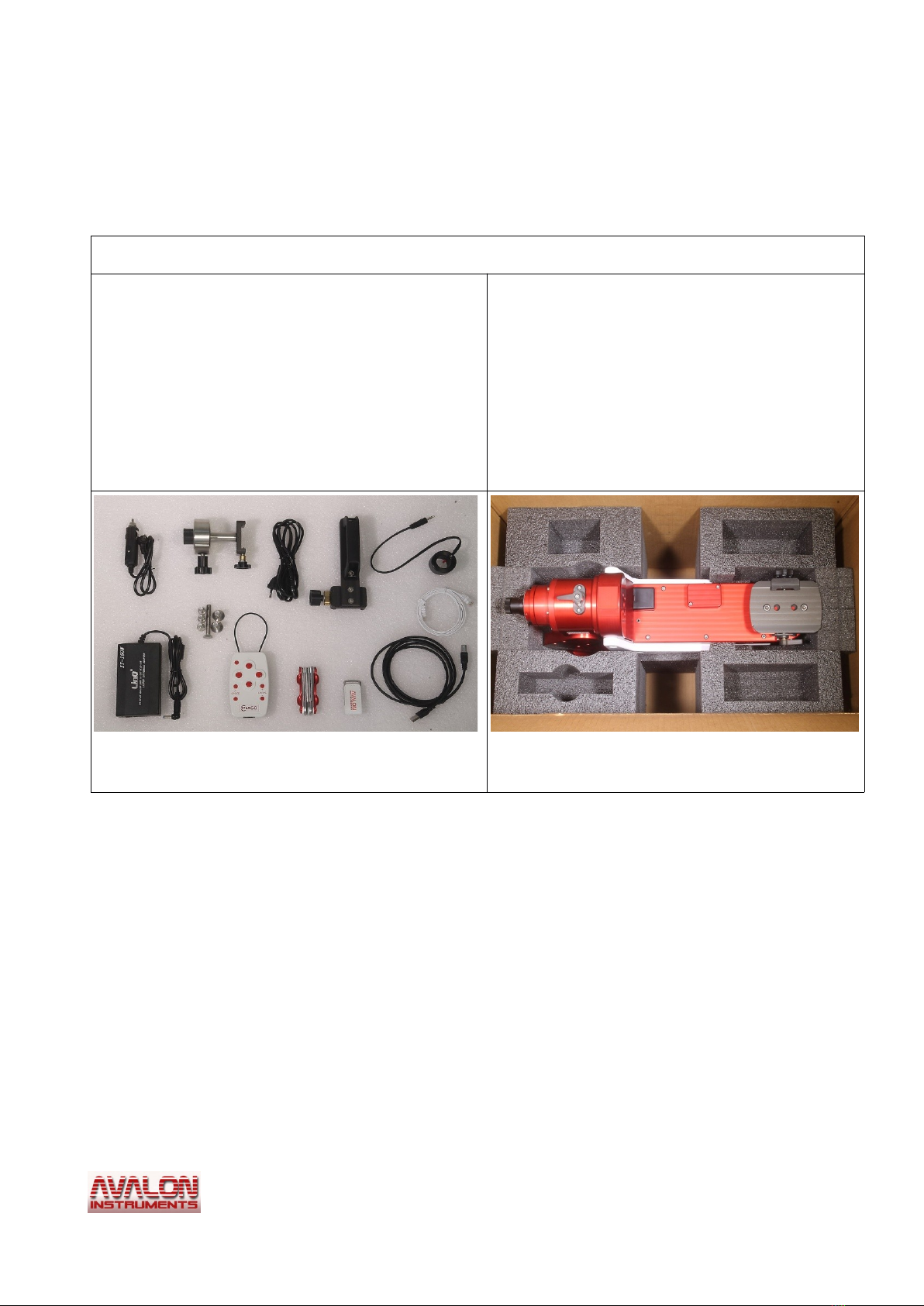
1. Pack ng Content
Open the box to take all the content out. Extract all the components from the small cardboard
box and from the mount bag side pocket putting them on a clean, flat surface.
Component L st
Car lighter power cable
Counterweight with support shaft
25/240 VAC / 2 VDC power supply with
related cable
StarGO control Keypad.
Keypad connection cable
Metric Hexagonal key set
Mount Transport Handle
Mount head with tripod plate and dovetail
platform, including the StarGO control
system
USB pen drive containing all needed
software and manuals
Polar finder and LED illuminator kit Mount
Transport case
Attachment screws
Documentation, warranty certificate
Contents of the upper part of the box Contents of the bottom part of the box
© All Rights reserved - 6

2 Mount Descr pt on
The M-uno Fast Reverse mount is a portable single arm fork mount devoted to deep-sky
imaging in the capacity range up to 20 kg (44 lb).
The following drawing show the M-Uno mount dimensional characteristics. Dimensions are in
mm.
The M-uno design was developed on the basis of the linear fast reverse, making use of the same
technical concepts:
•Fast Reverse technology
•Computer aided design (CAD)
•High quality manufacturing with digital control 5 axes CNC machines (CNC + CAM)
•Absolute quality materials: Anodized aluminium from milled mono-bloc, stainless steel
components and screws, brass components, techno-polymers
The M-Uno motion transmission technology is based on pulley-tooth belt without play, while its
peculiar geometry makes easy the imaging at the meridian crossing regardless the typical
problem affecting the classic German Equatorial Mounts, for both the risk of touching the tripod
and the need of waiting for the object cross the meridian.
© All Rights reserved - 7

Moreover, considering that at the meridian the sky is less subject to light pollution and to
atmospheric turbulence, the M-uno is the ideal tool to shoot deepsky objects in their best
conditions, close to the meridian, especially when the time is short and the sky is not so dark and
clear.
The M-uno is mainly designed for astroimaging with high focal length catadioptric tubes (such
as SC-Maksutov, RC, SC cameras, Cassegrain, DK, etc) up to 0″ aperture and 20 kg (44 lb)
weight, according to the tube length. It is possible to use the M-uno with Newton optics (for
example 8" f4) and even with short refractors (400-500 mm), with a piggyback or parallel
guidescope.
To allow the use of refractors with length exceeding approximately 500 mm, an optional
accessory has been realized allowing to distance the telescope from the mounting flange in order
to allow the passage over the RA axis. It is also available a special kit that, in addition to
distance the telescope from the mount, allows the housing of a small guide-scope obtaining also
a better telescope balancing. With this configuration it could be necessary to perform the
telescope inversion at the meridian passage in the case of the telescope striking the tripod.
However the larger overhang of the single arm system will allow a greater pointing angle
compared to the classic German Equatorial Mounts.
Another M-uno basic advantage is that it doesn't need neither counterweights, nor the bar. Its
declination axis can be quickly balanced like in an equatorial mount, while, for the RA axis, it is
possible to fix the arm on three possible positions and to make the fine balance using a very
small counterweight. The M-uno mount, as well as the LINEAR, is equipped with the super
tested, simple to use and inexpensive Synscan control system. The M-uno total weight is only
4.9 kg ( lb) and it is provided of a confortable handle for easy transportation. With these
features, in terms of lightness and transportability, the M-uno ranks at the top of the mounts with
capacity up to 20 kg (44 lb).
The use of pulleys and toothed belts has allowed to obtain several advantages: a really steady
motion without play (no backlash) and sudden peaks, factors of paramount relevance for long
guided exposures and during high magnification visual observations. These features are of
particular relevance especially for the declination axis motor that can now quickly reverse the
motion without breaks to recover the plays: from here the mount name FAST REVERSE. The
toothed belts used in the M-uno have the structure made of special material with steel strands to
avoid any deformation, elongation and stress, much better than those used in the automotive
engine distribution system (which are generally made of rubber with nylon strands).
Considering that the service time for the automotive toothed belts is around 00.000 km (60.000
miles), assuming a medium regime of 2.000 rpm and thermal stress from 0 to 90°C (30 to 95 F)
in a few minutes, we can think that the life cycle of the M-uno toothed belts will be extremely
long ! It is important to underline that in the gear-worm systems the motion transmission has
only one tangent point of contact, any errors on each of the two components will, sooner or
later, result into a tracking errors. On the contrary, in the pulley-toothed belt system, no direct
contact occurs between the pulley and the motion is transmitted by the belt engaging from 50%
© All Rights reserved - 8

to 90% of the girth surface. Consequently any error, eventually present, is averaged among the
cogs, moreover soft, greatly reducing the tracking error.
No wearing effects since no relevant frictions occur. In fact, all the pulleys and the axes rotate
on roller bearings, 3 for the RA axis and 3 for the DEC axis that allow to reduce the total
friction almost to zero.
Another significant advantage of very low frictions is that the risks of motor slipping during
GOTO operation is virtually null. On the contrary, it is well known the difficulty to regulate the
coupling between gear and worm in the conventional mounts. If the coupling is tight the motors
can stuck with consequent loss of the position, if the coupling is too loose the plays increase. On
the other hands, the absence of significant play in the M-uno makes the initial calibration of
guiding CCD quick and easy.
Since there are no gears, there is no need of periodical lubrication of the internal components
and therefore the maintenance is extremely reduced and limited to the external cleaning.
© All Rights reserved - 9

3. M-Uno In t al Setup
The M.Uno can work at latitudes range from about 5° to about 70°. For compactness purposes,
the supplied is mount preset at about 40° and therefore the first operation to perform is the
regulation of the latitude to the value related to the site in which the mount will be used. The
same operations will be carried out in the case the mount is transferred in a site with a different
value of latitude. This operation will be described in the section 3. below.
It is strongly recommended that the M-uno mount is used with the Avalon Instruments T-pod
tripod which has been designed to guarantee maximum performance. If a different kind of
tripod is used, it must have dimensions and characteristics compatible with the mount weight
and with the astronomical load to be installed. Section 3.2 describes the mount installation on T-
Pod tripod.
The installation of suitable optical tube will be described in section 3.3.
3.1 Lat tude Range Sett ng
This section describes in detail the procedures to set the correct range of latitudes of the site
where the mount will be used. The latitude range setting must be performed before installing the
mount on the tripod.
As said, the M-uno can be used in a wide range of latitudes from about 5° to 70°. This range is
divided into three different ranges of latitude.
•Position between 5° and 40°,
•Position 2 between 32° and 55°
•Position 3 between 45° and 70°.
These values correspond to the three latitude setting holes on the underside of the mount.
Observe that the values of the three latitude ranges partially overlap. The choice of latitude
setting should be made considering the greatest numerical distance between the latitude of the
observation site and the closest range choice. For example, if the site latitude is 53°, it would be
best to choose the third range. This is because there is an angular distance of 8° between latitude
53 and the third range value of 45°. Using second range setting would be less desirable because
there are only 2° between the site latitude of 53° and the largest value of the second range of
55°.
The steps needed for establishing the correct latitude operating range are as follows:
© All Rights reserved - 0
Table des matières
Autres manuels Avalon Instruments Accessoires


