
Andrew James Power Juicer Manuel utilisateur
1
Please read the manual fully before using the appliance and keep the
manual safe for future reference.
Power Juicer

2
Contents page
Safety guide Page 3
Appliance specic safety instrucons Page 4
Posioning the appliance Page 4
Appliance components Page 5
Preparing the fruit and vegetables for
juicing
Page 6
Assembly Page 7
Using the appliance Page 9
Tips Page 10
Recipes Page 11-12
Disassembling the appliance Page 13
Storing and cleaning Page 14
Disposal of the appliance Page 14
UK & EU Guarantee Page 15
Electrical informaon Page 16
Contact details Page 17

3
Safety guide
When using any electrical appliance, basic safety precauons should always be
followed, including:
This appliance can be used by children aged from 8 years and above and
persons with reduced physical, sensory or mental capabilies or lack of
experience and knowledge if they have been given supervision or instrucon
concerning use of the appliance in a safe way and understand the hazards
involved. Children shall not play with the appliance. Cleaning and user
maintenance shall not be made by children unless they are older than 8 and
supervised. Keep the appliance and its cord out of reach of children less than
8 years old.
Always ensure the voltage on the rang label corresponds to the voltage in
your home.
Check the power cord and plug regularly for any damage. If the cord or the
plug is damaged, it must be replaced by a qualied electrician or a service
repair centre. If in doubt please contact our customer service team.
The appliance is intended for domesc use only. Industrial or commercial
use will void the warranty. The supplier cannot be held responsible for injury
or damage if the appliance has been used for anything other than its
intended use.
Incorrect operaon and use can damage the appliance and cause injury to
the user.
Do not use the appliance if it has been dropped or damaged in any way. If
the unit has been damaged take the unit for examinaon and or repair by an
authorised service agent.
Do not immerse or expose the motor assembly, plug or the power cord in
water or any other liquid for any reason.
If the supply cord is damaged, it must be replaced by the manufacturer or by
someone who is suitably qualied to avoid a potenal hazard.
Do not let the cord hang over the edge of a table or counter. Ensure that the
cord is not in a posion where it can be pulled or tripped over accidentally.
Do not allow the cord to touch hot surfaces and do not place the cord near
hot gas, electric burners or in a heated oven.
Use of an extension cord with this appliance is not recommended. However
if it is necessary to use an extension cord, ensure that the extension cord is
equal to or greater than the power consumpon of the appliance to avoid
overheang of the appliance and extension cord. Do not use any other
appliance on the extension cord. Do not place the extension cord in a
posion where it can be pulled on by children or animals or be tripped over.
Always operate the appliance on a smooth, even and stable surface. Do not

4
Posioning the appliance
Always place the appliance at the back of the kitchen counter.
Do not place the appliance next to hot areas, for example gas rings and
electric hotplates.
place the unit on a hot surface.
Always remove the plug of the appliance safely. Do not pull on the
appliances cord to remove the appliance plug from the electrical socket.
Never handle or operate the appliance with wet hands.
Appliance specic safety instrucons
The appliance is only to be connected to 220-240V, 50Hz only. Max locked
power: 850W
The motor secon and the cord of the appliance must not be submerged in
water or any other liquid for any reason.
Never use your ngers, kitchen utensils or similar objects to push ingredients
down the feed tube. Use the accompanying tamper.
Never sck your ngers or other objects in the funnel or spout of the
appliance.
Never touch the moving parts of the appliance unl it has come to a
complete stop.
The centrifuge bowl must be handled with care as it contains extremely
sharp parts.
Do not leave the appliance running non-stop for more than 1 minute at a
me. If the appliance has been running connuously for 1 minute allow it
to cool down for 5 minutes before using it again.
5
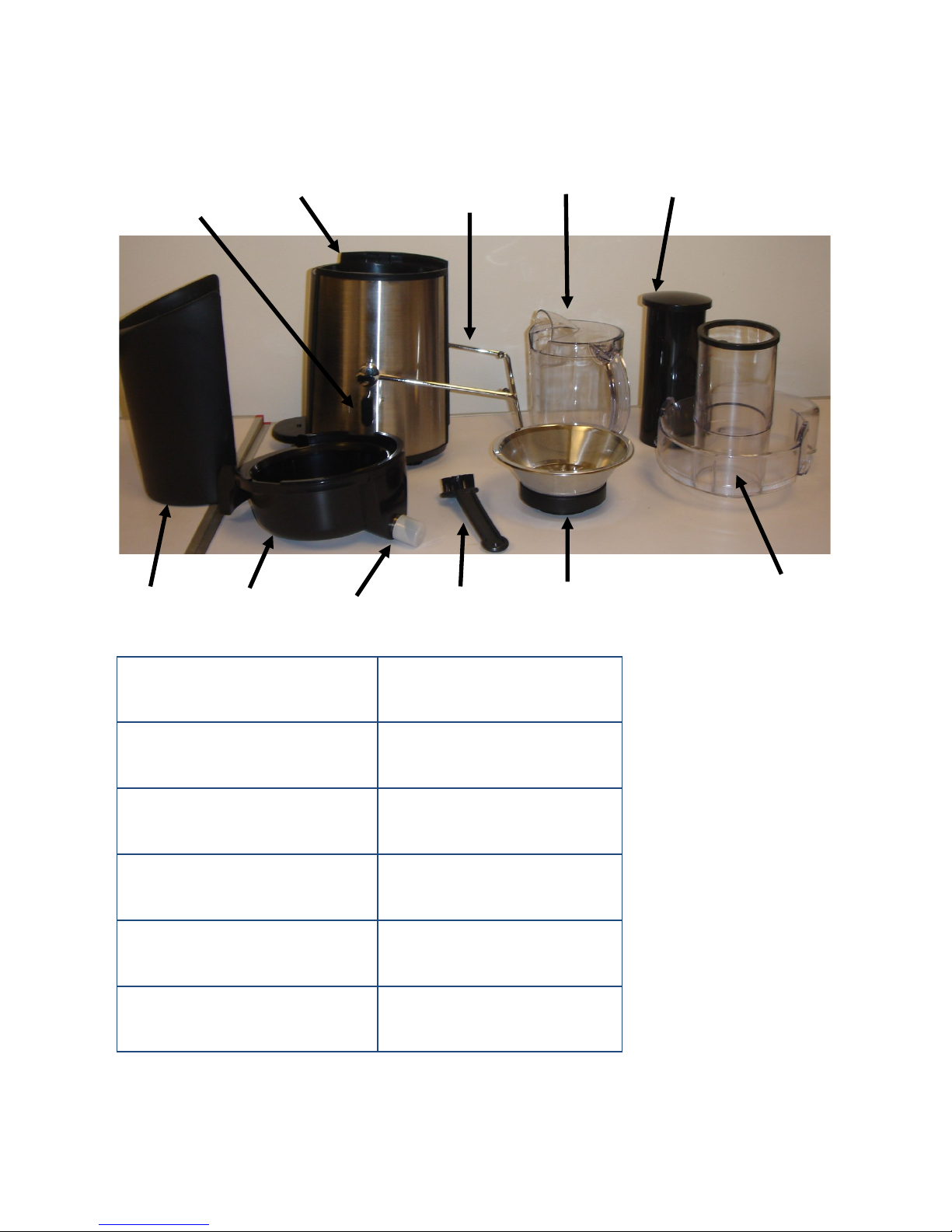
Appliance components
1. Plunger 7. Spout support
2. Funnel 8. Fruit pulp holder
3. Jug 9. Spout
4. Centrifugal bowl 10. Locking mechanism
5. Brush 11. Speed seng
6. Motor secon
1.
2.
4.
3.
5.
9.
7.
8.
11.
6. 10.

6
Preparing the fruit and vegetables for juicing
Always wash your fruit and vegetables thoroughly before juicing.
It is necessary to remove large seeds, pips or peels before using the
appliance.
Fruits with thick peels such as oranges and lemons must be peeled before
juicing, as even small amounts of peel can aect the taste of the juice.
It is also necessary to remove large pits (such as plums and apricot pits) to
avoid damaging the appliance.
Large fruits and vegetables should be cut into pieces so that they can t into
the funnel (2).
Note: Before using the appliance for the rst me or aer prolonged storage
without use, wash any parts that come into contact with food.

7
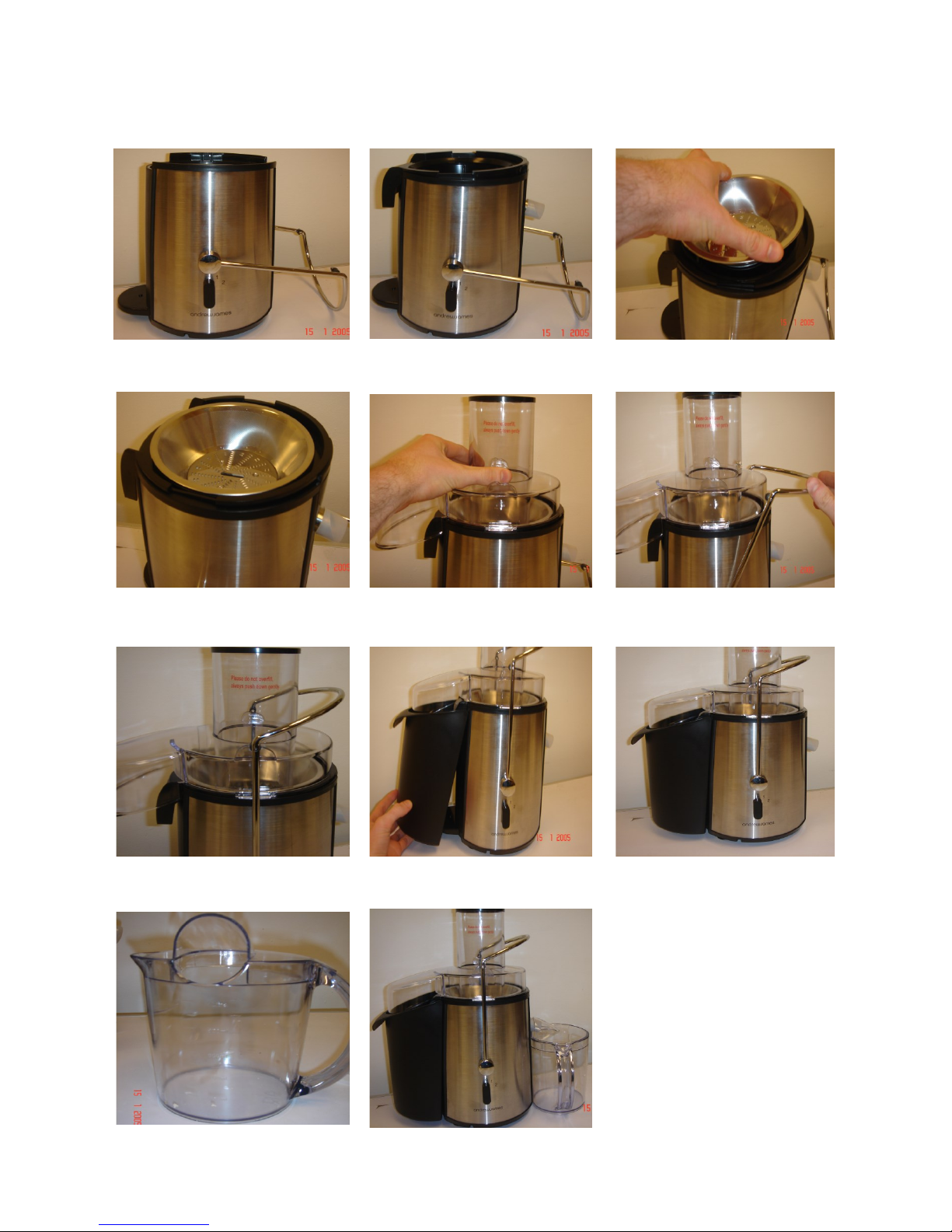
Assembly
1. Place the motor secon (6) onto a at stable surface. Make sure the speed
dial (11) is facing towards you.
2. Fit the spout support (7) into the motor secon (6).
3. Clip the centrifugal bowl (4) into the spout support (7). A click sound will
signal it has been correctly assembled.
4. Carefully place the funnel (2) onto the top of the spout support (7). Ensure
that the clips of the funnel (2) t into the spout support (7) slots.
5. Raise the locking mechanism (10) and rmly lock it into place on the funnel
(9).
Please note: As a safety feature, the juicer will not switch on unless the lid
is rmly locked into place. Please ensure the two black plasc stoppers on
the locking bar mechanism are pushed as far in towards the centre of the
machine as possible to ensure enough pressure is placed on the lid to allow
the internal sensors to engage.’
6. Aach the fruit pulp holder (8) under the lip of the funnel (2). Raise it at an
angle then slide the boom in place.
7. Place the jugs lid on top of the jug (3) and place it underneath the spout.
8. Plug the appliance power cord into the electrical socket.
9. Turn the appliances speed dial (11) to 1.
10. Place the ingredients into the funnel (2) and press the ingredients down into
the centrifugal bowl using the plunger (1). Increase the speed to 2 if
necessary.
8
Assembly of the appliance

9
Using the appliance
Start the appliance by turning the on/o buon to posion 1 (low speed) or
2 (high speed).
The low speed seng is suitable for juicing so fruit and vegetables.
The high speed seng is suitable for juicing harder fruits and vegetables.
Feed the selected fruits/vegetables into the appliance through the funnel a
lile at a me, pushing them down using the tamper provided.
Make sure that you turn the tamper so that the groove in the plunger ts
into the funnel properly.
Long vegetables such as carrots should be fed into the funnels pointed end
rst.
Press the fruits/vegetables gently with the tamper, too much pressure can
reduce the amount of juice extracted and can damage the appliance.
Stop the appliance before removing the tamper to add more fruit/
vegetables in order to avoid any splashing.
Always keep an eye on the fruit pulp holder and stop juicing before the
holder becomes too full.
Always turn the power o by pressing the on/o buon to the “0” posion
before taking o the lid.
Please note: The juicer is ed with a thermal cut o switch which is designed to
switch o the juicer if the motor becomes over-heated. If the juicer suddenly stops
working, allow it too cool down for 5 minutes and try the juicer again.

10
Tips
If you line the fruit pulp holder with a plasc bag before using the appliance,
it will be easier to clean the appliance aer use.
Try and use fresh fruit/vegetables as they contain the most juice.
Here are some ideal ingredients to juice: pineapple, apples, cucumbers,
celery, carrots, spinach, melons, tomatoes and other variees of citrus fruit.
Dierent variees of apples produce dierent tastes and avours when
juicing them. Experiment with dierent combinaons to nd your favourite
juice.
Leafy green vegetables such as cabbage and spinach can be juiced. Simply
roll the leaves into cylinders of an appropriate size before feeding them into
the funnel.
Harder more brous fruit such as bananas, mangoes, papayas and avocados
are not well-suited to juicing as the result is oen of a puree-like consistency
rather than juice.
All types of juice should be consumed right aer juicing, as fresh juice quickly
loses important nutrients when exposed to the air. The taste can also be
aected.
Pure apple juice turns brown quickly when exposed to the air, to prevent
discolouring serve the apple juice immediately aer juicing or add a lile
lemon juice.
Remember that fruit pulp can be used alternavely in cakes, vegetable
lasagne, muns etc.
Run the pulp through the power juicer to ensure that all the liquid has been
extracted from the fruit and vegetables.
Table des matières
Autres manuels Andrew James presse-agrumes


