alzaTools AT-COS20V Manuel utilisateur

Cordless Orbital Sander
AT-COS20V
User Manual


ENGLISH 4
DEUTSCH 14
ČESKY 24
SLOVENSKY 34
MAGYAR 44

4ENGLISH
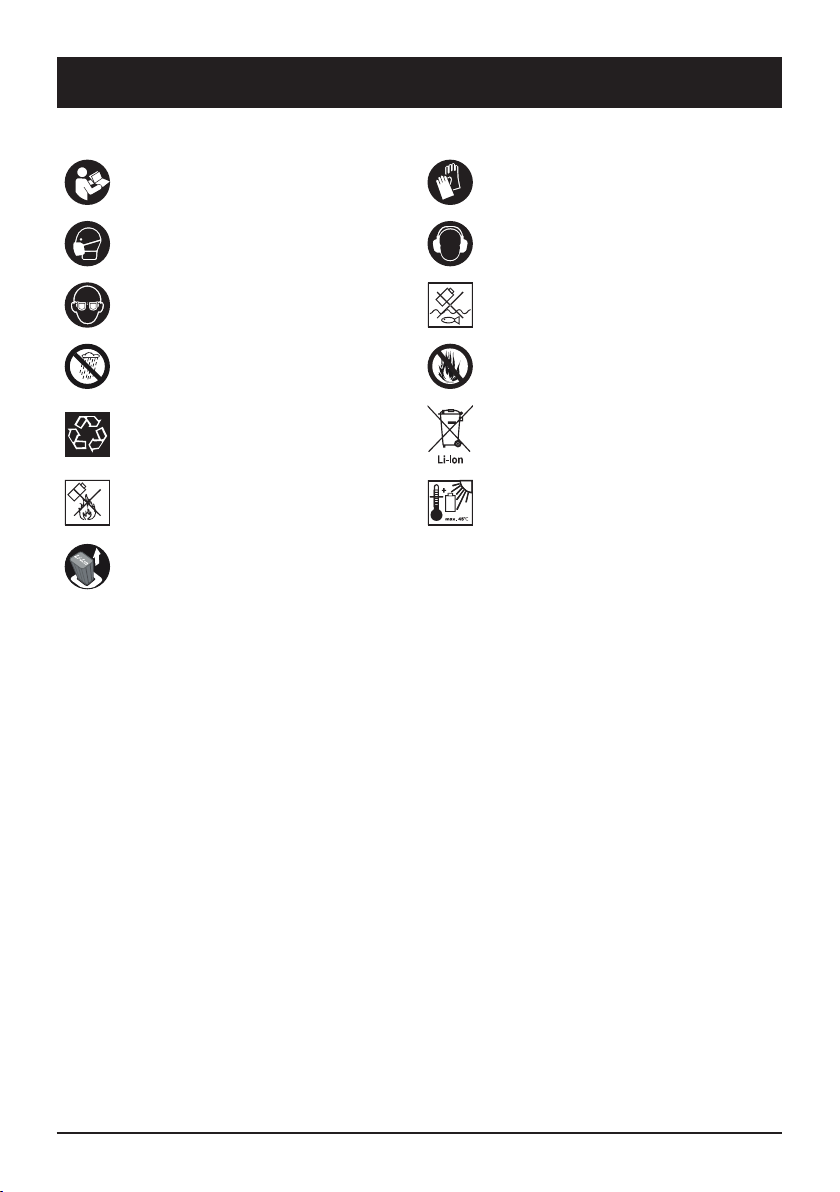
EXPLANATION OF SYMBOLS ON THE PRODUCT PACKAGING/TYPE LABEL
Read the operating instructions careful-
ly before use! Wear protective gloves
Wear mouth and nose protection. Wear noise protection.
Wear protective glasses Do not throw batteries into water!
Protect from rain and moisture. Protect from heat and fire.
Ensure proper recycling of the product
at the end of its service life and all pack-
aging materials.
Do not dispose of batteries with normal
household waste.
Do not throw batteries into a fire! Do not expose batteries to excessive
temperatures above 50 °C.
Always remove the battery during
work, transport, storage, maintenance
or repair.
GENERAL SAFETY INSTRUCTIONS FOR POW-
ER TOOLS
WARNING! All safety instructions, user man-
uals, images and regulations supplied with
these tools must be read. Failure to follow all
of the following instructions may result in elec-
tric shock, fire, and/or serious personal injury.
All instructions and the user manual must be
kept for future reference.
Safety of working environment
1. The workplace must be kept clean and well lit.
Untidy and dark spaces are often the cause of
accidents.
2. Power tools must not be used in potentially ex-
plosive atmospheres, such as in the presence
of flammable liquids, gases or dust. Power tools
create sparks that can ignite dust or fumes.
3. Children and other persons must be kept away
when using power tools. If the operator is dis-
turbed, he/she may lose control of the opera-
tion.
Electrical safety
1. The plug on the power tool's flexible lead must
match the power outlet. The plug must never
be modified in any way. No socket adapters
may be used with tools that have a protective
earth connection. Plugs and respective sockets
that are rendered unusable will reduce the risk
of electric shock.
2. The operator must not touch grounded ob-
jects, such as pipes, central heating units,
cookers and refrigerators. The risk of electric
shock is greater if your body is connected to
the ground.
3. Power tools must not be exposed to rain, mois-
ture or wetness. If water enters the power tool,
the risk of electric shock increases.
4. The flexible supply must not be used for oth-
er purposes. The power tool must not be car-
ried or pulled by the cord, nor must the plug
be unplugged from the socket. The inlet must
be protected from heat, grease, sharp edges
or moving parts. Damaged or tangled leads
increase the risk of electric shock.
5. If the power tool is used outdoors, an extension
cord suitable for outdoor use must be used. Us-
ing an extension cord for outdoor use reduces
the risk of electric shock.
6. If the power tool is used in a humid environ-
SAFETY INSTRUCTIONS

5ENGLISH
ment, a residual current device (RCD) must be
used. Using an RCD reduces the risk of electric
shock.
Safety of persons
1. When using a power tool, the operator must be
careful, pay attention to what he/she is doing,
and concentrate and think clearly. Power tools
must not be used if the operator is tired or un-
der the influence of drugs, alcohol or medica-
tion. Momentary inattention while using a pow-
er tool can result in serious personal injury.
2. Use personal protective equipment. Always
use eye protection. Protective equipment such
as a respirator, non-slip safety shoes, hard hat
and hearing protection, used in accordance
with the working conditions, reduces the risk of
personal injury.
3. Unintentional starting of the machine must be
avoided. Make sure that the switch is in the off
position before plugging in and/or connecting
the battery pack, lifting or carrying the tool.
Carrying a tool with your finger on the switch
or plugging in a tool fork with the switch on can
cause injury.
4. All adjusting tools or wrenches must be re-
moved before turning on the tool. An adjusting
tool or wrench that remains attached to the ro-
tating part of the power tool may result in per-
sonal injury.
5. The operator must only work where he/she can
safely reach. The operator must always main-
tain a stable posture and balance. This will al-
low better control of the power tool in unfore-
seen situations.
6. Dress appropriately. Do not wear loose cloth-
ing or jewellery. The operator must make sure
that his/her hair and clothing are a sufficient
distance away from moving parts. Loose cloth-
ing, jewellery and long hair can be caught in
moving parts.
7. Where equipment is provided for connecting
dust extraction and collection facilities, care
must be taken to ensure that it is connected
and used correctly. The use of such equipment
can reduce hazards caused by dust.
8. The operator must not allow the routine that
results from the frequent use of the tools, to
cause them to become complacent and ignore
the principles of tool safety. Careless activity
can cause serious injuries in a split second.
Use and the maintenance of power tools
1. Power tools must not be overloaded. It is es-
sential to use the correct power tool for the
work being carried out. The correct power tool
will do the work it was designed to do better
and safer.
2. Power tools that cannot be turned on and off
with the switch must not be used. Any power
tool that cannot be operated with the switch is
dangerous and must be repaired.
3. Before making any adjustments, changing ac-
cessories, or storing power tools, unplug the
power tool and/or remove the battery pack
from the power tool if it is removable. These
precautions reduce the risk of accidentally
starting the power tool.
4. Unused power tools must be stored out of
the reach of children. Persons unfamiliar with
the power tool or these instructions must not
be allowed to use the power tool. Power tools
are dangerous in the hands of inexperienced
users.
5. Power tools and accessories must be main-
tained. The adjustment of moving parts and
their mobility must be checked and attention
focused on cracks, broken parts and any other
circumstances that may jeopardize the func-
tion of the power tool. If the tool is damaged,
it must be repaired before use. Many accidents
are caused by poorly maintained power tools.
6. Cutting tools must be kept sharp and clean.
Properly maintained and sharpened cutting
tools are less likely to catch on material or jam
and are easier to control.
7. Power tools, accessories and tool bits etc. must
be used in accordance with these instructions
and in the manner intended for the particular
power tool, taking into account the working
conditions and the work to be carried out. Us-
ing power tools for activities other than those
for which they are designed can lead to dan-
gerous situations.
8. Handles and grip surfaces must be kept dry,
clean and free of grease. Slippery handles and
gripping surfaces mean the tool cannot be
held and controlled in unexpected situations.
Service
1. Power tool repairs must be carried out by qual-
ified personnel using identical spare parts. This
will ensure the same level of safety of the pow-
SAFETY INSTRUCTIONS

6ENGLISH
er tool as before the repair.
USE AND MAINTENANCE OF CORDLESS
TOOLS
1. The tool must only be charged with the charger
specified by the manufacturer. A charger that
may be suitable for one type of battery pack
may present a fire hazard when used with an-
other battery pack.
2. The tool must only be used with a battery pack
that is specifically designed for the tool. The
use of any other battery pack may present a risk
of injury or fire.
3. When the battery set is not used, the battery
pack must be protected from contact with oth-
er metal objects, such as paper clips, coins,
keys, nails, screws or other small metal objects
that can cause one battery contact to come into
contact with another. Short-circuiting the bat-
tery terminals may cause burns or fire.
SAFETY INSTRUCTIONS FOR BELT AND SATIN
GRINDERS
Electromechanical tools must be held by insulat-
ed gripping surfaces, as the grinding surface may
touch its own power supply. Cutting a "live" wire
can cause uninsulated metal parts of the power
tool to become "live" and result in an electric
shock to the user.
SAFETY INSTRUCTIONS

7ENGLISH
TECHNICAL DATA
Speed in revolutions per minute (no load)
Speed 1 2000/min
Speed 2 3500/min
Speed 3 5000/min
Speed 4 6500/min
Speed 5 8000/min
Speed 6 10,000/min
Plate size 125 mm
Circulation diameter 2.7 mm
Sound pressure level * 80.2 dB(A), K=3 dB(A)
Sound power level ** 91.2 dB(A), K=3 dB(A)
Level of vibrations 7.5 m/s2, K=1.5 m/s2
Weight (only machine) 1.15 kg
* Continuous sound pressure level with filter A for hand tools measured according to prEN ISO
15744: 1999 and stated according to EN ISO 4871.
** Sound power level with filter A for hand tools measured according to prEN ISO 15744: 1999 and
stated according to EN ISO 4871.

8ENGLISH
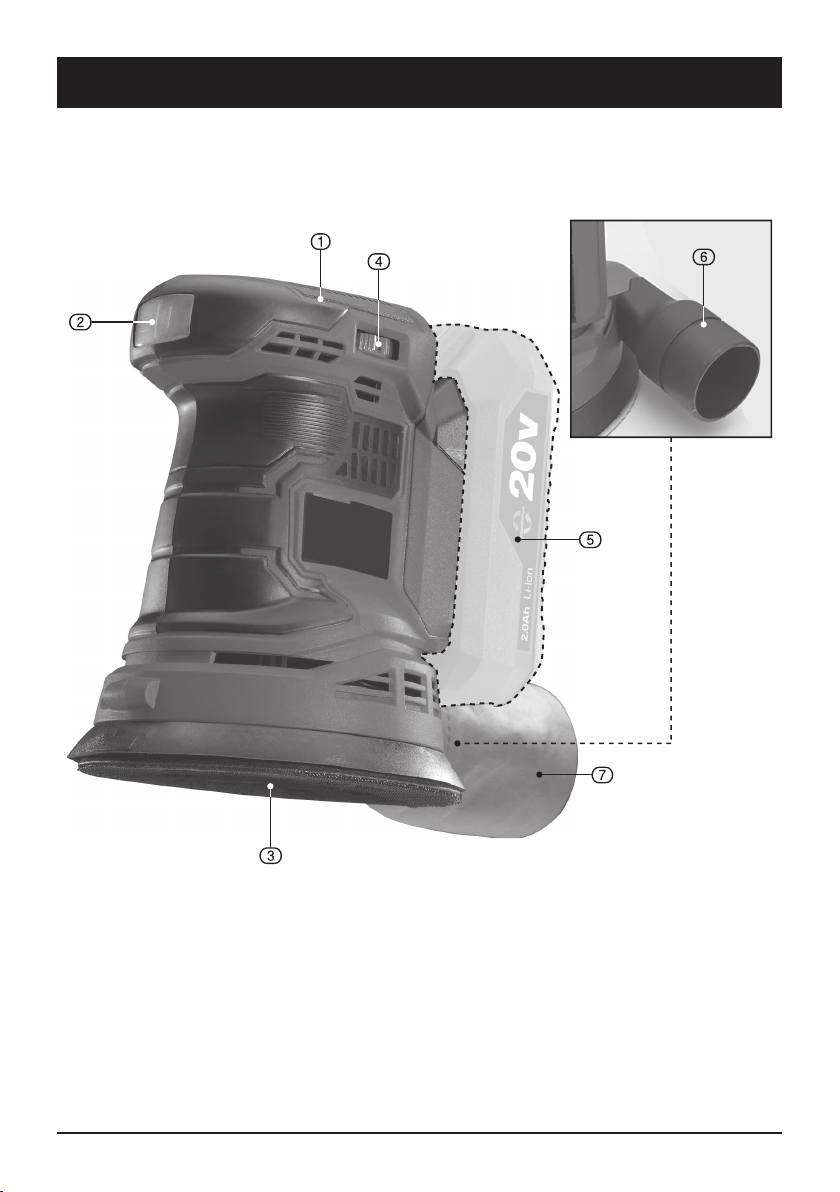
DESCRIPTION
1 Handle
2 Power button
3 Sanding board
4 Circulation speed regulator
5 Rechargeable battery Li-ion 20 V/2.0 Ah (sold separately)
6 Dust extraction output
7 Dust bag

9ENGLISH
DESCRIPTION
The machine is only designed for sanding wood and similar materials. The product is designed for
domestic use. Other uses are outside the warranty conditions.
UNPACKING
Carefully unpack the product, remove the packaging material and check the condition for any dam-
age during transport. Disassemble the contents of the package and check the completeness of the
accessories according to the next paragraph. If anything is missing, contact your dealer and do not
use the product.
Keep the packaging material for at least the warranty period, it must be used in the case of shipment.
Warning!
• Packaging material can be dangerous to children. Keep it out of the reach of children.
• Follow applicable local recycling regulations when disposing of the packaging.
PACKAGE CONTENTS
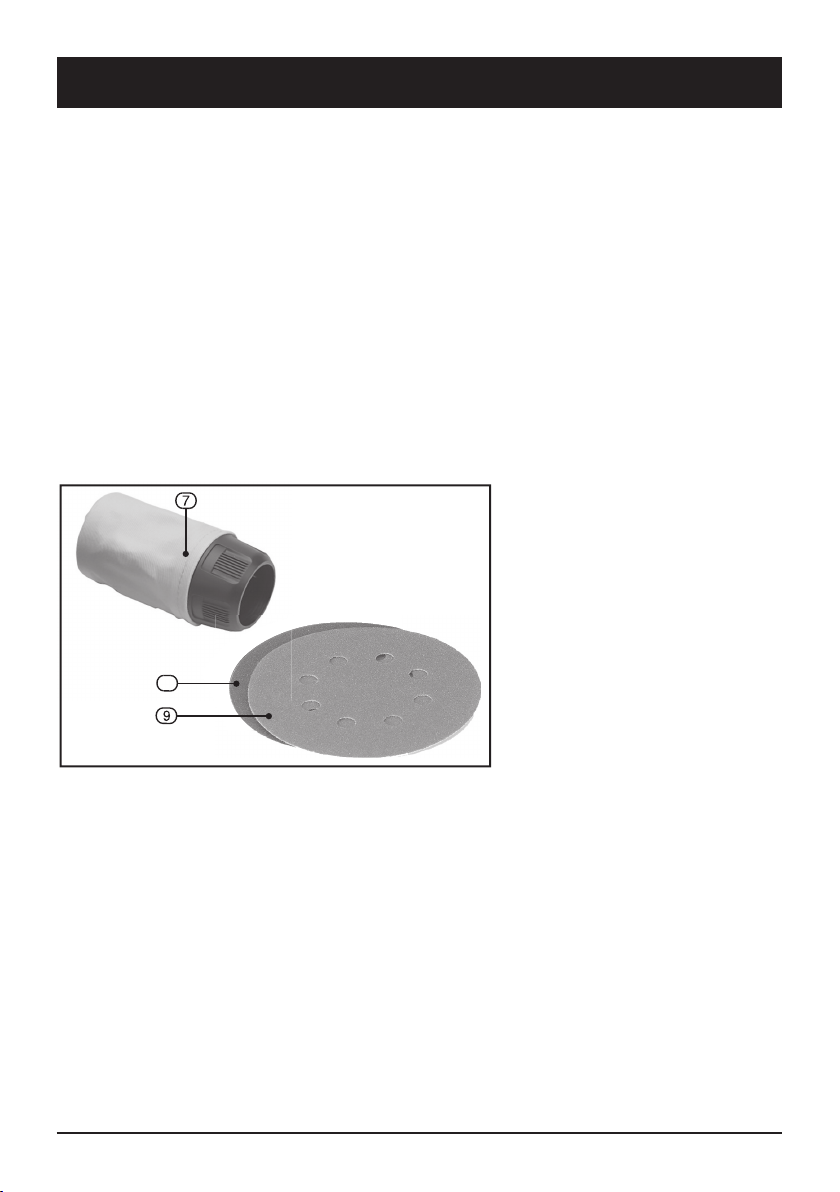
In addition to the product, the package also contains three accessories:
7
8
Dust bag
Sandpaper 120 ×1
9Sandpaper 400 ×1
UNPACKING AND INSPECTION
8

10 ENGLISH
GRINDING PREPARATION
GRINDING DISC INSTALLATION/REPLACEMENT
Both the sanding disc and the sanding plate are consumables.
•Simply press the grinding disc (9), (10) or (11) onto the grinding plate (3), where it is held in place
by Velcro.
•To ensure dust extraction, make sure that the holes in the sanding paper match the holes in the
sanding plate.
• To remove a used disc, tear it off by the edge. Keep the grinding plate clean.
DUST EXTRACTION
Dust bag
Attaching the bag (7)
• Place the dust bag with the flange on the dust extraction outlet (6).
• When inserting the flange, turn the bag so that it holds well.
To remove the bag from the machine, turn and pull the flange out of the suction outlet pipe. Then
empty the bag.
Dust extraction connection
The manufacturer recommends the use of a certified "class M" vacuum cleaner, which ensures suffi-
cient suction power and extraction parameters.
Note: A pipe reducer (not included) may be required to connect the extractor.
• With the dust bag removed, connect the suction line to the suction outlet (6) on the grinder.
All wood dust (including laminate dust, plastics dust, etc.) poses a health risk to the respiratory system,
eyesight and skin. For example, MDF boards contain formaldehyde, which is a proven carcinogen. In
addition to these measures, an appropriate face mask must be worn according to the scope of work.
A respirator of at least FFP2 is required against fine wood dust.
Table des matières
Langues :