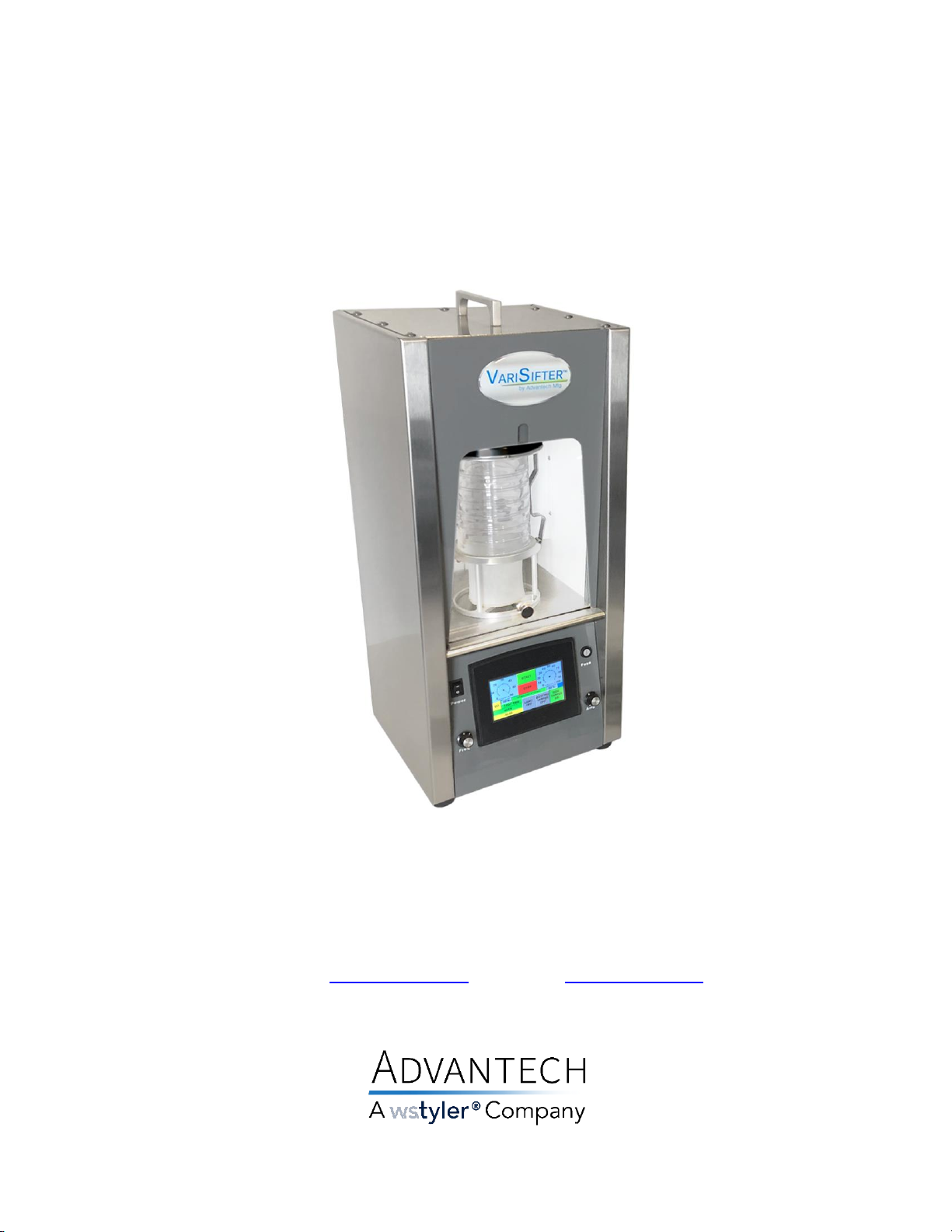
the test chamber. To avoid possible stack upset, unclamp the arms
immediately upon removal from the machine.
Disassembling the Stack Assembly
While steadying the stack with one hand, spread the column locking
arms with the other hand by sliding a thumb and forefinger into the
openings between the lowest sieve and the column locking. The
spring-loaded column lock will release. It can then be carefully
removed and access gained to the rest of the stack components.
Selecting the Sieves for Analysis
Select the sieves required for analysis. The height of the testing stack
used within the VariSifter™is a fixed height.
U.S. Standard Sieve Series –5/8” overall height
A maximum of six U.S. standard series sieves (sieve sizes #3.5
through #635) may be used at one time. Any combination of sieves,
accessories, or spacers making up the standard stack height of six
standard sieve units may be used.
Precision Electroformed Sieve Series –1-1/4” overall height
A maximum of three precision electroformed sieves may be used at
one time. Any combination of sieves, accessories, or spacers making
up the standard stack height equivalent to three precision
electroformed sieves may be used. When performing separations
30µm or finer, use only one precision sieve at a time.
Preparation for the Analysis
To prepare for the analysis of a sample for the first time, it will be
necessary to perform a few simple tasks:
Gather the Ancillary Equipment Needed:
Weighing device (balance or scale with resolution in grams
suitable for your application; generally, 0.1g or 1.01g are
sufficient) 100g capacity is suitable.
Small, natural hair brush for brushing fine particles from the
standard sieves wire cloth or precision mesh frames. (NOTE:
Brush sieves from the underside ONLY! Never force material
through a sieve opening. Never brush precision mesh.)
Means of recording and calculating tare weights, sample
weights, percentages, etc.
Note: In addition, prior to performing the first test, all sieve,
standard spacers, and the top cone should be washed according
to the care section that follows. This step will reduce the
chance of sample contamination from any residues left over
from the manufacturing process.